


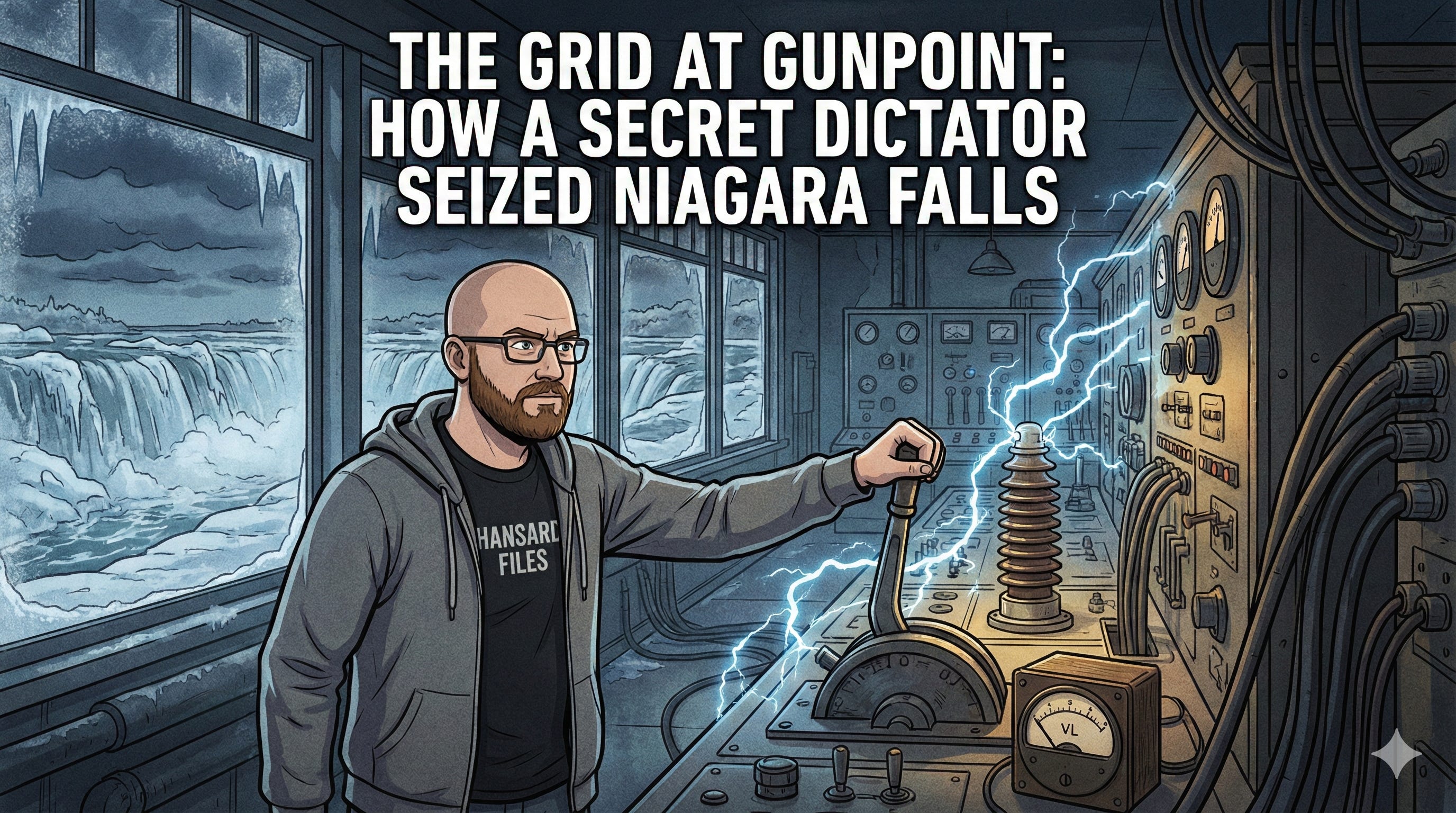
On January 12, 1918, the men inside the generator room of the Ontario Power Company heard a sound that shouldn’t exist. Deep inside the penstocks—the massive tubes funneling the Niagara River into the turbines—there was a grinding crash.
It wasn’t just ice. The report, filed in the dry, terrifying language of government bureaucracy, noted the cause simply: “Rocks smashing gates.”
Outside, the winter of 1917 had frozen the world solid. The Niagara River, usually a relentless conveyer belt of “white coal,” had turned into a slushy, choking mess of ice blocks. Inside the Canadian Niagara Power Company, the situation was catastrophic. Their plant, rated for 100,000 horsepower, was being beaten to death by the river. As the ice clogged the intakes and rocks battered the machinery, the output plummeted. Down to 50,000. Then 25,000. Finally, it bottomed out at a terrifying 5,500 kilowatts—barely 5% of its capacity.
Across the province of Ontario, the grid began to die. In Fergus, the local chopping mill was ordered to cease operations during the day, allowed to run only between 10:00 PM and 7:00 AM. In Kitchener, streetlights were dimmed by 10%, casting the snow-covered streets into gloom. In New Toronto, the load was slashed by 20,000 horsepower, leaving factories silent.
But this wasn’t just a weather event. It was a man-made disaster, engineered by lawyers years before the ice arrived. While Canadian munitions plants stood idle for lack of power, tens of thousands of horsepower were flowing smoothly, legally, and untouchably across the river to the United States.
This is the story of the “Power Controller”—a position created out of desperation—and the secret war Sir Henry Drayton waged to seize the energy of the Falls.
The Paper Blockade
To understand the crisis, you have to look at the contracts. By 1917, the Canadian side of Niagara Falls was dominated by three giants: the Ontario Power Company (recently acquired by the public Hydro-Electric Power Commission), the Canadian Niagara Power Company, and the Electrical Development Company.
These weren’t just power stations; they were export machines. Years prior, they had signed “firm contracts” to sell massive amounts of power to American distributors. The Ontario Power Company was legally bound to deliver 60,000 horsepower to the Niagara, Lockport & Ontario Power Company until the year 1950. The Canadian Niagara Power Company was effectively a branch plant of a New York corporation, funneling its output to its American parent.
When the Great War turned into a war of industrial attrition, these contracts became a death pact. The report commissioned by the Privy Council exposed the absurdity: The British Forgings plant in Toronto—vital for the Imperial Munitions Board—was suffering “grave load dislocations.” Every time the voltage dropped, the production of steel for the Admiralty stopped.
Yet, because of the contracts, Sir Henry Drayton found that Canadian electrons were lighting up “luxury” advertising signs in Buffalo while the British Empire ran out of shells. The Americans had built a massive infrastructure—rights of way, switching stations, and towers from Lockport to Syracuse—reliant on this Canadian power. They had contracts with their own customers, and they weren’t about to let Canada turn off the tap.
The Dictator of the Grid
On November 6, 1917, the Canadian government stopped asking nicely. Invoking the War Measures Act, they passed Order-in-Council P.C. 3142. It appointed Sir Henry Drayton as the “Power Controller.”
The title granted him powers that would make a modern CEO weep. Drayton could “determine preferences and priorities,” commandeer plants, and dictate exactly who got electricity and who sat in the dark. Crucially, the Order included a legal shield: any company that broke a contract because of Drayton’s orders was “relieved from all liability for damages.” He effectively indemnified the power stations against their American lawsuits.
Drayton’s first move was to drag the private companies into line. The Toronto Power Company (operating the Electrical Development Company) was a particular thorn. They were sitting on a steam plant—a coal-fired backup generator—that they refused to run at full capacity because it was expensive. Drayton didn’t care about their margins. He ordered them to connect their generators in parallel with the rest of the grid, risking their machinery to stabilize the system.
When the Toronto Power Company protested that they couldn’t supply power to the city of London, Ontario, without cutting off their own customers, Drayton’s response was icy. The correspondence reveals a vicious corporate battle, with the company claiming “we have no power available” and Drayton’s engineers proving they did.
The Cyanamid Paradox
The climax of the crisis wasn’t a battle, but a deal. It involved the American Cyanamid Company, located on the Canadian side of the Falls. They were a massive energy vampire, sucking up power to make chemicals vital for explosives. The US War Department was desperate to keep this plant running.
Drayton saw an opening. Canada was rich in hydro but starving for coal. The US had plenty of coal but needed the Cyanamid output.
Drayton engineered a “circular paradox.” He forced the Toronto Power Company to fire up their expensive steam plant. To fuel it, he negotiated with the US Fuel Administration to guarantee shipments of American coal, exempting them from rationing. This coal was burned in Toronto to generate 13,500 horsepower of expensive electricity. This expensive power was fed into the grid, freeing up the cheap, clean Niagara hydro to flow to the American Cyanamid plant.
It was a logistical masterpiece: American coal was imported to Canada to create power for an American factory in Canada, so that the Canadian hydro it would have used could be diverted to British munitions plants.
The Cost of Victory
The report by Drayton, submitted in 1919, reads like a post-mortem of a near-death experience. The “ice troubles” of 1918 had nearly broken the war effort. At one point, the Hamilton Steel Company was short 1,500 horsepower needed for munitions. In Walkerville, street lighting was reduced to “intersections only.” In Brantford, the waterworks pumps were frantically switched to steam power as the grid flickered.
But the “Power Controller” had held the line. By seizing control of the private companies, indemnifying them against American lawsuits, and ruthlessly prioritizing war industries over municipal comfort, Drayton kept the forges running.
The legacy of those frozen months is written in the modern electrical grid. The crisis proved that electricity was not just a commodity like wheat or timber; it was a matter of national survival. The “firm contracts” of 1950 were never fully honored. The roar of the Niagara had been nationalized, not by ideology, but by the desperate reality of a world at war.
If you want to uncover more forgotten crises buried in government archives, subscribe to “Hansard Files.” We dig through the dust so you don’t have to.
Source Documents
Drayton, H. L. (1919). Report on Export of Electricity from Canada and Report of the Power Controller. Ottawa: J. de Labroquerie Taché.
"The report by Drayton, submitted in 1919, reads like a post-mortem of a near-death experience." What awesome recollections !
Chilling!
For anyone with ears, let them hear. For anyone with eyes, let them see.
THINK: 2026 Trade tensions...