


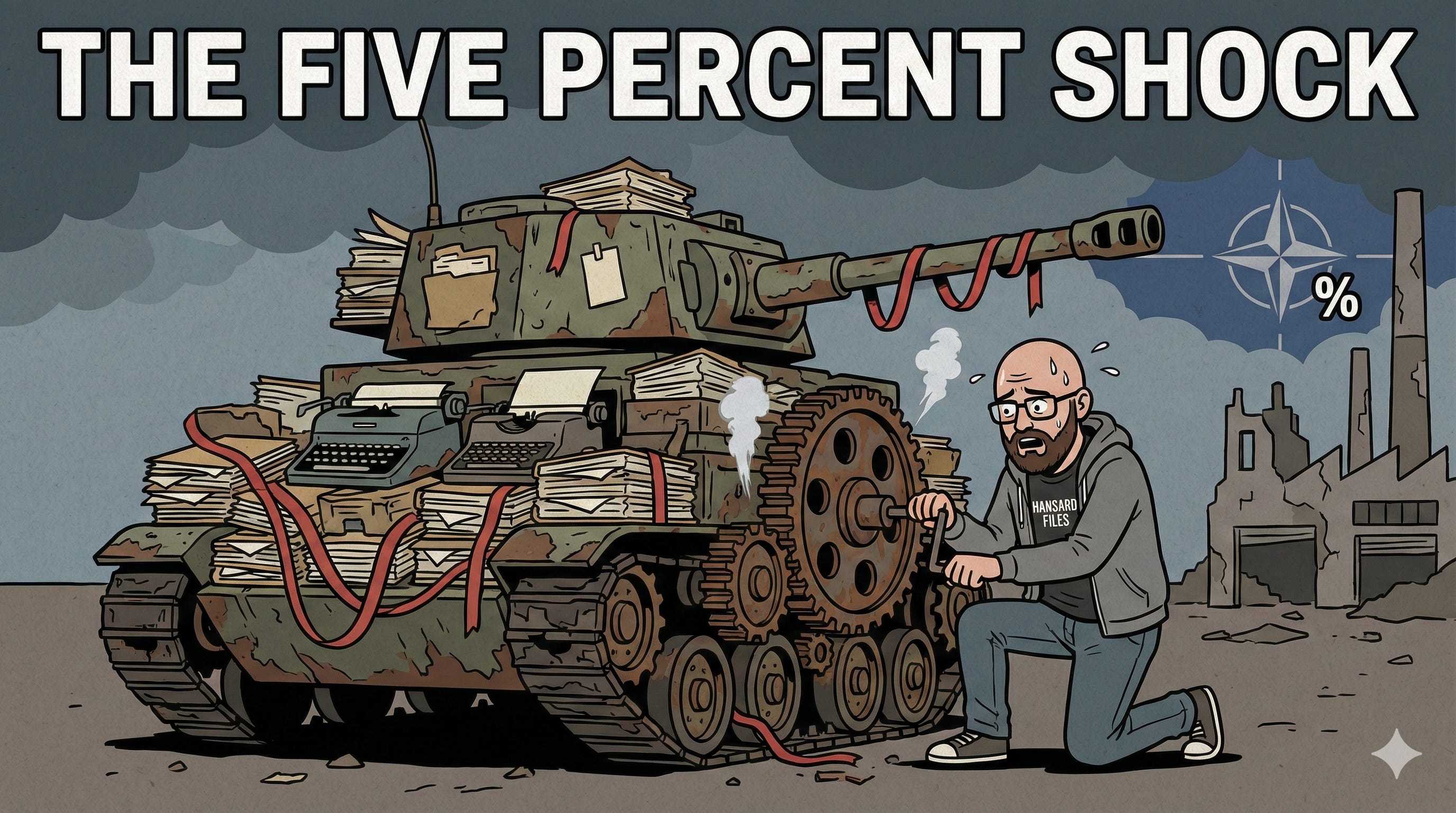
The silence in the halls of The Hague was not born of peace, but of sticker shock. It was June 2025, and the NATO summit—anticipated for months as a routine diplomatic gathering—had just upended the fiscal reality of the Western world. The United States, emboldened by a renewed administration under a second Trump presidency, laid a stark ultimatum on the table. The old target of spending 2% of GDP on defense was dead. The new price of admission to the Atlantic Alliance was 5% of GDP.
For Canada, a nation that had comfortably coasted on the “peace dividend” since the fall of the Berlin Wall, this was not just a policy shift; it was a mathematical catastrophe.
NATO burden-sharing had officially evolved from a bureaucratic metric into an existential threat. For Prime Minister Mark Carney, whose Liberal government had swept into power just two months earlier in April 2025, the summit transformed a domestic mandate into an international crisis. The era of discretionary defense spending was over; the era of “total defense” had begun.
The End of the Peace Dividend
To understand the gravity of the 5% target, one must look at the lethargy that preceded it. For thirty years, Canadian defense expenditure followed a “remarkably stable” flatline. Since the deep budget cuts of the mid-1990s—the years that balanced the federal books—spending hovered near lows of 0.9% and highs of only 1.3%. Even the war in Afghanistan and the 2014 Russian invasion of Ukraine failed to make a significant dent in this inertia.
The logic in Ottawa was simple: Canada was geographically isolated, protected by three oceans and the American nuclear umbrella. The “public good” of security, provided largely by the US, allowed Canada to be a free rider. But the geopolitical landscape of 2025 shattered that complacency. The full invasion of Ukraine in 2022 had already served as a grim “epilogue” to the post-Cold War era, proving that high-tech contingency forces were insufficient without massive industrial depth.
By 2024, Canada was still “stuck at 1.31%,” drawing open criticism from US Senators. The Hague Summit codified the consequences of this lag: deterrence now required not just better weapons, but a society-wide resilience capable of withstanding prolonged conflict.
The Procurement Trap: “Reinventing Wheels”
The Carney government’s pledge to hit the 2% target by the end of 2025 was an ambitious start, but analysts immediately questioned its credibility. The problem was not just finding the money; it was spending it.
Decades of “economic nationalism” had clogged Canada’s procurement arteries. The desire to build domestic defense industries turned simple equipment purchases into multi-year bureaucratic odysseys. Instead of buying efficient, off-the-shelf equipment from allied industries, Ottawa frequently prioritized regional benefits and domestic production, often resulting in second-tier contractor status for Canadian firms.
The contrast with the 5% mandate is stark. While the new target demands speed and volume, the Canadian system is built for deliberation and regional distribution. The “Defence Production Sharing Agreements” of the 1950s integrated Canada into the US industrial base, yet modern procurement often fights against this efficiency in the name of “sovereignty”.
The Business Council of Canada argues that a “sovereign defence industrial base” supercharges innovation and job creation. But critics argue that in a world demanding immediate re-armament, “reinventing wheels” by subsidizing new sectors is a luxury Ottawa can no longer afford. The purchase of the F-35s was a rare example of an “economically efficient decision” that prioritized interoperability over domestic tinkering, yet it remains the exception rather than the rule.
The Arctic Blind Spot and the “Gated Community”
The urgency is compounded by a shift in threat perception that many Canadians have yet to internalize. While the public does not “expect to see missiles raining down,” the strategic reality of the Arctic has changed fundamentally. Climate change has opened the North not just to shipping, but to autocratic maneuvering. The Arctic is no longer a frozen buffer; it is a potential battleground.
This disconnect creates a dangerous “curiosity gap” between the government’s commitments and the voters’ comprehension. Why triple defense spending when the threat feels distant? The answer lies in the “Club Good” theory of alliances: NATO operates like a “gated community”. If Canada fails to pay its dues, the club—specifically the US—may simply stop extending its protection.
With the US pivoting to contain China in the Indo-Pacific, and looking for reliable partners to secure the northern flank, Canada’s traditional reliance on American benevolence is a depreciating asset. Unlike Poland or Finland, whose “contiguity” to Russia makes defense an immediate visceral necessity, Canada’s remoteness now requires a “higher benefit-cost value” to justify its place in the alliance.
The Finnish Lesson: “Total Defence”
If Canada needs a roadmap for 2035, it should look to Helsinki. Finland’s entry into NATO highlighted a defense culture radically different from Canada’s. Finland practices “total defence,” where armed forces rely on a vast network of civilian resources to achieve their operations. This includes everything from the “resilience and competitiveness of the economy” to satellite monitoring systems.
Canada is attempting to bridge this gap through programs like IDEaS (Innovation for Defence Excellence and Security). Celebrating its fifth anniversary, IDEaS has moved over 20 technologies to “test-ready state,” ranging from “Green Heat” solutions to “Pop up city” infrastructure concepts. These innovations are critical for the “civilian means” of defense, providing the “lever effect” that modern warfare demands. But while Finland has spent decades building a “culture of government openness” and preparedness, Canada is playing catch-up, trying to foster an innovation ecosystem overnight.
The Spiritual Deficit
Perhaps the deepest challenge is not fiscal, but cultural. In his review of Ce qui nous attend, Lieutenant-General (retired) Michel Maisonneuve identifies a “peril of individualism” threatening the West. Fed by social media and “TikTok videos,” this apathy has eroded the concept of “service to country”.
The “shock” of 5% is ultimately a test of national will. It demands a shift away from the individualism that has defined the post-Cold War slumber toward a prioritized service to others. The machinery of the state is grinding into motion, but the friction is immense. Canada is no longer just a “laggard”; it is a nation racing to catch a train that left the station a decade ago. The 5% ultimatum is not a negotiation. It is the cost of remaining a sovereign nation in a century where “peace” is no longer free.
While the mainstream press skims the press release, the Hansard Files digs into the treaty text to show you what the government actually signed. Subscribe to support deep-dive investigative journalism.
Source Documents
Bellais, R. (n.d.). Burden-Sharing: Misunderstandings, Issues, and Stakes Inside the Atlantic Alliance. Canadian Military Journal, Future Issue.
Solomon, B., & Berkok, U. G. (n.d.). Canada: A Laggard in Reaching the NATO Burden-Sharing Target, Then and Now?. Canadian Military Journal, Future Issue.
Dalziel, A. (n.d.). Finland’s Geostrategic History: Insights for Canada. Canadian Military Journal, Future Issue.
Maisonneuve, J.O.M. (n.d.). Book Review: Ce qui nous attend. Canadian Military Journal, Future Issue.
Department of National Defence. (2025). IDEaS Annual Report 2023-2024.
The term "analysis paralysis" was invented to describe Canadian military procurement. DND procurement analysts have been known to spend their entire 30 year careers working on just a tiny handful of files, often with disastrous and/or laughable outcomes (see the sleeping bag debacle, as just one recent example). The notion that DND procurement can scale up and spend nearly 4 times their current budget is simply absurd.
Canada urgently needs a strategic review including a longitudinal assessment of defence needs. Without that we are chasing an arbitrary number plucked from the decaying brain of a US wannabe world leader. The actual budget number for Canada to get the "job" (as yet undefined) done might be 6%, 4 %, .. But the important number, as any Condo manager knows, is a forward multiyear projection of spending needs, with a budget plan to meet them. Until we lnow what the needs are, blathering about 5% is a dangerous distraction!