


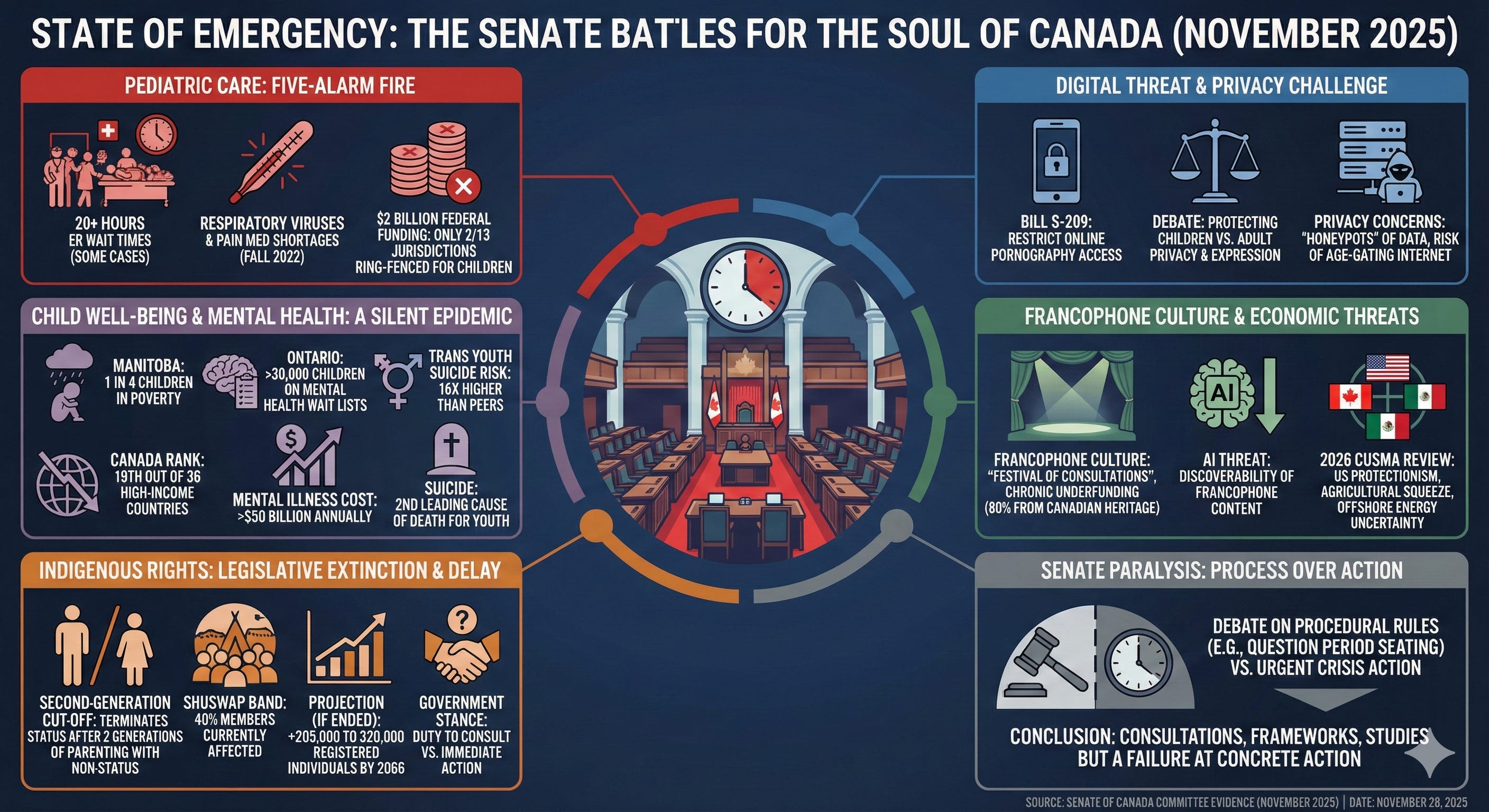
As 2025 draws to a close senators face a nation fracturing under the weight of suicidal youth excluded Indigenous families and a looming trade war while the machinery of government offers consultations instead of cures.
In the sterile, wood-panelled committee rooms of Ottawa a terrifying mosaic of a nation in crisis is being pieced together. It is November 2025 and the testimony flowing into the Senate is not merely a collection of policy grievances. It is a symphony of alarm bells. From the fishing villages of Newfoundland to the grain fields of Saskatchewan and the digital battlegrounds of the internet a singular narrative has emerged. Canada is a wealthy nation that has lost its way. It is failing its children, erasing the identities of its First Peoples, and sleepwalking into an economic hurricane.
At the center of this legislative storm is the fight for a National Strategy for Children and Youth. The evidence presented to the Standing Senate Committee on Social Affairs, Science and Technology was visceral and damning. Witnesses described a healthcare system that has collapsed for the youngest citizens leaving them to wait twenty hours in emergency rooms or languish for years on mental health waiting lists.
Senator Rosemary Moodie, a pediatrician by trade, sat before her colleagues to advocate for Bill S-212. Her message was blunt. The system is failing. It is inefficient. It leaves behind those who need help most. Without a coordinated plan Canada is flying blind. There are no clear targets. There is no consistent data. There is only a patchwork of provincial and federal silos while the moral integrity of the country crumbles.
The Five-Alarm Fire in Pediatric Care
The testimony from the front lines of Canadian healthcare was not just statistical. It was a cry for help. Emily Gruenwoldt, the President of Children’s Healthcare Canada, described the current state of affairs as a “five-alarm fire.” She took the committee back to the fall of 2022 when a convergence of respiratory viruses overwhelmed pediatric hospitals just as pharmacy shelves across the country were emptied of children’s pain medication. Parents watched their children suffer in feverish agony while the healthcare system buckled under the strain.
In response to that crisis the federal government announced two billion dollars in funding. Yet because the funds were not ring-fenced for children specifically only two out of thirteen jurisdictions actually used the money to build pediatric capacity. The rest vanished into the general healthcare void. This, Gruenwoldt argued, is why a legislated strategy is a matter of life and death. Without a mandate governments will always find somewhere else to spend the money.
The statistics are chilling. In Manitoba one in four children lives in poverty. In Ontario more than thirty thousand children are waiting for mental health services. Transgender youth face a suicide risk sixteen times higher than their peers. Canada now ranks nineteenth out of thirty-six high-income countries for child well-being—a humiliating statistic for a G7 nation.
Sara Austin of Children First Canada reminded senators that this failure was a choice. Twenty years ago Canada had a national strategy for children. It was abandoned following a change in government in 2004. Since then the country has been in freefall. Austin argued that political will is fickle but legislation is permanent. Unless the rights of children are enshrined in law they will continue to be the first victims of budget cuts and shifting political winds.
The Silent Epidemic and the Digital Threat
The physical collapse of the system is matched only by the psychological toll. Michael Braithwaite, CEO of Jack.org, testified that the cost of mental illness in Canada now exceeds fifty billion dollars annually. But the human cost is incalculable. Suicide is the second leading cause of death for young people in Canada. Braithwaite described a generation entering the workforce already burned out and struggling.
Senators pressed for amendments to explicitly name mental health in the national strategy refusing to leave the issue to chance. Senator Katherine Hay refused to accept assurances that mental health would “naturally” be included. Braithwaite agreed noting that mental health is consistently treated as secondary to physical health. If it is not named in the bill it will be ignored.
While one committee fought to build a safety net another wrestled with the predators lurking in the digital shadows. The Legal and Constitutional Affairs committee continued its study of Bill S-209 which seeks to restrict young persons’ access to online pornography. This hearing exposed a fundamental clash between the desperate need to protect children and the rights of adults to privacy and expression.
Janine Benedet, a law professor from the University of British Columbia, urged the committee not to be distracted by abstract privacy concerns when the harm to children is so evident. She described pornography not as a private fantasy but as a harmful cultural product that conditions boys to view women as servile and sexually insatiable. She cited research linking the consumption of violent pornography to real-world sexual violence arguing that the industry earns billions by exploiting bodies and that modest verification burdens are a small price to pay.
Opposing this view was Michael Geist, a law professor at the University of Ottawa, who warned that the bill was a privacy disaster waiting to happen. He argued that requiring millions of Canadians to upload government identification to verify their age would create massive “honeypots” of data for hackers. He cited a recent breach involving a third-party system used by Discord where tens of thousands of IDs were stolen. He warned that the bill’s broad drafting could inadvertently capture social media platforms and search engines effectively “age-gating” the entire internet.
Jeanette Patell from Google Canada appeared to defend the tech giant’s approach arguing for a risk-based model where controls are placed on content providers rather than the search engine itself. She equated requiring ID for Google searches to carding everyone at the entrance of a shopping mall rather than just at the liquor store.
Legislative Extinction
The struggle for survival is not limited to the youth. In the Committee on Indigenous Peoples the fight was over the very definition of who belongs. Bill S-2 seeks to amend the Indian Act to correct sex-based inequities in registration but for many First Nations it is too little too late.
The room was tense as Chief Barbara Cote of the Shuswap Band testified via video conference. She demanded an immediate end to the “second-generation cut-off,” a bureaucratic rule that terminates Indian status after two generations of parenting with non-status individuals. Chief Cote called this “legislative extinction.” She revealed that forty percent of her band members are currently affected—children and grandchildren who are excluded from their identity and rights right now.
Across from her sat the Honourable Mandy Gull-Masty the Minister of Indigenous Services. Appointed by Prime Minister Mark Carney, Gull-Masty is a Cree woman and former Grand Chief. She found herself in the excruciating position of defending a delay. She argued passionately that while she supports ending the cut-off she has a constitutional duty to consult with First Nations communities before making such a sweeping change. She insisted that imposing a solution from Ottawa would be a repetition of colonial mistakes stating that predetermining a solution without living the reality is “racism itself.”
Senator Brian Francis, himself a former Chief, challenged the Minister directly. He argued that Indigenous people have been “consulted” since 1985 and that the government uses consultation as a tool to perpetuate discrimination. He asked if the government was ready to prioritize the passage of an amended bill now. The Minister held her ground insisting that the solution must come from the communities themselves.
This philosophical deadlock exposed deep wounds. Senator Mary Jane McCallum noted that while the government waits for consensus families are being torn apart. She argued that the consultation has already happened at the grassroots level where women and children have been living with exclusion for decades.
The Numbers Game and the Lost Canadians
While the moral arguments raged the bureaucratic machinery attempted to quantify the crisis. Laurent Martel from Statistics Canada presented projections suggesting that ending the second-generation exclusion could result in an additional 205,000 to 320,000 registered individuals by 2066. Senator McCallum questioned the reliability of data based on colonial records where ancestors were often unnamed or simply listed as “an Indian woman,” fearing these large numbers were being used as a scare tactic to imply the cost of justice would be unmanageable.
In a parallel struggle for belonging the Social Affairs committee undertook a clause-by-clause review of Bill C-3 the Citizenship Act amendments. While less explosive than the Indian Act hearings the underlying theme was identical: the state’s power to grant or withhold identity. Senator David Arnot, wearing his “lucky tie” following the Saskatchewan Roughriders’ Grey Cup victory, introduced observations to ensure that in fixing the law the government does not inadvertently create new classes of excluded citizens—the so-called “Lost Canadians.”
A Culture Drowning in Consultation
While Indigenous communities fight for their status Canada’s Francophone minority communities are fighting for their cultural survival. The Standing Senate Committee on Official Languages heard testimony that revealed a sector drowning in bureaucracy.
Nancy Juneau and Marie-Christine Morin from the Fédération culturelle canadienne-française described a “festival of consultations.” Organizations are exhausted by endless government meetings that yield few concrete results. Despite the modernization of the Official Languages Act the arts and culture sector remains chronically underfunded dependent on 80 percent of its funding from Canadian Heritage while other departments ignore their obligations.
The threat is not just financial. It is existential. The witnesses warned that the rise of artificial intelligence poses a direct threat to Francophone culture. Without specific protections and investments in discoverability Francophone content risks being buried by global algorithms. They called for a seat at the economic table arguing that culture is not a charity case but a major economic driver that requires stable core funding not just project-based scraps.
Economic Storm Clouds Gathering
Looming over all these domestic crises is the existential threat of the 2026 review of the Canada-United States-Mexico Agreement. The Foreign Affairs and International Trade committee heard from business leaders who are terrified that the American political climate is turning against trade.
Ryan Greer from Canadian Manufacturers & Exporters described the situation as a “U.S. problem” that Canada cannot diversify its way out of. The manufacturing sector is deeply integrated with the United States. If the border thickens or if tariffs are imposed the damage will be immediate and catastrophic. He warned that the United States increasingly views trade as a zero-sum game.
The agricultural sector is equally exposed. Kyle Larkin of the Grain Growers of Canada described farmers as being “stuck between a rock and a hard place.” They rely on the U.S. market but are simultaneously being squeezed by Chinese tariffs on canola. The consensus was that Canada must approach the 2026 review not defensively but with a clear strategy to prove its value to North American economic security.
In the Energy, the Environment and Natural Resources committee the focus shifted to the offshore petroleum industry in Newfoundland and Labrador. Kristopher Drodge from the Marine Institute described a sector that is a world leader in safety and training yet faces an uncertain future in a decarbonizing world. The testimony highlighted the precarious balance between economic necessity and environmental reality as the region tries to maintain its workforce and safety standards amidst shifting global tides.
The Paralysis of Process
While these existential threats swirl around the Senate the institution itself seems caught in its own gears. The Standing Committee on Rules, Procedures and the Rights of Parliament spent hours debating the mechanics of Question Period.
The debate centered on whether the rules should state that a minister “may” appear or “shall” appear and where they should sit when they do. Senator Denise Batters fought a rearguard action against codifying the practice arguing that it strips rights from non-affiliated senators and imposes rigidity on a process that requires flexibility. The committee eventually passed the motion on division but the fracture lines were visible.
It was a stark contrast. In one room senators were debating how to save children from suicide and poverty. In another they were arguing over seating arrangements.
Conclusion
As the files stack up in the Senate archives a clear narrative emerges. Canada is a nation rich in resources and rhetoric but poor in execution. The government excels at consultations, frameworks, and studies. It fails at action.
From the “festival of consultations” frustrating Francophone artists to the endless “duty to consult” delaying Indigenous justice the bureaucratic process has become an end in itself. Meanwhile the real world consequences accumulate. Children wait in agony in emergency rooms. Indigenous families remain separated by colonial laws. Businesses brace for a trade war. And the economic storm clouds of 2026 draw closer.
The Senate has gathered the evidence. The transcripts are filled with the voices of the vulnerable. The question that remains is whether these reports will serve as a catalyst for the radical change the country needs or if they will simply become more paper in a library of unfulfilled promises.
Source Documents
Standing Senate Committee on Social Affairs, Science and Technology. (2025, November 5). Evidence.
Standing Senate Committee on Social Affairs, Science and Technology. (2025, November 6). Evidence.
Standing Senate Committee on Social Affairs, Science and Technology. (2025, November 18). Evidence.
Standing Senate Committee on Indigenous Peoples. (2025, November 5). Evidence.
Standing Senate Committee on Indigenous Peoples. (2025, November 19). Evidence.
Standing Senate Committee on Legal and Constitutional Affairs. (2025, October 22). Evidence.
Standing Senate Committee on Foreign Affairs and International Trade. (2025, November 6). Evidence.
Standing Senate Committee on Official Languages. (2025, November 17). Evidence.
Standing Senate Committee on Human Rights. (2025, November 3). Evidence.
Standing Senate Committee on Energy, the Environment and Natural Resources. (2025, November 6). Evidence.
Standing Committee on Rules, Procedures and the Rights of Parliament. (2025, November 4). Evidence.
Standing Committee on Rules, Procedures and the Rights of Parliament. (2025, November 18). Evidence.