


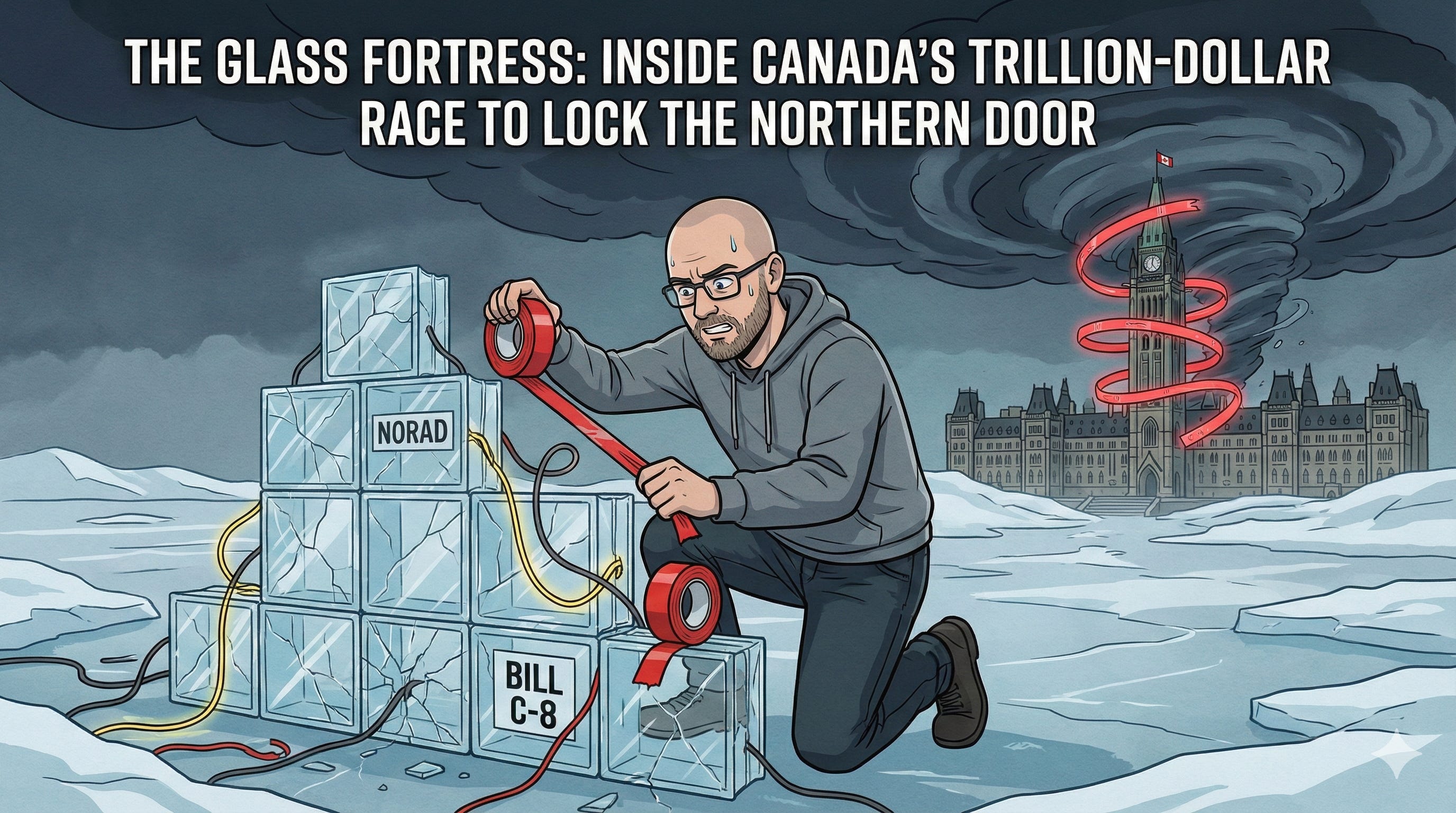
The realization didn’t come with a bang, but with the quiet shuffle of papers in a windowless room on Parliament Hill. It was late January 2026, and the House Standing Committee on National Defence (NDDN) had reconvened to face a cold reality: the 20th-century shield that had protected North America for seventy years was full of holes.
“Canadians are very anxious about the current geopolitical landscape,” noted a committee member during the testimony of Lieutenant-General Jamie Speiser-Blanchet. The anxiety wasn’t misplaced. As witnesses detailed the arrival of Canada’s first F-35 fighter jets and the overhaul of NORAD’s sensors, a darker subtext emerged. The threat wasn’t just physical anymore. It was digital, it was expensive, and it was already here.
While the generals spoke of “integrated air and missile defence”, a few buildings away, the Minister of Industry was delivering a parallel warning about an enemy that doesn’t need a missile to cripple the economy. Canada is attempting to build a 21st-century fortress, but as the transcripts from four separate committees reveal, the foundation is being poured into a swamp of procurement failures, political gridlock, and legislative friction.
The Physical Shield: Looking Over the Horizon
For decades, Canada’s defence strategy relied on the “North Warning System”—a string of radar stations designed to spot Soviet bombers. That system is now a relic. In its place, the Department of National Defence is rushing to build a “technology-enabled” network capable of tracking hypersonic missiles and stealth threats that the old radars would never see.
Testifying before the NDDN committee, Jonathan Quinn, Director General of Continental Defence Policy, described a massive pivot toward “over-the-horizon” radar and “cloud-based command and control”. This isn’t just an upgrade; it’s a total architectural tear-down. The new system relies on data fusion—taking information from satellites, ships, and ground sensors and feeding it into a “combined aerospace operations centre”.
The stakes were highlighted by the delivery of the first Canadian F-35s to 8 Wing Trenton, a milestone that LGen Speiser-Blanchet confirmed was finally underway. But the hardware is only as good as the alliance behind it. In a moment of rare candour, the committee heard that “relations with our neighbours to the south have never been so tense”. While likely referring to the crushing pressure from Washington for Canada to meet its spending obligations, the comment hangs over the proceedings like a storm cloud. Canada isn’t just arming itself against adversaries; it is racing to prove its worth to its protectors.
The Invisible Siege: The $5 Billion Bleed
While the Air Force scans the skies, the true frontline has shifted to the server rooms of Toronto and Montreal. On January 27, 2026, Minister of Industry Mélanie Joly appeared before the Public Safety Committee (SECU) to defend Bill C-8, the Cyber Security Act.
Her testimony painted a picture of an economy under siege. “Canadian businesses lose more than $5 billion every year due to cybersecurity incidents,” Joly revealed. The digital economy, particularly the 5G networks rolling out across the country, is projected to add $112 billion to Canada’s GDP by 2035. But without a new legal framework, that asset is a liability. “With greater connectivity comes greater exposure,” Joly warned. “Cyber-threats are more sophisticated, more aggressive and borderless”.
Bill C-8 is the government’s answer. It explicitly aims to modernize the Telecommunications Act by making security a “core objective”. It grants Ottawa “targeted and practical tools” to order telecommunications companies to secure their networks against specific threats.
But the cure may be as controversial as the disease. During the hearing, Conservative MP Dane Lloyd pressed the government on the potential for overreach, fearing the bill could allow the state to “shut down services” without a warrant. The Privacy Commissioner had already flagged the bill’s privacy protections as “insufficient”.
Joly’s defence was blunt: “Infrastructure security is not freedom of speech”. It was a definitive statement of the new era—where the integrity of the conduit takes precedence over the content flowing through it.
The Internal Rot: The Drag of Bureaucracy
If the threats are high-speed, the government’s ability to respond is agonizingly slow. While the Defence and Public Safety committees debated future wars, the Public Accounts Committee (PACP) was dissecting the failures of the present.
The committee’s review of “Professional Services Contracts” revealed a government machinery gummed up by reliance on outside consultants and botched IT migrations. The testimony focused on “Project CARM,” a massive overhaul of the Canada Border Services Agency’s revenue management system, and the migration of the Employment Insurance system.
The contrast is jarring. On one side, the military is discussing “integrated data fusion” for missile defence. On the other, the civil service is struggling to modernize basic benefit systems without incurring massive cost overruns or relying on firms like McKinsey. The shadow of the ArriveCAN scandal—where millions were wasted on a simple app—looms large over every promise to “modernize” national infrastructure. If Ottawa cannot successfully migrate an insurance database, can it really build a cloud-based command center for NORAD?
The Distraction: A Parliament at War with Itself
Perhaps the greatest threat to Canada’s security isn’t a hypersonic missile or a malware packet, but the paralysis of its own legislature. While the generals and ministers warned of existential threats, the Justice Committee (JUST) descended into a procedural brawl over Bill C-9, legislation targeting hate crimes.
The transcripts from December 2025 show a committee stuck in a loop of filibusters and points of order. Members argued over whether they were debating amendment “LIB-1” or “BQ-2”. Tensions flared over the definition of symbols like the swastika and accusations of members living in a “Conservative echo chamber”.
“I looked in the mirror and I had a hard conversation with myself,” one MP said, recounting the emotional toll of the debate. While the protection of communities from hate propaganda is a vital issue, the juxtaposition is stark. The legislative machinery required to pass critical security bills like C-8 and C-11 is being ground down by a culture war that consumes massive amounts of parliamentary oxygen.
The Cost of Sovereignty
As 2026 unfolds, Canada finds itself in a precarious position. The “glass fortress” is being built, but the costs are staggering and the timeline is tight. The “neighbours to the south” are watching with growing impatience. The hackers are already inside the firewall. And the machinery of government is creaking under the weight of its own complexity.
The modernization of NORAD and the passage of the Cyber Security Act represent the largest shift in Canadian defence policy since the Cold War. But laws and radar stations are only the hardware. The software—the political will to execute, the bureaucratic competence to deliver, and the national unity to endure—remains unwritten.
Hansard Files digs through the archives so you don’t have to. If you value deep-dive investigations into the machinery of the Canadian state, subscribe today to support independent, non-partisan journalism.
Source Documents
Standing Committee on National Defence. (2026, January 26). Evidence, Number 020. House of Commons Canada.
Standing Committee on National Defence. (2026, January 28). Evidence, Number 021. House of Commons Canada.
Standing Committee on Public Safety and National Security. (2026, January 27). Evidence, Number 020. House of Commons Canada.
Standing Committee on Public Accounts. (2025, December 11). Evidence, Number 021. House of Commons Canada.
Standing Committee on Justice and Human Rights. (2025, December 9). Evidence, Number 014. House of Commons Canada.
Standing Committee on Science and Research. (2026, January 26). Evidence, Number 021. House of Commons Canada.
Standing Committee on Industry and Technology. (2026, January 26). Evidence, Number 021. House of Commons Canada.
It is worth noting that Trump is in the process of defunding multilateral cybersecurity collaborations. There is a real concern for Canada that cyberattacks will be used to soften the border...But we have purchased Palantir drones and use US software both on a government and individual level. So perhaps the camel's nose is already in the tent?
It would be a shame to ignore the values for the perception of security or defense. But it seems that this is focused on infrastructure. Hardening critical infrastructure makes sense. But that would seem to be something that is best done by bureaucrats acting under the broad directives of Parliament....such as focus on security
The sad part is this "gap" has been common knowledge for decades but the gubbermint would rather spend money on DEI insanity than securing our country. But hey... now all of the men's bathrooms have tampons so... yeah...
My friends in the CAF tell me the US military would not permit Canada to put defenses in the north without their participation and guidance. So... who actually controls our territories?
When I suggested we should build nuclear submarines to replace the ancient broken down used submarines Chretien bought decades ago for a song, I was told the US Navy would not permit such. I asked "Who is charge of Canada... us or the Americans?" and the reply was we operate within constraints.