


The alarm cuts through the air. It is a sound designed to induce panic and action simultaneously. You are deep inside a sprawling distribution center or on the thirty-fifth floor of a glass residential tower. Your instinct is primal. You need to get out. You scan the room for the glowing green sign of a running man. The distance between where you stand and that door is not random. It is a calculated value dictated by the National Building Code. For most sprinklered buildings in Canada, that limit is exactly forty-five meters.
Most occupants assume this number is the result of rigorous modern science, derived from computer simulations of smoke spread and human physiology. They assume it accounts for the toxicity of burning plastics, the walking speed of an aging population, and the time it takes for a confused person to react.
They would be wrong.
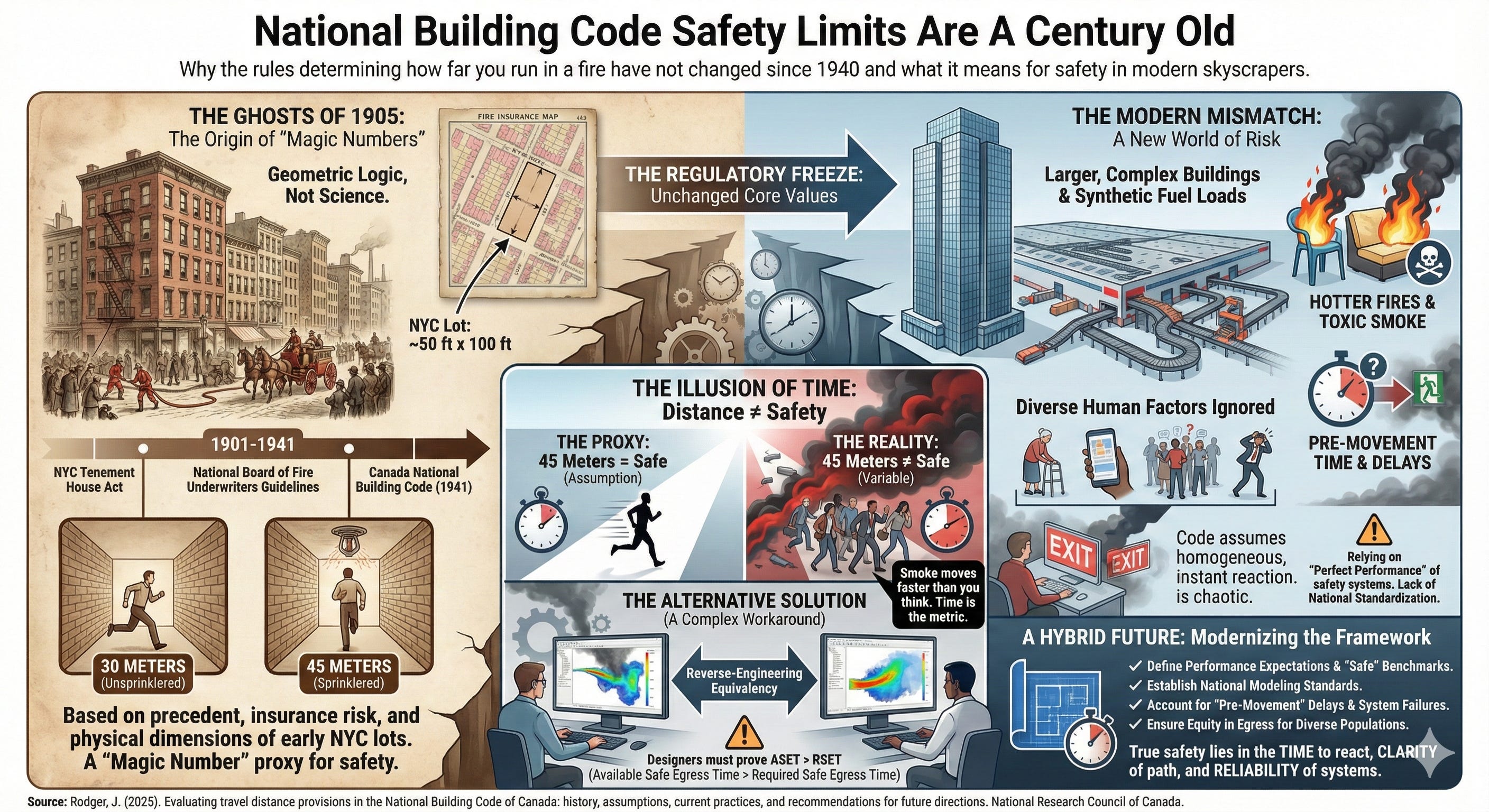
A comprehensive report commissioned under the National Research Council of Canada reveals a startling reality. The foundational travel distance limits in the National Building Code are not based on modern empirical modeling. They are ghosts of the early twentieth century, based on precedent, insurance guidelines from 1905, and the physical dimensions of New York City lots from a time when skyscrapers were a novelty. As buildings have grown larger, more complex, and filled with synthetic materials that burn hotter and faster, the regulatory numbers governing our escape have remained virtually frozen in time.
The Magic Numbers of 1905
To understand why a Canadian office worker in 2025 is limited to a forty-five-meter run to an exit, one must look back to the fire insurance maps of the early 1900s. The report traces the genealogy of these regulations back to the New York City Tenement House Act of 1901 and subsequent guidelines from the National Board of Fire Underwriters.
In that era, the logic was geometric rather than scientific. A standard New York City lot measured roughly 50 by 100 feet. Firefighters needed to access the interior with hoses. Insurance underwriters needed a simple metric to assess risk. The consensus settled on a travel distance of roughly 100 feet, or about 30 meters. When sprinklers were introduced—a technology that drastically reduced property loss—insurers allowed that distance to increase by fifty percent, up to 150 feet, or roughly 45 meters.
These figures were codified in the United States in the 1920s. When Canada published its first National Building Code in 1941, it largely adopted these American models. The numbers were practical proxies for safety in an era of brick, timber, and open windows.
Over eighty years later, the core values remain largely unchanged. The current National Building Code prescribes a maximum travel distance of 45 meters in sprinklered floor areas and 30 meters in unsprinklered ones. While minor adjustments have been made for open-air garages or specific corridors, the baseline assumption persists: if you are within 45 meters of an exit, you are safe. The report describes these as “magic numbers,” metrics that convey a sense of precise engineering safety while concealing the fact that they originate from administrative convenience rather than data on human survival.
The Modern Mismatch
The built environment has transformed radically since 1941, yet the travel distance provisions have not kept pace. The report highlights a growing disconnect between these prescriptive limits and the reality of modern construction. Today, we build massive, open-plan warehouses that stretch for hundreds of meters. We construct high-rise towers with complex, winding corridors. Perhaps most critically, the fuel load inside these buildings has changed. Modern furnishings are largely synthetic, creating fires that grow faster and produce more toxic smoke than the wood and cotton furnishings of the past.
The rigid application of travel distance limits also fails to account for the people inside the buildings. The code generally assumes a homogeneous population capable of perceiving an alarm and moving immediately toward an exit at a steady pace. It does not explicitly differentiate requirements based on age, cognitive ability, or mobility limitations unless the building is a designated care facility.
Research cited in the report notes that real-world evacuation is chaotic. People do not react instantly. There is a “pre-movement time” where occupants seek social confirmation, gather belongings, or simply hesitate. In high-density environments, queues form at doorways. Smoke obscures exit signs. In complex layouts, people suffer from “movement to the familiar,” ignoring closer emergency exits to leave through the main entrance they use every day. A fixed distance of 45 meters offers no guarantee of safety if the time required to traverse it exceeds the time before the corridor fills with smoke.
The Alternative Solution
When a modern building cannot meet these prescriptive 1940s standards—a common occurrence in large airports, stadiums, or automated warehouses—designers must use a mechanism called an “Alternative Solution.” This allows them to prove that their design provides a level of performance equivalent to the code.
This process, however, reveals the fragility of the current system. Because the National Building Code does not explicitly define the quantitative safety margins of the prescriptive limits, engineers are forced to reverse-engineer an equivalency. They must use complex modeling tools to demonstrate that the Available Safe Egress Time (ASET) is greater than the Required Safe Egress Time (RSET).
The review of thirty alternative solutions filed in Calgary exposed significant variability in how this is done. Some designs rely on sophisticated Computational Fluid Dynamics (CFD) models to predict smoke flow. others rely on simpler hand calculations. A critical finding was the reliance on “perfect performance” from safety systems. Many alternative solutions justify extended travel distances by assuming that sprinklers, smoke control fans, and detection systems will function without error or delay.
The report notes that while these performance-based designs often result in safe buildings, the lack of a standardized national framework means that safety margins can vary wildly from project to project. A warehouse in one jurisdiction might be allowed a 60-meter travel distance based on one set of assumptions, while an identical building in another city is rejected.
The Illusion of Time
The core tension identified in the report is the difference between distance and time. The National Building Code regulates distance (meters), but life safety is measured in time (seconds).
In a fire, the distance to the door is irrelevant if the smoke moves faster than the occupant. The report argues that the code operates as a proxy. It assumes that 45 meters equals a survivable evacuation time. But this proxy breaks down when the variables change. A 45-meter dash for an athletic adult in a clear hallway is a matter of seconds. That same distance for an elderly resident in a smoke-filled corridor using a walker is an entirely different equation.
Survey feedback from architects, engineers, and building officials across Canada reinforces this concern. Many respondents felt the current prescriptive limits were too rigid for low-risk buildings, like sprinklered parking garages, yet potentially not conservative enough for complex environments with high fuel loads. There is a strong consensus that the code needs to evolve toward a time-based metric that explicitly accounts for human behavior, including the reality that people do not start running the moment a bell rings.
A Hybrid Future
The report concludes not by calling for the abandonment of the travel distance limits, but for a modernization of the framework. The “magic numbers” of 30 and 45 meters still serve a purpose as a conservative baseline for simple buildings. They are easy to design, easy to build, and easy to inspect.
However, for the increasingly complex built environment, the report recommends a shift toward a hybrid model. This would involve clarifying the performance expectations behind the code. Regulators need to define exactly what “safe” looks like in terms of visibility, temperature, and toxicity.
Key recommendations include establishing national benchmarks for evacuation modeling, requiring designers to account for “pre-movement” delays, and mandating that alternative solutions consider the failure of safety systems. If a design relies on a smoke control fan to justify a 100-meter walk to an exit, the engineer must prove the building is safe even if that fan operates at reduced capacity.
Furthermore, the report emphasizes the need for equity in egress. Future code provisions must account for a diverse population, ensuring that “safe egress” is a reality for occupants of all abilities, not just the able-bodied subjects of theoretical models.
As cities grow denser and buildings climb higher, the reliance on century-old rules of thumb becomes increasingly tenuous. The physical distance to a door is a static measure in a dynamic world. True safety lies in the time we have to react, the clarity of the path ahead, and the reliability of the systems that protect us. The ghost of 1905 may still be in the code, but modern engineering is beginning to write a new chapter.
Source Documents
Rodger, J. (2025). Evaluating travel distance provisions in the National Building Code of Canada: history, assumptions, current practices, and recommendations for future directions. National Research Council of Canada.