


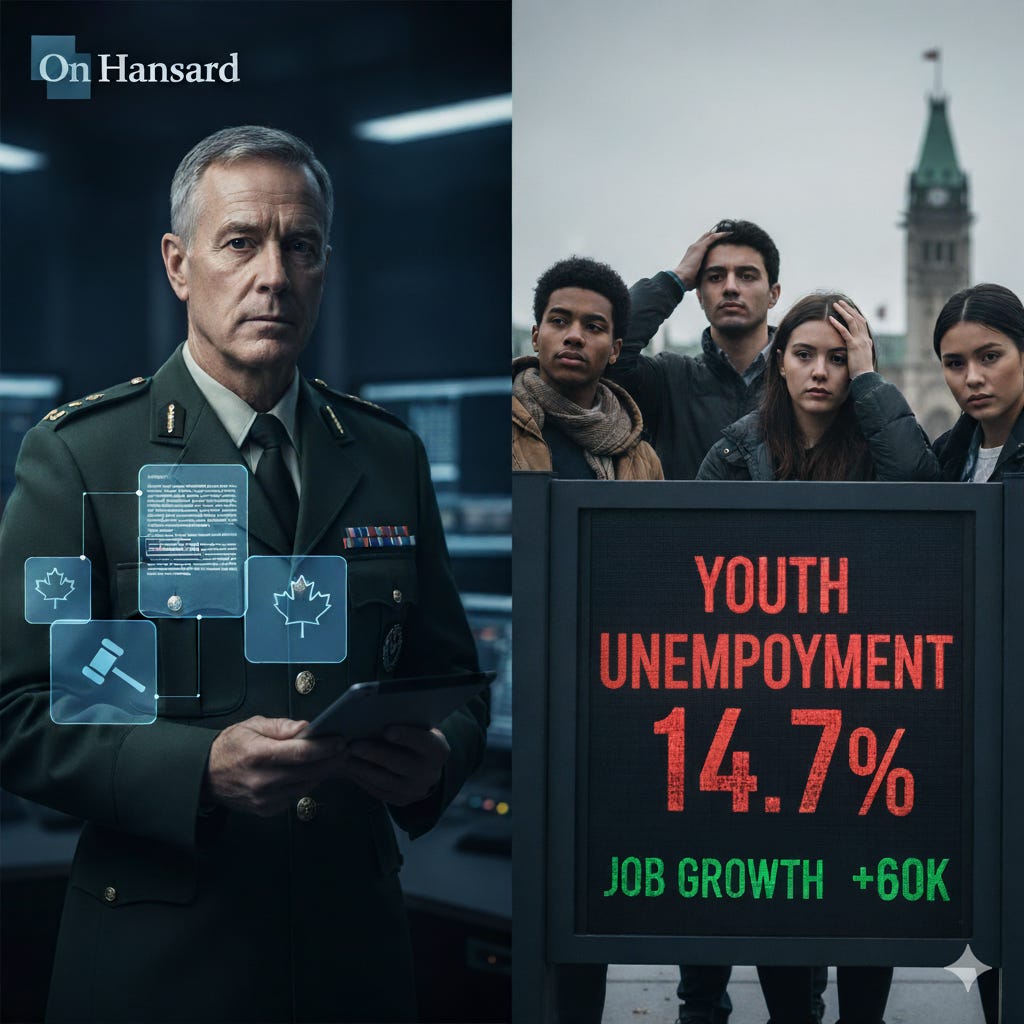
Parliament has officially removed the term “child pornography” from the Criminal Code, a move that received Royal Assent a year ago today. While Members of Parliament marked this milestone, the House turned its attention to another overhaul of the justice system, this time within the Canadian Armed Forces. This briefing breaks down the debate.
Estimated read time: 4 minutes
GOVERNANCE
Military Justice Faces Civilian Takeover
Driving the news: The House of Commons advanced Bill C-11, legislation that will transfer the investigation and prosecution of sexual offences in the Canadian Armed Forces to civilian authorities.
Catch-up: The bill responds to recommendations from former Supreme Court justices Louise Arbour and Morris Fish, aiming to address a long-standing culture of misconduct. Since a ministerial directive in November 2021, cases have already been transitioning to civilian police forces.
Why it matters: Proponents argue this change is critical for rebuilding trust and ensuring survivors’ cases are handled outside the chain of command, aligning military procedures with the civilian justice system. Critics, while supporting the bill in principle, question the decade of Liberal inaction on the file and raise concerns about backlogs in civilian courts and potential for partisan appointments under the new structure.
What’s next: The bill has passed its second reading and will now be studied by a committee, where members from all parties have indicated a need for careful scrutiny and potential amendments.
ECONOMY
A Tale of Two Job Reports
Driving the news: September’s job numbers sparked a sharp divide in Parliament, with the government highlighting overall job growth while the opposition focused on a deepening youth unemployment crisis.
Catch-up: Statistics Canada reported the creation of 60,000 new jobs last month, including 106,000 full-time positions. At the same time, the youth unemployment rate climbed to 14.7%, a level the opposition describes as the highest since 2010, excluding the pandemic years.
Why it matters: The government points to the overall numbers as proof its economic plan is working, promising generational investments in housing and major projects to create more jobs. The opposition argues the high youth unemployment rate—approaching half a million young people—signals a crisis that hurts the next generation’s long-term prospects and is a direct result of failed government policies.
JUSTICE
Liberals Face Renewed Fire on Bail Reform
Driving the news: Conservative MPs repeatedly attacked the government’s “catch-and-release” bail policies during Question Period, linking them to a rise in violent crime and citing specific instances of re-offending.
Catch-up: The criticism centers on laws like Bill C-75, which the opposition claims requires courts to release repeat violent offenders under the least onerous conditions possible. The previous Conservative government implemented several crime bills that were later struck down by the Supreme Court.
Why it matters: The debate highlights a fundamental ideological split on criminal justice. The opposition is calling for the government to scrap its existing bail laws immediately, arguing they endanger public safety. The government defends its record, states that public safety is already a factor in bail decisions under the Criminal Code, and promises to introduce new, constitutional bail reform legislation this fall after consulting with provinces and territories.
On The Docket
As of October 10, 2025, the term “child pornography” is officially eliminated from the Criminal Code and replaced with “child sexual abuse and exploitation material” after Bill C-291 came into force.
The Blood Tribe of Alberta is calling on the federal government to honour a Supreme Court ruling confirming the tribe was shorted over 162 square miles of land promised under Treaty No. 7.
A new bill, S-227, was introduced in the House to designate April of every year as Arab Heritage Month across Canada.
Concerns were raised about the “Driver Inc.” model in the trucking industry, with calls for the federal government to prevent temporary immigrants from working as incorporated drivers to improve highway safety.
In Their Own Words
Headline: Conservative MP and former prosecutor Frank Caputo on the lasting impact of sexual assault.
The Quote: “Victims who experience sexual trauma, at whatever age but particularly at a young age, live a psychological life sentence.”
Why it matters: During the debate on Bill C-11, Caputo delivered an impassioned speech connecting the failures to legislate on sexual offences in the military to what he sees as a broader failure across the justice system. His comments underscore the human toll behind the technical debate on legal jurisdiction and highlight the urgency felt by some MPs for stronger penalties for sex offenders.
Also Noteworthy
The House of Commons recognized October 11 as International Day of the Girl Child.
Winnipeg’s Théâtre Cercle Molière, the oldest operating theatre in Canada, celebrated its 100th anniversary.
Mortgage delinquency rates have increased by 64% since 2022, according to one MP’s statement.
A government announcement makes the national school food program permanent, which is expected to save families up to $800 a year.
Softwood lumber tariffs have doubled during the current Prime Minister’s time in office.
Calls were made for the government to mandate Automated External Defibrillators (AEDs) in all RCMP vehicles nationwide.
Via Rail faces criticism for not reinstating passenger service to the Gaspé region despite federal funding and track repairs.
The Data Brief
150: Number of sexual offence case files referred by military police to civilian police forces since 2021.
14.7%: The unemployment rate for Canadian youth as of September 2025.
60,000: Total net new jobs created in Canada during September 2025, according to Statistics Canada.
114%: The year-over-year increase in visits to the Cambridge food bank, with one-third of users being children.
Sources
House of Commons of Canada. (2025, October 10). House of Commons Debates (Hansard), 45th Parliament, 1st Session, Vol. 152, No. 038.