


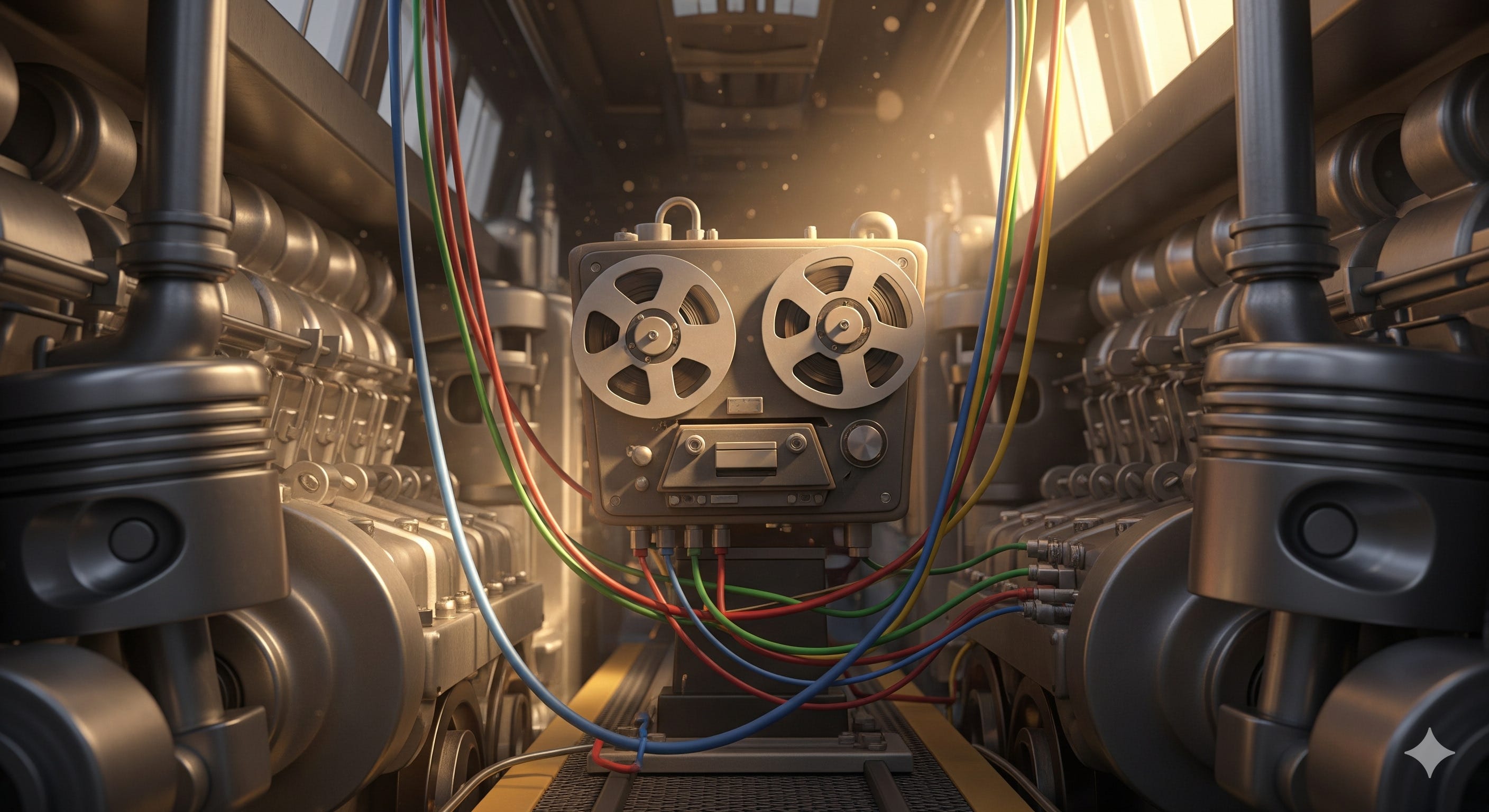
Maintenance monitoring is now a standard practice in heavy industry, but a 1973 Laboratory Memorandum from the National Research Council of Canada reveals just how forward-thinking this concept was half a century ago. Written by W.S. Heggie for the Division of Mechanical Engineering, the document proposes instrumenting a diesel locomotive not just for research, but to fundamentally change how railways handle repairs. The proposal argues that by recording specific engine parameters on magnetic tape, operators could predict failures before they occurred, resulting in massive financial savings.
Why was the industry looking at maintenance monitoring?
In the early 1970s, recording important variables on charts or by camera was common in research, but the National Research Council report suggests the time was ripe for a “complete integrated system”. The electric power generation field was already using gas analyzers and oscilloscopes to plan maintenance, maximizing their equipment availability. The railway sector, however, had not yet fully adopted these methods.
The memorandum highlights that without good diagnosis, diesel locomotive costs increase significantly due to inefficient pumps and injectors. These inefficiencies lead to:
Increased fuel costs caused by incomplete combustion.
Higher maintenance costs in specific cylinders due to carbon buildup and wear.
Situations where “good” cylinders are forced to accept the load from faulty ones, pushing them into overload conditions.
The report warns of “chain reaction deterioration”. For example, a simple waste of lubricant can lead to bearing failure, which may eventually result in a crankcase explosion.
How would the 1973 recording system work?
The proposed system was surprisingly sophisticated for its time. It called for a multi-channel, scanning, magnetic tape recording system capable of tracking upwards of 100 different parameters.
The technical specifications included:
Two recording decks: One to provide standard resolution and another for high-frequency data, ranging from 0.02 to 20 Kilohertz.
Sample intervals: Short samples would be recorded every half hour on permanent tape to save bulk.
The “Black Box” Loop: A five-minute history prior to a fault would be recorded on an endless tape loop, allowing engineers to review the exact moments leading up to a failure.
To capture fast-moving data like fuel injection signatures, the report recommended a frequency of 4,000 Hertz. This required a tape speed of 1 7/8 inches per second for standard data, but up to 15 inches per second for detecting phenomena like leaking gas.
What sensors were required?
To make maintenance monitoring effective, the locomotive would need to be fitted with a vast array of sensors. The proposal lists 100 specific data points to be tracked.
Key sensors included:
Exhaust Temperatures: 18 separate sensors using Iron-Constantan thermocouples.
Injection Pressure: 18 strain gauges to monitor fuel delivery.
Turbo-Charger Performance: Ceramic microphones to monitor rundown and revolutions per minute.
Engine Speed: A permanent magnet generator to track revolutions per minute.
Reserves: 20 channels were reserved for auxiliary propulsion motors and suspension equipment.
What were the projected financial returns?
The most compelling part of the document is the economic analysis found in Appendix A. The author modeled the savings for a hypothetical operation running 1,000 locomotives.
The analysis assumed that without monitoring, engines with a specific fuel consumption of 40 pounds per Brake Horsepower hour would average 45 pounds due to inefficiencies. Correcting this drift offered the largest single saving.
The Projected Annual Savings:
Fuel Savings: $7,000,000.
Maintenance Savings: $6,600,000.
Capital Savings: $1,600,000 (derived from needing fewer spare locomotives and parts).
Total Gross Savings: $15,200,000.
After accounting for the cost of the monitoring system itself, which was estimated at $3.3 million per year, the net annual saving was projected to be $11,900,000.
Takeaway
This 1973 memorandum demonstrates that the principles of maintenance monitoring—using data to predict mechanical health rather than reacting to failure—were well understood long before modern digital telematics became standard. The National Research Council author argued that because these techniques were already successful in stationary plants, the probability of success in rail was high.
The proposal aimed to reduce “destructive failures” and ensure locomotives only went to the shop when absolutely necessary, rather than “limping in”. By investing in what was then high-tech tape recording equipment, the report laid out a clear path to saving millions of dollars through data-driven efficiency.
Source Documents
Heggie, W. S. (1973). A proposal for the instrumentation of a locomotive for research purposes (Laboratory Memorandum No. NRC-ENG-79). National Research Council Canada, Division of Mechanical Engineering.