


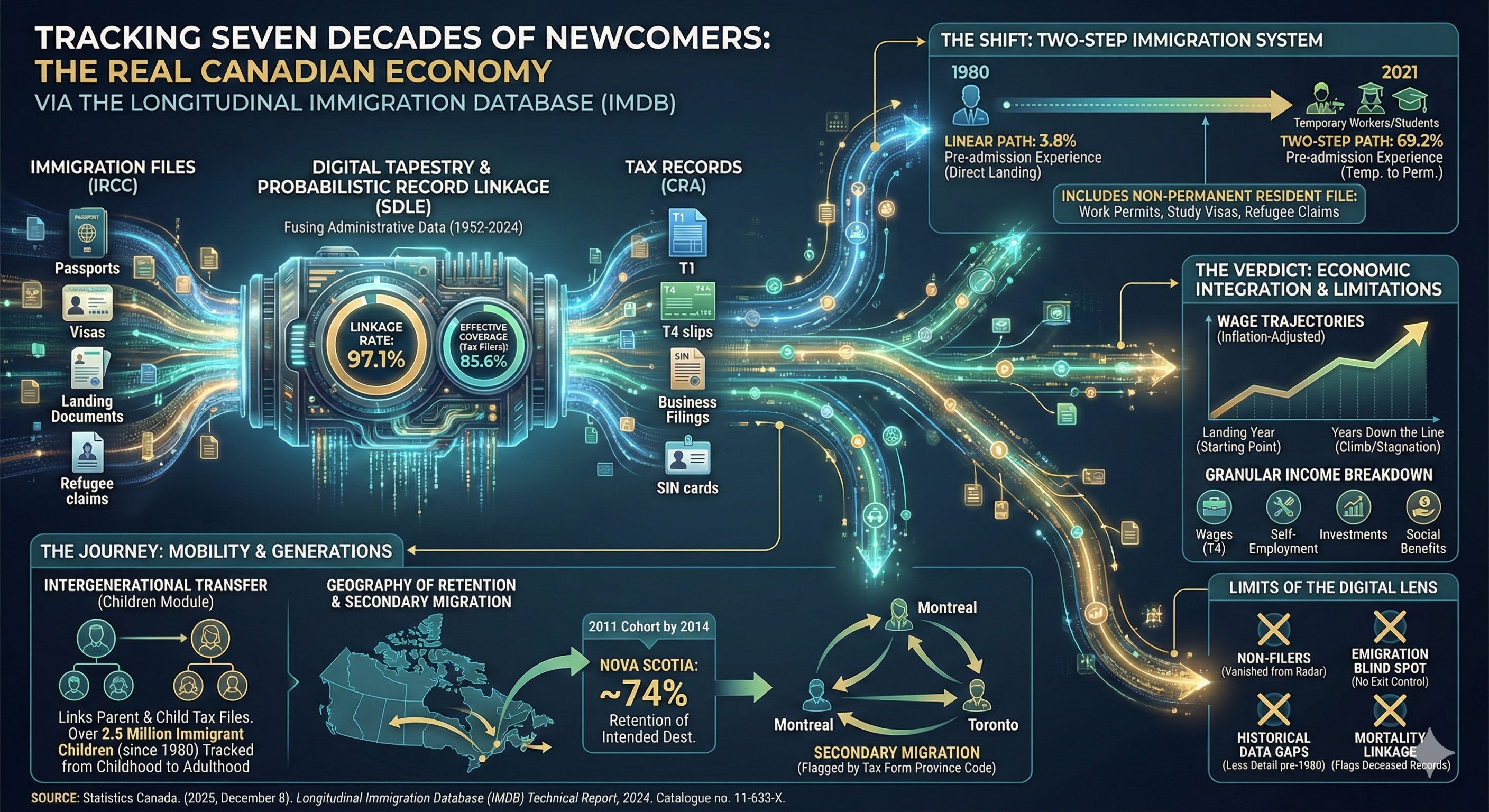
In the quiet, secure servers of Statistics Canada, a digital tapestry of the nation is being woven, thread by individual thread. It is a record of millions of lives, spanning from the post-war boom of 1952 to the high-tech labor market of 2024. This is not merely a collection of spreadsheets. It is the Longitudinal Immigration Database, the single most powerful tool the federal government possesses to understand the economic heartbeat of those who chose Canada as their home. By fusing administrative immigration records with decades of tax filings, this massive dataset reveals the unvarnished truth of the immigrant experience, stripping away political rhetoric to expose the raw data of wages, mobility, and retention.
The scope of this undertaking is staggering. It connects the mechanic who arrived from Italy in the 1950s with the software engineer landing from Bangalore today, tracking their financial trajectories through time. It captures the moment a temporary worker becomes a permanent resident and flags the tax year a family moves from Ontario to Alberta in search of opportunity. For policymakers and economists, the Longitudinal Immigration Database serves as the ultimate feedback loop, a mechanism that determines whether the Canadian dream is a statistical reality or a policy failure.
The Architecture of Digital Oversight
The creation of such a comprehensive history requires a complex feat of data engineering. The database is not a static list but a living organism, updated annually through a process known as probabilistic record linkage. This method allows statisticians to bridge the gap between two colossal government entities: Immigration, Refugees and Citizenship Canada and the Canada Revenue Agency.
The linkage process relies on the Social Data Linkage Environment, a secure ecosystem where distinct administrative files are merged. By comparing non-unique identifiers such as names, dates of birth, and gender, the system estimates the likelihood that a landing record from 1985 belongs to the same individual filing a tax return in 2023. This is not a simple matching game. It is a mathematical operation designed to overcome misspelled names, changing marital statuses, and clerical errors.
The efficacy of this system is high. According to the 2024 technical report, the linkage rate between immigration files and the central record depository stands at 97.1 percent. When it comes to connecting those immigrants to actual tax files, the effective coverage is 85.6 percent. This means that for the vast majority of newcomers, the government maintains a continuous economic narrative, tracking their fiscal contributions from their first year of filing.
This digital architecture allows for a granular view of the population. It separates the “principal applicants”—those assessed on their ability to contribute to the economy—from their spouses and dependents. It distinguishes between refugees fleeing persecution and investors seeking business opportunities. Crucially, it creates a longitudinal timeline, allowing analysts to observe how these categories perform not just upon arrival, but five, ten, and twenty years down the line.
The Shift to a Two Step Immigration System
One of the most profound revelations within the database is the fundamental shift in how people arrive in Canada. In the early 1980s, the path was linear. An individual applied from abroad, was accepted, and landed as a permanent resident. The data reflects this reality. In 1980, only 3.8 percent of new permanent residents had any “pre-admission experience,” meaning they had lived in Canada as temporary workers or students before gaining permanent status.
By 2021, that dynamic had inverted entirely. The database shows that 69.2 percent of new permanent residents had prior experience in the country. This statistical leap documents the rise of the “two-step” immigration system, where Canada increasingly draws its permanent citizens from a pool of temporary residents already working or studying within its borders.
This structural change required the database to evolve. The inclusion of the Non-permanent Resident File allows the system to track individuals long before they officially “land.” It captures the history of work permits, study visas, and refugee claims. This addition is critical for understanding economic outcomes. By comparing an immigrant with five years of Canadian work experience against one who arrived cold, the database provides empirical evidence on the value of Canadian integration prior to citizenship. It reveals that the modern immigrant journey often begins years before the government officially grants permanent residency.
Tracking the Next Generation
The economic story of an immigrant does not end with their own tax return. It extends to their children. To capture this intergenerational transfer of status and opportunity, the database includes a specialized “Children Module.” This dataset links the tax files of immigrant children to their parents, creating a bridge between childhood socioeconomic conditions and adulthood economic outcomes.
The linkage is often established through the “Dependent Identifier Number” or by connecting a child’s Social Insurance Number to a parent’s file. This allows researchers to answer complex questions about social mobility. Do children of economic immigrants earn more than children of refugees? How does a family’s initial poverty affect a child’s university prospects?
The data shows that since 1980, over 2.5 million immigrants admitted to Canada were under the age of eighteen. These children represent nearly a quarter of all admissions during that timeframe. Because they grow up within the Canadian education system, their challenges and successes differ vastly from their parents. By tracking them from their first presence on a family tax form through to their own independent tax filings, the database provides a report card on Canada’s ability to facilitate upward mobility across generations.
The Geography of Retention
Beyond income and family structure, the database serves as a tracking device for movement across the diverse Canadian landscape. Immigrants may state an intention to live in a specific province upon arrival, but the tax data reveals where they actually end up. This discrepancy between “intended destination” and “province of residence” offers a stark metric of regional economic health known as the retention rate.
The technical report illustrates this with the 2011 admission cohort. By 2014, three years after landing, the data revealed significant variations in how provinces held onto their newcomers. Nova Scotia, for instance, managed to retain approximately 74 percent of the immigrants who originally intended to settle there.
The database also captures “secondary migration,” identifying individuals who land in one province—often Ontario or British Columbia—and subsequently move to another. This is done by tracking year-over-year changes in the province of residence code on tax forms. If an immigrant lands in Montreal but files taxes in Toronto two years later, the system flags this as a loss for Quebec and a gain for Ontario.
This mobility data is essential for provincial governments. They invest heavily in settlement services and recruitment programs, and the retention rate serves as the return on that investment. A low retention rate signals that a region is failing to provide the economic opportunities necessary to keep new talent, turning the province into a mere waystation rather than a home.
The Wages of Integration
The core purpose of linking these files remains the assessment of economic integration. The database breaks down income into granular components: wages, self-employment earnings, investment income, and social welfare benefits. This level of detail prevents broad generalizations. It allows for the specific analysis of how different admission categories perform in the labor market.
To refine this analysis, a “Wages and Salaries” module was integrated, utilizing T4 tax slips directly from employers. This addition is particularly useful for tracking temporary residents who may not file a standard T1 tax return. It provides a more immediate and accurate picture of earnings, bypassing some of the lag associated with annual tax filing.
The data reveals that income trajectories are rarely flat. Most immigrants file taxes for the first time in their year of landing or the year immediately following. From that starting point, the database charts their climb—or stagnation—up the income ladder. It allows for the adjustment of these figures against the Consumer Price Index, ensuring that an immigrant’s wages in 1990 are comparable in real terms to those in 2020. This inflation-adjusted view is crucial for determining whether the economic promise of Canada is appreciating or depreciating for new arrivals.
Limits of the Digital Lens
Despite its immense scope, the Longitudinal Immigration Database is not omniscient. It relies on the administrative compliance of its subjects. If an immigrant stops filing taxes, they effectively vanish from the economic radar. This “non-filer” status can complicate analysis. A missing tax return could mean the individual is unemployed, has left the country, or has simply failed to file.
Emigration remains a significant blind spot. The database does not explicitly capture when an immigrant leaves Canada permanently, as there is no exit control requiring individuals to declare their departure. Statisticians must infer emigration through the cessation of tax activity, but this is an imperfect proxy.
Mortality data helps clarify some of these disappearances. By linking to the Canadian Mortality Database and provincial vital statistics, the system can flag records where an individual has died. This distinction is vital. It ensures that a deceased taxfiler is not counted as an economic failure or an emigrant. The 2024 report notes that death dates are now available for permanent residents dating back to 1952, allowing for a more accurate calculation of the living immigrant population.
There are also limitations in the historical data. While the expansion to 1952 is significant, the granularity of data for these early cohorts is less detailed than for those arriving after 1980. Furthermore, geography variables derived from mailing addresses on tax forms may not always reflect a person’s physical residence, particularly if they use a business address or a post office box.
The Verdict of the Data
The Longitudinal Immigration Database stands as a testament to the modern state’s capacity for surveillance and analysis. It transforms the chaotic, individual experiences of millions of people into orderly rows of data that determine the future of national policy. It confirms that the immigrant experience is not a monolith. It is a fragmented reality where a software engineer in Toronto and a caregiver in rural Manitoba exist in different economic universes, yet both are bound by the same tax codes and admission files.
As the database continues to expand, integrating citizenship records and Express Entry scores, its resolution will only sharpen. It provides the empirical bedrock upon which the arguments for and against immigration levels are built. In the cold, hard numbers of the IMDB, the government finds the answer to its most pressing question: Is the system working? The data suggests that while the machinery of selection and taxation is robust, the human outcomes it measures remain as varied and complex as the history of the nation itself.
Source Documents
Statistics Canada. (2025, December 8). Longitudinal Immigration Database (IMDB) Technical Report, 2024. Catalogue no. 11-633-X.