


“It’s almost Christmas!”
Senator Joan Kingston’s voice rang out in the committee room, a cheerful reminder to the gathered members of the Standing Senate Committee on Energy, the Environment and Natural Resources. It was 8:02 a.m. on Thursday, December 11, 2025. Outside, Ottawa was bracing for the deep freeze. Inside, the parliamentary machinery was grinding through the final friction points before the winter break.
The mood was light, but the agenda was heavy. Buried within the dense text of Bill C-15—the government’s omnibus Budget Implementation Act—sat Division 41.
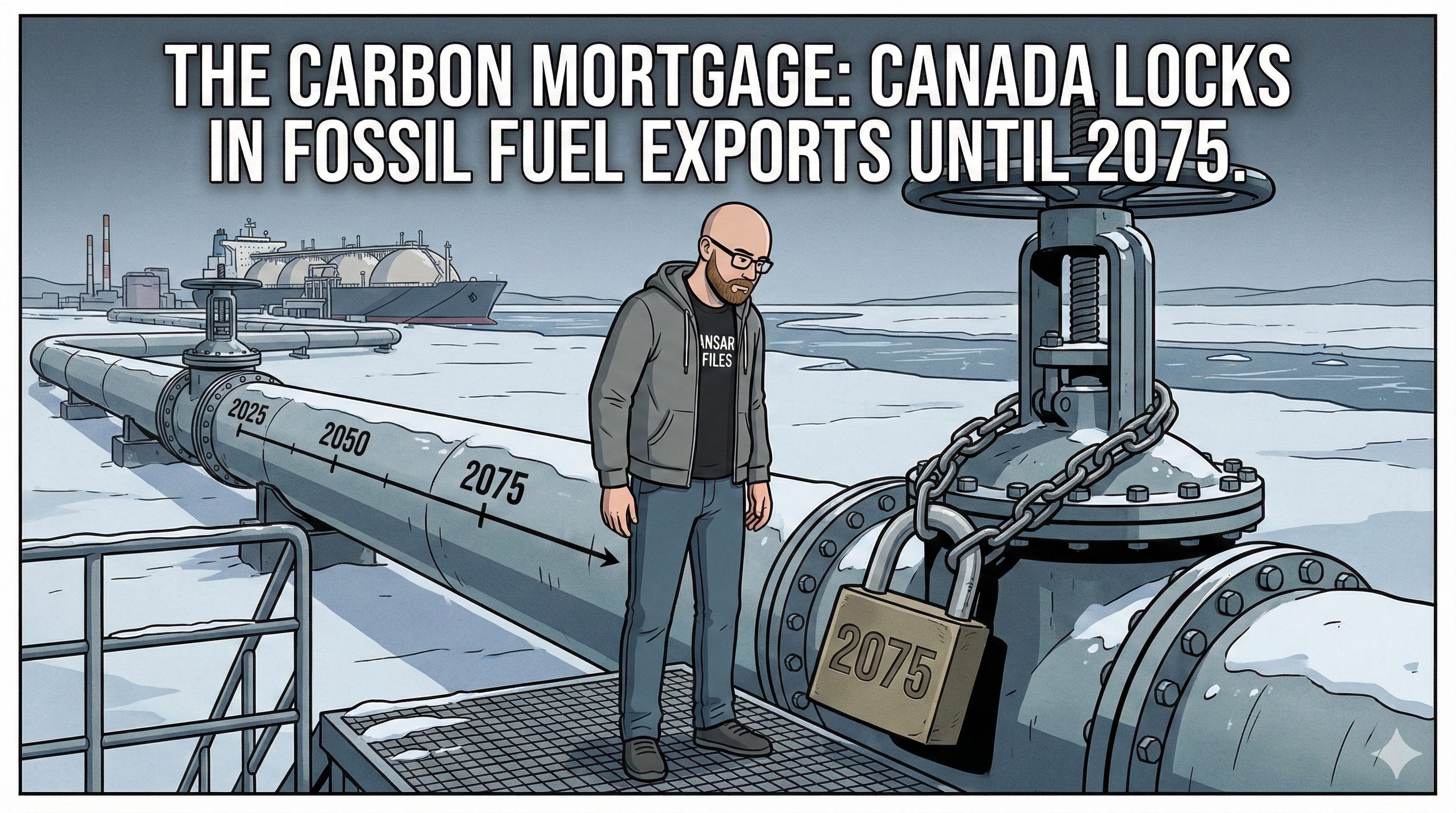
To the casual observer, it looked like a clerical tweak to the Canadian Energy Regulator Act. In reality, it was a multi-billion-dollar geopolitical wager. The provision proposed extending the maximum validity period for Liquefied Natural Gas (LNG) export licenses from 25 years to 40 years. With standard regulatory lead times, this effectively grants corporations the right to export Canadian gas well into the 2070s.
While the government publicly touts a transition to a “net-zero” economy by 2050, the testimony given in that room revealed a starkly different operational reality. The state is quietly re-gearing its legislative machinery to guarantee fossil fuel exports for half a century, betting the national balance sheet against the climate clock.
The “Amortization” of the Future
The logic for the extension was laid out by Erin O’Brien, Assistant Deputy Minister for the Fuels Sector at Natural Resources Canada (NRCan). Her testimony was smooth, technical, and financially prudent. She explained that the sheer scale of capital required to build LNG terminals—like the newly operational LNG Canada facility in Kitimat—requires a longer runway to pay off.
“Many of these LNG projects will require significant capital investment,” O’Brien told the committee, noting that Canadian projects must compete for “global investment dollars” with the United States.
The core argument is one of amortization. Investors need to know they can sell gas for decades to recoup their billions. “Providing an export licence extension... would allow them to amortize that volume of production over a longer period,” O’Brien said.
But the math of amortization clashes violently with the math of atmospheric science. Senator Rosa Galvez, an environmental engineer by trade, zeroed in on the paradox. If Canada is legally committed to net-zero emissions by 2050, how can it issue export licenses that run through 2065 or 2075?
“You are amending the law and you’re asking for an extension because you are expecting that there will be a future market for Canadian LNG,” Galvez challenged the NRCan officials. “I would like to see those numbers”.
The officials demurred on the specifics, pointing instead to the International Energy Agency (IEA) and the “surplus test”—a regulatory mechanism that ensures Canada has enough gas for itself before exporting. Crucially, however, the regulator admitted that the surplus test focuses on supply adequacy, not climate compatibility.
The “Carbon Mortgage” was being signed, and the terms were clear: to attract capital today, the government had to promise the right to pollute for the next two generations.
The 3,000-Day Nightmare
While the Energy Committee discussed locking in 40-year guarantees for corporations, a very different conversation about “time” was happening just down the hall.
The Standing Senate Committee on Legal and Constitutional Affairs was meeting to examine Bill S-205, a piece of legislation born from desperation rather than finance. The bill seeks to amend the Corrections and Conditional Release Act to place a hard cap on the isolation of prisoners.
Here, the timeframes weren’t measured in decades, but in hours. And for the people affected, time didn’t move fast enough.
Savanna McGregor, representing the Assembly of First Nations, brought the room to a hush with the story of Joey Toutsaint, a Dene man from the Black Lake First Nation. Toutsaint has spent over 20 years in the federal correctional system.
“Joey has spent over 3,000 days—eight years—in segregation or SIUs [Structured Intervention Units],” McGregor testified.
Three thousand days in a concrete box.
The contrast between the two committee rooms was jarring. In the Energy Committee, the government was fighting to extend timelines—giving corporations the certainty of 40-year licenses. In the Legal Committee, advocates were begging for a limit—a 48-hour cap on isolation without judicial oversight.
McGregor described a system of “systemic failures” where Indigenous inmates are routinely over-classified as maximum security, denying them access to Section 81 “healing lodges” that could break the cycle of incarceration. While NRCan officials spoke of “best-in-class emissions profiles” to market Canadian gas, Indigenous leaders spoke of “intergenerational trauma” and a justice system that functions as a new form of colonization.
“The federal government created this mess in federal corrections,” argued Dr. Pamela Palmater, Chair in Indigenous Governance at Toronto Metropolitan University. “So it has a legal obligation to address the mess”.
Yet, while the LNG extension in Bill C-15 was fast-tracked as a budgetary necessity, the human rights reforms in Bill S-205 faced the usual bureaucratic friction. The disparity in urgency was palpable: The state moves mountains to guarantee the flow of capital, but moves glaciers to guarantee the rights of the incarcerated.
The Flaring Loophole
Back in the Energy Committee, the “clean energy” narrative used to justify the LNG expansion was taking hits. The government’s pitch is that Canadian LNG will displace dirtier coal in Asia, ostensibly lowering global emissions.
Laura Minet, an Assistant Professor in Civil Engineering at the University of Victoria, warned the Senators that this optimization relies on assumptions that don’t always hold up in the field. She pointed specifically to “flaring”—the burning off of excess gas—which releases methane and other pollutants.
Minet noted that while facilities have permits, the monitoring is imperfect. “In the community of Kitimat, we also have air quality monitors... but they are not perfect because they do not cover the whole area,” she explained.
Senator Galvez pushed further, questioning whether extending licenses to 50 years would cause Canada to “backtrack” on its climate commitments. Minet’s response was cautious but damning: it depends entirely on how the facilities operate. If they aren’t fully electrified—or if methane leaks aren’t rigorously plugged—those 50-year licenses become 50-year emissions liabilities.
The “clean” brand of Canadian LNG assumes a level of regulatory perfection that rarely exists in practice. By locking in the licenses now, the government is betting that technology will solve the emissions problem later. If it doesn’t, the legal obligation to allow exports remains, but the carbon budget is blown.
The Christmas Eve Adjournment
As the morning wore on, the pressure to wrap up became the dominant force in the room. In the Internal Economy Committee (CIBA), Chair Lucie Moncion was presiding over her final meeting, accepting tributes and managing the “consent agenda”—a parliamentary tool to rubber-stamp non-controversial items quickly.
“It’s almost Christmas!” echoed the sentiment across all three committees.
The rush to clear the decks meant that complex, generational decisions were being processed with the speed of a holiday shopping checkout. The 50-year LNG extension, a policy shift that will define Canada’s economic and environmental posture until the late 21st century, was just one division in a massive omnibus bill.
By the time the gavels fell and the Senators headed for the airport, the die was cast.
For the Energy Sector: A secured future, amortized over decades, backed by the full weight of the Crown.
For Joey Toutsaint: Another day in the box, counting toward day 3,001.
The transcripts from December 11, 2025, reveal a government capable of extraordinary long-term planning when the beneficiary is a pipeline, and extraordinary inertia when the beneficiary is a person. As the lights went out in the committee rooms, two timelines continued to run: the countdown to a climate tipping point, and the indefinite count of days spent in solitary confinement.
Only one of them had a guaranteed extension.
The Hansard Files digs through thousands of pages of parliamentary transcripts to find the stories that shape our future—stories that usually vanish into the archives. Subscribe today to support independent investigative journalism that reads the fine print so you don’t have to.
Source Documents
Standing Senate Committee on Internal Economy, Budgets and Administration. (2025, December 11). Evidence.
Standing Senate Committee on Legal and Constitutional Affairs. (2025, December 11). Evidence.
Standing Senate Committee on Energy, the Environment and Natural Resources. (2025, December 11). Evidence.
So if "Net Zero" is the goal the Liberals are playing chicken with, they just blinked?
A very good article showing how some committees can “expedite” goals yet fail to act on others. Hansard, is there any data which shows the types of crimes Indigenous people have committed and a means of justification categorizing such crimes as major? Further, regardless of the crime, why aren’t healing lodges applicable in our cases?