


On October 2nd, the House of Commons debated a topic that has become a source of profound public anxiety. It began not with abstract policy, but with tragedy. The Leader of the Opposition spoke of a woman in Saint-Jérôme, Quebec, whose body had just been found. She was allegedly killed by a partner who, according to the parliamentary record, had been arrested 30 times and released 16 times under existing laws. This story, along with others shared during the debate involving horrific violence by repeat offenders, grounds the political back-and-forth in a painful reality. Many Canadians feel their communities are becoming less safe, and when they look to Ottawa for answers, they are met with a dizzying volley of accusations, defenses, and competing proposals.
This sense of being pulled in multiple directions at once is a symptom of what we might call Legislative Whiplash. It’s the jarring experience of seeing Parliament enact a major reform, only to have that same reform become the villain in a subsequent crisis, prompting a frantic push for another, often opposite, fix. The October 2nd debate on bail reform is a perfect case study in this phenomenon. To understand the current paralysis, you need to see past the partisan noise and grasp the three distinct arguments that are pulling the system in different directions. By breaking down the debate using the primary source material, you can arm yourself with the clarity that the daily news cycle often obscures.
The Problem of the Revolving Door
The central argument from the Conservative opposition is that the current crisis is a direct and predictable result of the Liberal government’s Bill C-75, passed in 2019. The motion before the House on October 2nd was to expedite a new bill, C-242, specifically designed to reverse the effects of that earlier legislation.
According to Conservative members, the core flaw of Bill C-75 was its introduction of a “principle of restraint” into the Criminal Code. As MP Arpan Khanna, the sponsor of the new bill, explained, this principle directs judges and police to release an accused person at the “earliest reasonable opportunity and on the least [restrictive] conditions”. The opposition argues this has created a “revolving door” justice system, where even violent, repeat offenders are quickly released, often within hours of an arrest.
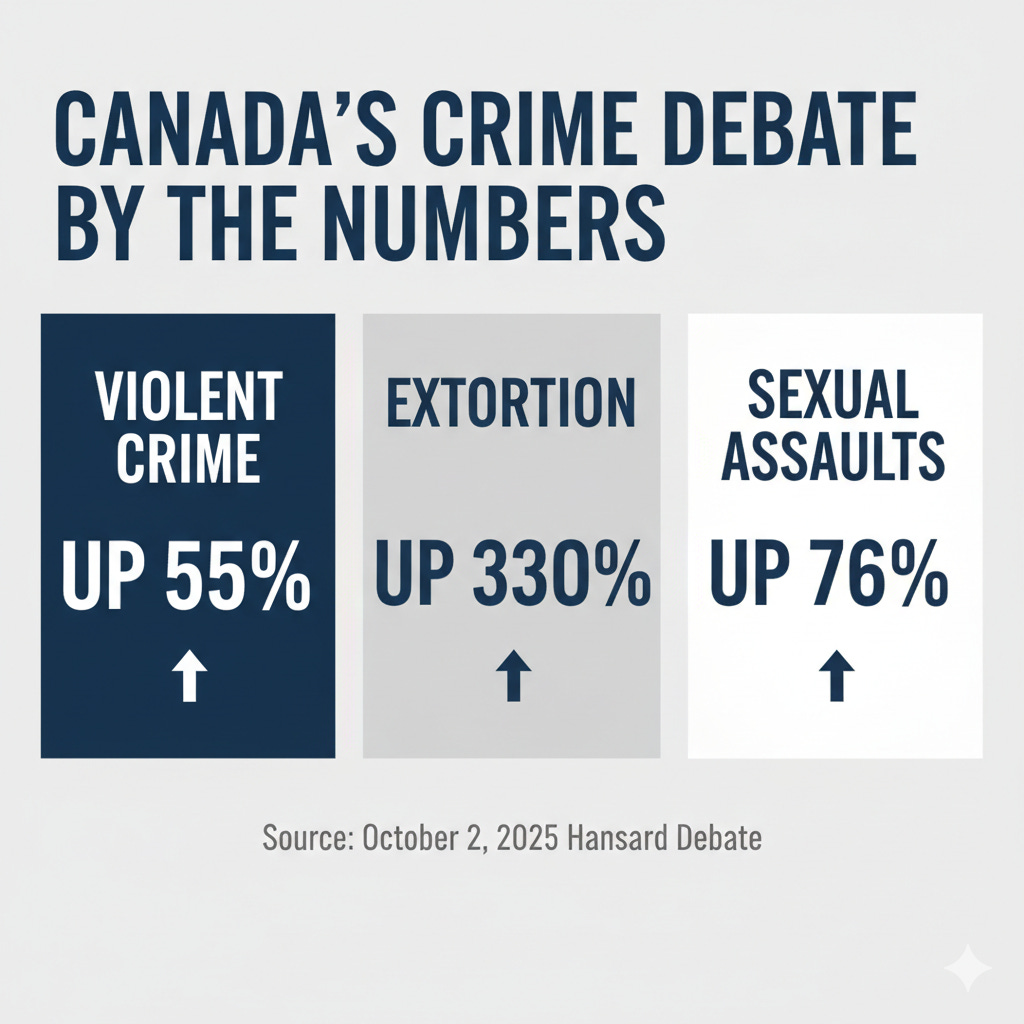
The statistics cited to support this claim are stark. Throughout the debate, members repeatedly pointed to the same set of numbers:
Since the Liberal government took office, violent crime is up 55%, extortion is up 330%, homicides are up 29%, and sexual assaults are up 76%.
This data is paired with visceral, tragic stories. MP Fred Davies spoke of “little E,” a three-year-old toddler in his Niagara riding who was brutally sexually assaulted by a recently released registered sex offender. The Leader of the Opposition recounted the murder of Bailey McCourt, a young mother killed by her ex-partner just hours after he was granted bail. These stories are presented not as isolated incidents, but as the inevitable outcome of a system that, in the opposition’s view, has been legally tilted in favour of criminals over public safety.
The Push for a “Common-Sense” Fix
The Conservative response to this problem is Bill C-242, the “Jail Not Bail Act.” The opposition day motion was designed to force this bill through the legislative process as quickly as possible. Its proposed solution is a direct reversal of the “principle of restraint.”
As outlined in the debate, Bill C-242 would amend the Criminal Code to make the “protection and safety of the public” the primary consideration in bail decisions. It proposes several key mechanical changes:
It introduces a new “major offences” category for violent crimes like extortion, home invasion, carjacking, and sexual assault.
For these offences, it would create a “reverse onus,” meaning the accused would have to prove why they should be released, rather than the Crown having to prove why they should be detained.
It would mandate that judges consider an accused person’s entire criminal history.
It would prohibit individuals with recent serious convictions from acting as a surety for another accused person, ending the “criminals vouching for criminals” scenario.
The opposition frames this not as a radical proposal, but as a restoration of balance. MP Larry Brock, who spent nearly 28 years in the criminal justice system before becoming a legislator, argued that before 2019, the system balanced the constitutional rights of the accused with community safety. In his view, Bill C-75 destroyed that balance, and Bill C-242 is the necessary corrective.
The Government’s Case for Deliberation
The government’s response to this pressure is twofold. First, they acknowledge the public’s concern. Second, they argue that their own process for reform is more responsible and will ultimately be more effective.
Throughout the debate, Liberal members repeatedly stated that the Minister of Justice will be introducing the government’s own comprehensive bail reform legislation this fall. They position their forthcoming bill as the product of careful and extensive consultation, a direct contrast to what they label the opposition’s “slogans” and “political theatre”.
“This comprehensive bail reform is based on extensive consultations with the provinces and territories. It is based on extensive discussions with law enforcement. It is based on evidence. It is not based on cut-and-paste American bail laws. It a bail law that will work.”
- Right Hon. Mark Carney (Prime Minister, Lib.)
The government also defends its record, pointing out that Bill C-75 included measures to strengthen bail provisions related to intimate partner violence and that a more recent bill, C-48, was unanimously passed in 2023 to create a reverse onus for repeat violent offending involving firearms. Furthermore, they shift some responsibility to the provinces, arguing that the administration of bail hearings, the resourcing of courts, and the collection of bail data are provincial duties that are not being adequately met. This points to a system where even the best federal laws, in their view, can be let down by failures in provincial implementation.
The Constitutional Guardrail
The Bloc Québécois introduces a third, crucial perspective that slows the rush to action. While they share the concern over violent crime, particularly against women, they argue that the Conservative motion to expedite Bill C-242 is a “dereliction by the legislature of its duties”.
Their argument is rooted in fundamental legal principles. MP Alexis Deschênes, a former criminal defense lawyer, reminded the House of the rights protected in the Canadian Charter of Rights and Freedoms: the right to liberty, the right to be presumed innocent, and the right not to be denied reasonable bail without just cause. He argues that Bill C-242 raises “significant constitutional issues” that demand serious, unhurried study, not an expedited process.
Here’s the detail I find most revealing: The Bloc argues some of the proposed changes are functionally redundant. Deschênes points to the existing Criminal Code, subsection 515(10), which already allows a judge to detain an accused person for the “protection or safety of the public”.
The core of his argument is that the tools for detaining dangerous individuals already exist. The problem may not be the law itself, but how it is being applied. This raises a critical question: If judges already have the power to detain for public safety, why are so many repeat offenders being released? Is it because of the “principle of restraint” in Bill C-75, or is there another factor at play? The Bloc’s position suggests that rushing another law without fully understanding this question risks creating new injustices without solving the original problem.
Balancing the Scales
The October 2nd debate makes it clear that the frustration you feel about bail reform isn’t just about politics. It’s about a deep, unresolved tension in our system of governance between two essential duties: protecting the public from harm and upholding the procedural rights that prevent the state from unjustly depriving a citizen of their liberty. The Conservatives are pulling hard on the lever of public safety. The Bloc Québécois is holding firm on the brake of procedural justice. And the government is arguing for a slow, consultative path down the middle. This is the anatomy of Legislative Whiplash, a cycle of reactive policymaking that leaves citizens feeling like passengers in a car swerving from one side of the road to the other. True public safety is not achieved by sacrificing justice, but by finding the discipline to serve both.
In Other News...
Beyond this deep dive, you can find more analysis and commentary on the On Hansard site.


Sources:
House of Commons. (2025, October 2). House of Commons Debates (Vol. 152, No. 032). 45th Parliament, 1st Session.