


On October 1, 2025, during a debate in the Senate of Canada, Senator Amina Gerba shared a personal story. Years ago, after seeking medical help for a painful condition, she underwent what she believed to be a minor surgery. Two years later, a routine ultrasound revealed the truth. Her uterus had been removed. She was never told. She never consented. As she explained to her colleagues, she was sterilized without her knowledge. Her story is not a historical anecdote. It is a modern Canadian reality.
The debate that day centred on Bill S-228, a piece of legislation designed to address a profound failing in our justice system. The bill seeks to explicitly criminalize sterilization performed without a person’s consent. Your first reaction to this is likely one of confusion. How is this not already a crime? How is performing life-altering surgery on someone without their consent not a clear case of assault? The answer to these questions reveals a persistent and dangerous blind spot in Canadian law, one that has allowed a horrific practice to continue with impunity, disproportionately affecting Indigenous women, Black women, and other marginalized people. Understanding this issue requires moving past the headlines and looking directly at the evidence presented in our own Parliament.
A Crime Hidden in Plain Sight
The core of the problem is that forced and coerced sterilization is not a relic of a darker past. It is happening now. During the debate on Bill S-228, Senator Yvonne Boyer, the bill’s sponsor, shared multiple contemporary accounts from women who have contacted her office. These are not isolated incidents.
You took generations from us. I could have had more kids. My daughter could have had more siblings.... It’s like you wiped out a generation.
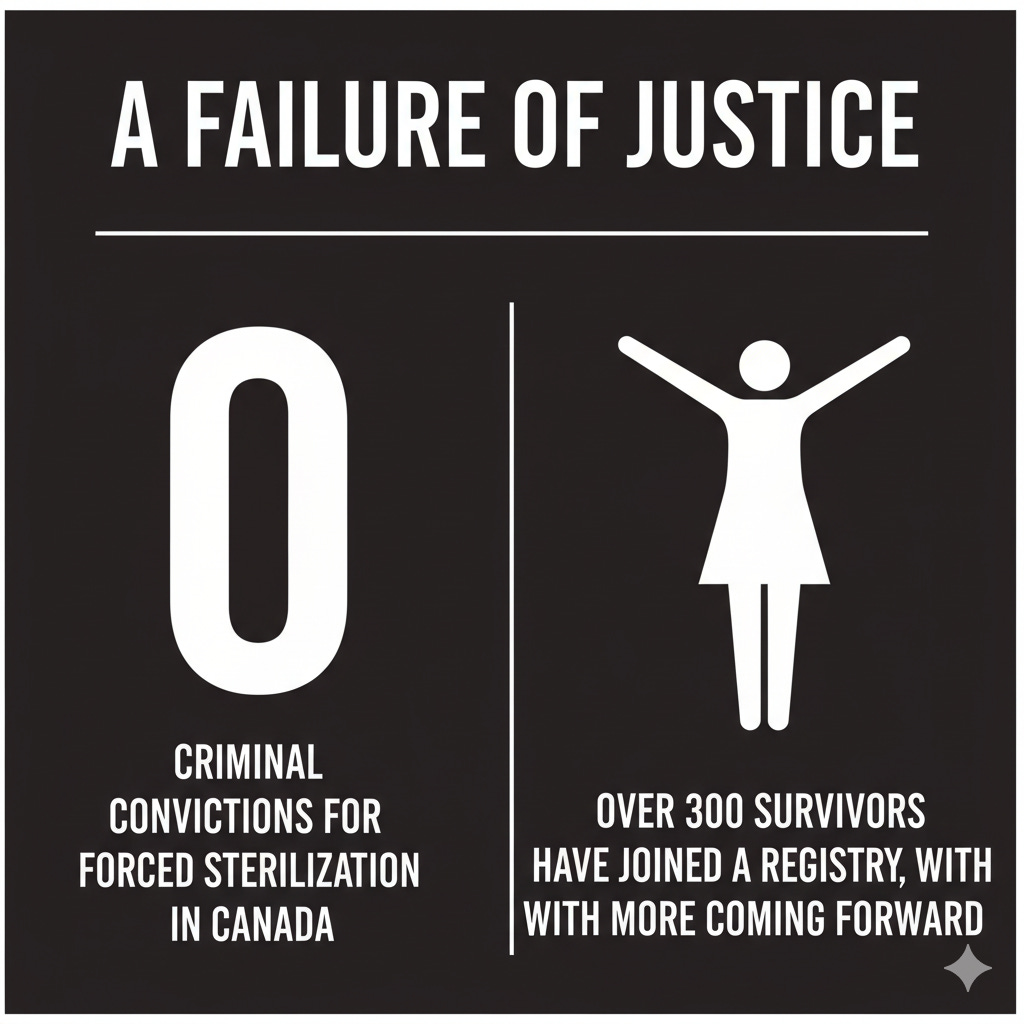
This was the testimony of Nicole Rabbit, a survivor whose mother and niece were also sterilized without consent. Senator Boyer also described the experience of Sylvia Tuckanow, who was restrained and sterilized immediately after giving birth while crying and begging the medical staff to stop. These stories are devastating, and they are far from unique. Senator Boyer notes her office has spoken with hundreds of women, with a formal survivors’ registry now numbering over 300 and growing.
What Senator Gerba’s testimony adds is a crucial dimension. This is not an issue that affects only those who are vulnerable in obvious ways. She is a successful, educated businesswoman and a member of the Senate. Yet, inside the healthcare system, she experienced a complete violation of her bodily autonomy.
I realized that systemic racism does not differentiate between educated and uneducated women or wealthy and poor women. It affects all Indigenous and racialized women, because when we enter the health care system or the justice system, we are viewed in one and the same way: with suspicion, indifference and too little consideration.
This points to a systemic failure. The system itself has proven incapable of protecting the fundamental rights of certain citizens within a medical context. This failure is not just ethical, it is legal.
The Analogy of the Legislative Blind Spot
Think of our legal system as a large vehicle. It has a comprehensive set of rules and protections, like a wide windshield offering a clear view of most dangers. But it also has blind spots, specific areas where its design prevents it from seeing a particular type of harm. Forced sterilization sits in one of these blind spots.
In theory, performing surgery without consent should be covered by the Criminal Code’s existing provisions on assault, particularly aggravated assault. In practice, it is not. The medical setting creates a unique power dynamic and a veneer of legitimacy. A doctor can claim a procedure was “necessary,” and the legal definition of consent can become murky, especially when a patient is in a vulnerable state, such as during childbirth.
Here is the detail I find most revealing: despite thousands of documented cases across Canada for decades, Senator Boyer confirmed a staggering fact.
Not one doctor in Canada has ever been criminally convicted for forced sterilization.
Civil lawsuits are proceeding, but these provide compensation after the fact. They do not function as a deterrent in the same way a criminal conviction would. The professional consequences are also shockingly lenient. Senator Boyer cited the case of a doctor in Yellowknife who, in 2019, removed both fallopian tubes from an Inuk woman without her consent. His penalty was a five-month suspension and a fine. He continues to practice medicine. The lack of criminal accountability sends a clear message. This action is seen as a breach of professional ethics, not a violent crime. The law’s blind spot effectively shields perpetrators from true justice.
Installing the Mirror: The Simplicity of Bill S-228
When you discover a blind spot on a vehicle, you install a new mirror. You make a simple, targeted adjustment to make the unseen visible. This is precisely what Bill S-228 proposes to do for the Criminal Code.
The bill is not a complex overhaul. It is a short, 14-line amendment. Its purpose is to add a “for greater certainty” clause to the existing section on aggravated assault. This clause would explicitly state that a sterilization procedure performed on a person without their consent constitutes a form of wounding or maiming under the law.
This change does two critical things. First, it removes all ambiguity for prosecutors and judges. The specific act is named as a crime, eliminating the grey area that has prevented charges. Second, it sends an unmistakable signal to the medical community. Performing this procedure without explicit consent is not a professional misstep, it is a criminal act with severe consequences. The bill is carefully written to protect doctors who must act in genuine life-threatening emergencies and does not interfere with voluntary access to sterilization or gender-affirming care. It targets one specific violation: the removal of a person’s right to choose.
The Principle of Explicit Protection
A just society does not assume its laws are sufficient. It listens for evidence of their failure. The testimony of survivors makes it clear that our laws have failed. The state has a fundamental duty to protect the bodily autonomy of every citizen, and this duty is most critical when a significant power imbalance exists, as it does between a doctor and a patient. When a system repeatedly allows the violation of the powerless by the powerful, the law must become more explicit. True justice requires not only a set of general rules but a willingness to name and prohibit specific, recurring evils.
In Other News...
Beyond this deep dive, you can find more analysis and commentary on the On Hansard site.


Sources:
Parliament of Canada. (2025, October 1). Debates of the Senate (Hansard), 154(20).