


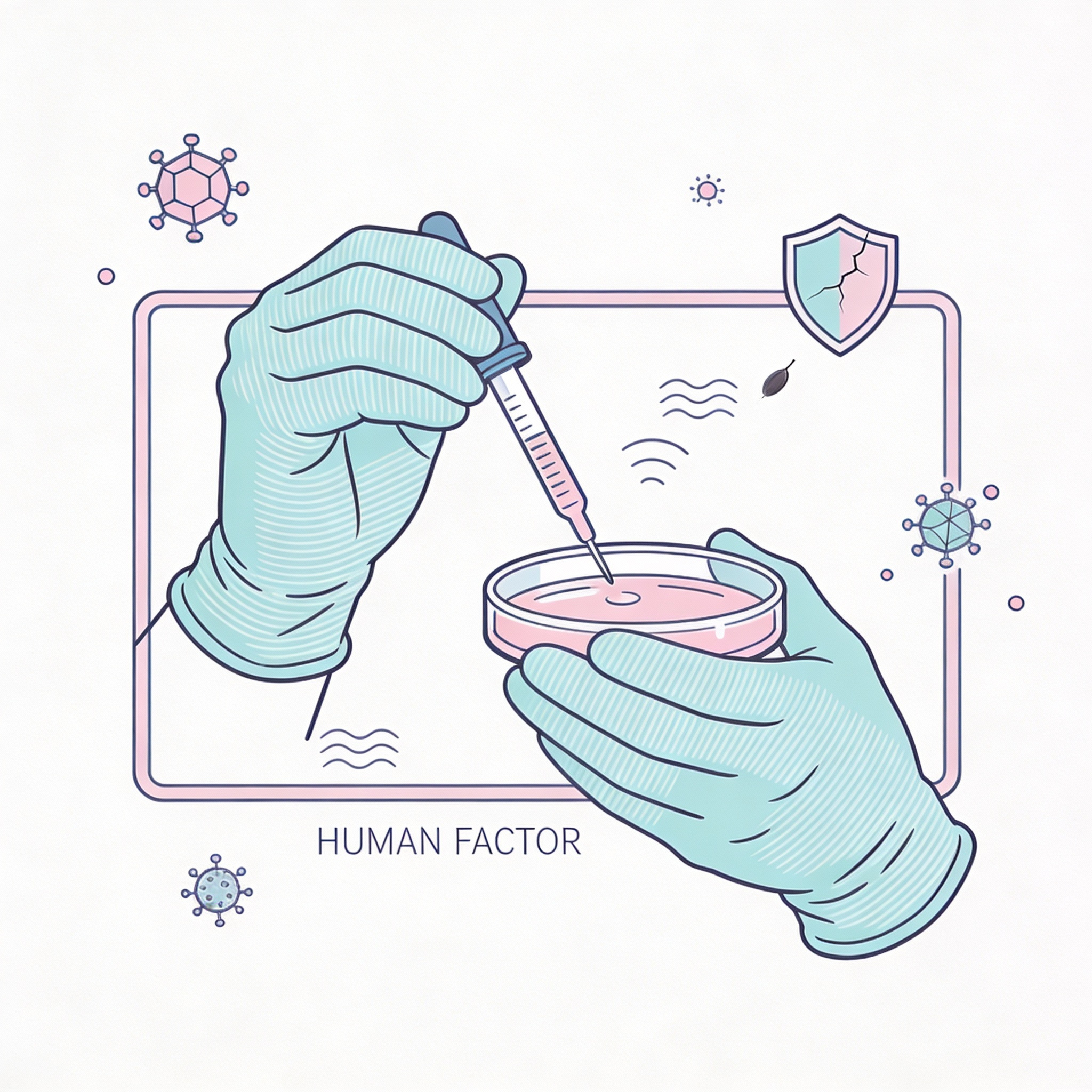
The air in a containment laboratory is designed to move in a single, predictable direction. It flows inward, pulled through high-efficiency particulate air filters, creating an invisible curtain between the scientist and the sample. This is the negative pressure environment of Canada’s biological safety infrastructure, a system built to keep the world’s most dangerous pathogens from escaping into the hallway. But a new federal report suggests that inside these controlled environments, the human variable is becoming increasingly unpredictable.
In 2024, the calculated rate of laboratory exposure incidents rose significantly. Across the country, 71 confirmed exposure incidents occurred within licensed facilities, affecting 132 individuals. These are not theoretical risks. They are shattered vials of bacteria, needle sticks involving contaminated blood, and malfunctions in the very cabinets designed to protect the operator. While the public moves through a post-pandemic world, often assuming biological threats are contained behind steel doors, the data portrays a more fragile reality. The rate of exposure incidents has climbed to 67.5 per 1,000 active licenses, a number that surpasses pre-pandemic levels.
The incidents paint a picture of a workforce under strain. The Public Health Agency of Canada, through its Laboratory Incident Notification Canada system, tracks every slip and spill involving human pathogens. The 2024 surveillance data reveals that the public health sector itself—the very institutions tasked with safeguarding the population—reported the highest rate of exposure incidents. These breaches are rarely the result of catastrophic equipment failure. Instead, they are the result of human factors. They are the product of procedural shortcuts, fatigue, and the inherent danger of handling the microscopic building blocks of disease.
The Microbiology of Human Error
The narrative of a laboratory accident often conjures images of Hollywood alarms and flashing lights, but the reality is far more mundane and terrifying. The report details that the majority of these exposures happen during routine microbiology work. A technician is identifying a culture on an open bench rather than within the safety of a cabinet. A hand moves too quickly. A sharp object is mishandled.
In 2024, the most frequently cited root cause for these exposures was human error, accounting for 62 percent of incidents. Standard operating procedures were either ignored or followed incorrectly in nearly 40 percent of cases. This suggests a drift in discipline or perhaps a complacency born of routine. The text-based descriptions of these events are chilling in their simplicity. Words like “plate,” “tube,” “spill,” and “glass” dominate the incident reports.
Specific pathogens appear repeatedly in the data. Brucella melitensis, a bacteria that can cause debilitating fevers and inflammation, was one of the most commonly implicated agents. Neisseria meningitidis, responsible for life-threatening meningitis, was another. These are not benign organisms. They require precise handling, yet the data shows that technicians and technologists—the backbone of the laboratory workforce—are the ones bearing the brunt of these exposures. They account for over 76 percent of the affected individuals.
The qualitative analysis of these incidents reveals a troubling trend. Procedures that should be confined to biological safety cabinets are migrating to open benches. Face protection is being neglected. The report notes that while gloves and lab coats are standard, eye protection and masks are worn less consistently. In a high-stakes environment, these small lapses in protocol accumulate until the barrier between the worker and the pathogen collapses.
The Superbug in Ontario
The stakes of these laboratory breaches are amplified when one considers the evolving nature of the pathogens themselves. While labs struggle with containment, the bacteria they study are becoming harder to kill. A separate case report from Ontario, released alongside the laboratory incident data, provides a stark example of what is at risk.
A young male patient walked into an Ontario clinic with standard symptoms of a sexually transmitted infection. He had no history of travel. He had not left the province. Yet, when the laboratory analyzed the Neisseria gonorrhoeae cultures, they found something alarming. The strain was non-susceptible to ceftriaxone, the primary antibiotic used to treat the infection.
Genomic sequencing revealed that the isolate was closely related to the FC428 clone, a multidrug-resistant superbug previously identified in Asia. It harbored the mosaic penA60 allele, a genetic mutation that acts as a shield against cephalosporins. The implications are profound. This was not an imported case brought in by a traveler returning from abroad. This was a locally acquired infection. A drug-resistant superbug is now circulating within the community in Ontario, largely undetected.
This case connects directly back to the risks in the laboratory. As pathogens like Neisseria evolve to survive our best drugs, the laboratories tasked with studying them become even more critical. The technicians handling these samples are not just dealing with routine infections; they are handling organisms that, if released or contracted, offer few treatment options. The report on the Ontario patient notes that while he was successfully treated with a combination of therapies, the detection of such a strain without travel links suggests a silent transmission chain that public health authorities have yet to fully map.
The Screen at the Border
While laboratories form the inner wall of defense, the outer wall is the screening of migrants and newcomers. The federal reports highlight a massive logistical effort to catch infectious diseases, specifically tuberculosis, before they can take root in the general population. Canada has a low domestic incidence of tuberculosis, yet the disease persists, driven largely by the reactivation of latent infections in people born outside the country.
In Alberta, a four-year evaluation of a new enhanced screening initiative offers a glimpse into the mechanics of this defense. The program targeted migrants with specific risk factors—those with HIV, renal disease, or recent contact with infectious cases. The results were a mix of high success and bureaucratic redundancy.
Of the 179 referrals made to Alberta tuberculosis services, not a single individual developed active disease. The preventative treatment completion rates were exceptionally high, hovering near 95 percent. This is a victory for public health. It proves that when the system identifies a risk and offers a solution, people accept it. The migrants involved were willing participants in their own healthcare, trusting the system to protect them.
However, the machinery of the state is not without friction. The evaluation found significant inefficiencies. Nearly two-thirds of the individuals referred had to undergo repeated testing because their immigration medical exam results were either missing or recorded qualitatively rather than quantitatively. Furthermore, over a third of the referrals were for individuals who were already known to the provincial health system. This duplication of effort represents a significant drain on resources in a system that is already stretched thin.
A parallel study in New Brunswick reinforced the importance of the human element in this screening process. In a province seeing a rise in immigration from tuberculosis-endemic regions, the healthcare system faced the challenge of managing latent tuberculosis infections without a dedicated immigrant health clinic. Despite this, they achieved treatment acceptance rates of over 92 percent.
The key to this success was not just medication; it was navigation. Immigrant-serving organizations acted as the connective tissue between the newcomers and the rigid structures of the healthcare system. They helped schedule appointments, explained the concept of refills, and provided translation services. When the medical system felt opaque or intimidating, these community organizations built a bridge of trust.
The Architecture of Trust
The concept of trust appears as a unifying theme across these disparate reports. Whether it is a laboratory technician trusting a safety protocol, a patient trusting a diagnosis, or a migrant trusting a government screening program, the entire public health apparatus relies on a foundation of psychological confidence.
A national survey included in the federal release quantifies this intangible asset. The study found that trust in one’s community is the single most potent predictor of whether an individual will adhere to public health measures. It is not fear of government fines or blind faith in political leaders that drives compliance. It is the belief that one’s neighbors are also doing the right thing.
The survey data is stark. Nearly 90 percent of respondents who believed their community was following health guidelines reported adhering to them as well. When that trust in the community evaporated, adherence plummeted to below 30 percent. This has profound implications for how safety is managed, both in the public sphere and inside high-containment laboratories.
If laboratory safety is viewed as a collective community responsibility within the workplace, adherence to standard operating procedures is likely to be high. But if that culture of mutual trust fractures—if technicians believe their colleagues are cutting corners or that management is prioritizing speed over safety—the data suggests that individual compliance will degrade. The rise in human error cited in the laboratory incident report may be a symptom of a broader erosion in this culture of safety.
The Fragile Shield
The synthesis of these reports presents a sobering view of Canada’s biological defense network. It is a system staffed by dedicated professionals who are nonetheless prone to fatigue and error. It is a system detecting drug-resistant pathogens that are outpacing our pharmaceutical arsenal. And it is a system attempting to screen a growing population of newcomers through administrative processes that are often redundant and disconnected.
The increase in laboratory exposure incidents is a warning light on the dashboard. It signals that as the pace of research accelerates and the pressure on the public health sector mounts, the basic protocols that keep workers safe are fraying. The confirmed exposure of 132 individuals in a single year is a statistical anomaly that demands attention.
Simultaneously, the undetected transmission of ceftriaxone-resistant gonorrhea in Ontario demonstrates that the threats are already inside the gates. The laboratory is not just a place of study; it is a frontline. The technicians dropping vials or pricking fingers are handling organisms that have evolved to defeat our best defenses.
The path forward, according to the findings in New Brunswick and Alberta, lies in integration and support. Just as migrants needed navigators to help them complete tuberculosis treatment, laboratory workers may need renewed support systems to reduce error rates. The human factor cannot be eliminated, but it can be managed.
As Canada moves toward its goal of eliminating tuberculosis and managing emerging threats, the reliability of its laboratories is non-negotiable. The containment of dangerous pathogens relies on a chain of custody that is only as strong as its weakest link. Right now, that link is the exhausted human hand holding the pipette.
Source Documents
Abalos, C., Gauthier, A., Davis, A. N., Ellis, C., Balbontin, N., Kapur, A., & Bonti-Ankomah, S. (2023). Surveillance of laboratory exposures to human pathogens and toxins, Canada, 2022. Canada Communicable Disease Report, 49(9), 398–405.
Government of Canada. (2024). Human Pathogens and Toxins Regulations.
Heffernan, C., Jamro, A., Egedahl, M. L., & Long, R. (2025). Evaluating Canada’s initiative of enhanced screening for tuberculosis infection in migrants: Implementation lessons from Alberta. Canada Communicable Disease Report, 51(10/11/12), 381–388.
Komorowski, A. S., Eshaghi, A., Burbidge, J., Johnson, K., Saunders, A., Zygmunt, A., Hasso, M., Almohri, H., Martin, I., Patel, S. N., & Tran, V. (2025). Detection of non-travel-associated, ceftriaxone non-susceptible Neisseria gonorrhoeae FC428-like harbouring the mosaic penA60 allele in Ontario, Canada. Canada Communicable Disease Report, 51(10/11/12), 420–426.
Public Health Agency of Canada. (2025). Canada Communicable Disease Report, 51(10/11/12).
Seeman, N., Trent, J., & Murty, K. (2025). Trust in community as a predictor of public health measure adherence: Insights from a national Canadian survey. Canada Communicable Disease Report, 51(10/11/12), 413–419.
Shamputa, I. C., Nguyen, D. T. K., Mackenzie, H., Gaudet, D. J., Harquail, A., Barker, K., & Webster, D. (2025). Treatment of tuberculosis infection among immigrants in southern New Brunswick, Canada: A cross-sectional study. Canada Communicable Disease Report, 51(10/11/12), 389–400.
Tran, E. F., Gauthier, A., Davis, A. N., Abalos, C., & Bonti-Ankomah, S. (2025). Surveillance of laboratory exposures to human pathogens and toxins, Canada, 2024. Canada Communicable Disease Report, 51(10/11/12), 401–412.
Wong, E., Baclic, O., Salvadori, M. I., & Hildebrand, K. (2025). Summary of the National Advisory Committee on Immunization (NACI) Statement: Recommendations on the use of pneumococcal vaccines in adults, including Pneu-C-21. Canada Communicable Disease Report, 51(10/11/12), 375–380.