


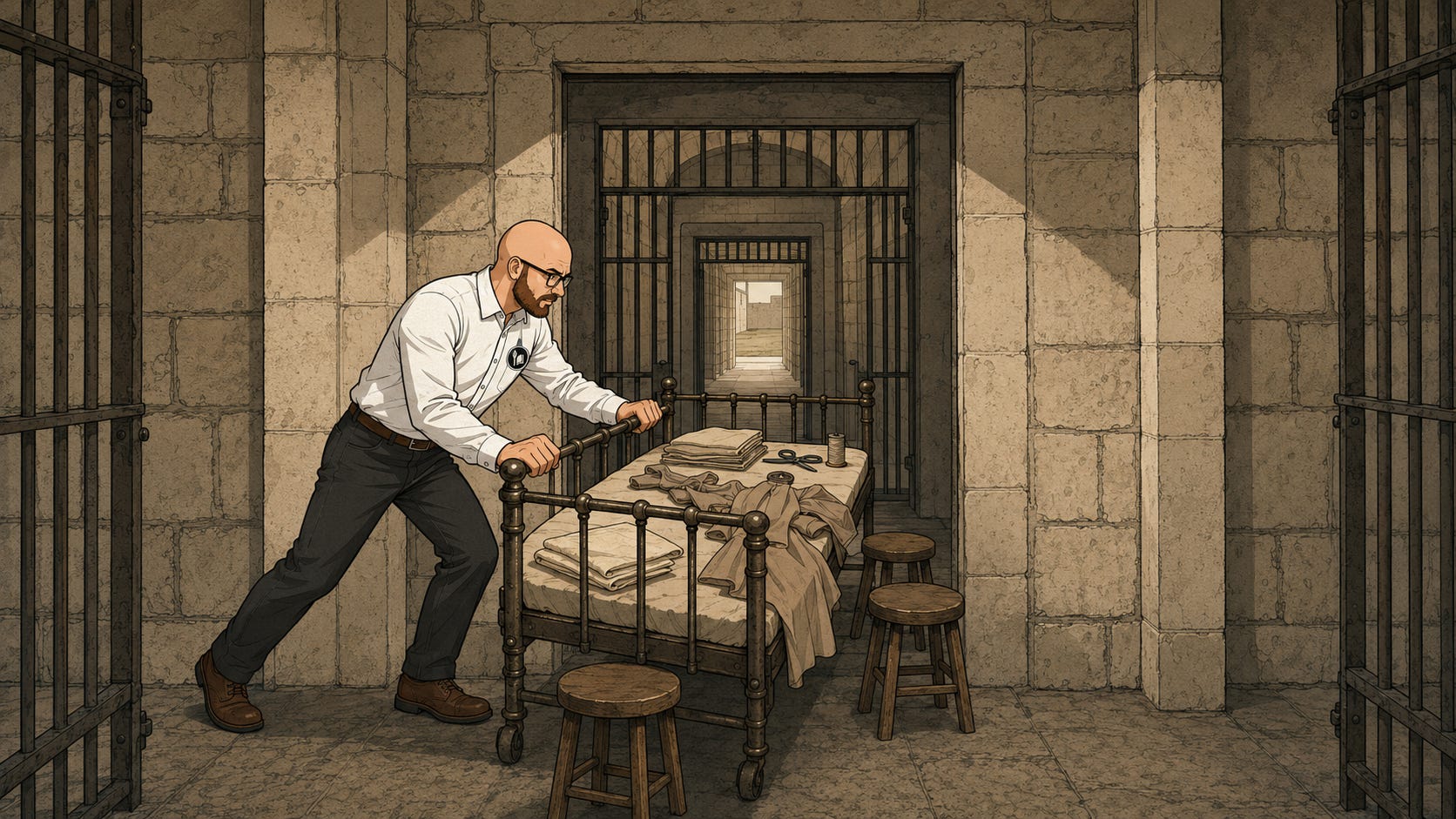
In September 1835, Susan Turner, Hannah Downes and Hannah Baglen arrived at Kingston Penitentiary to serve sentences of one to two years for larceny. The warden was not ready for them.
The institution had opened that June. Its first six prisoners had been put to work finishing the place that confined them. Women were expected eventually, but Warden Henry Smith had not expected them so soon. He had no separate prison ready.
The three women went into the hospital.
That temporary arrangement lasted until 1839.
The account appears in the Correctional Service of Canada’s 1985 history, Kingston Penitentiary: The First Hundred and Fifty Years, 1835–1985. The book traces a century of women’s imprisonment inside an institution built around men, along with a long sequence of reports saying the arrangement should end.
It took 99 years.
The hospital became the women’s quarters
Turner, Downes and Baglen started work as seamstresses. They stayed in the hospital because the institution needed to keep them apart from the men and had nowhere else to put them.
In 1839, part of the North Wing became the first designated prison for women. That solved the immediate placement problem. It did not produce a suitable institution.
The women moved several times as their numbers grew. By 1858, eight were sleeping in a corridor because there were not enough cells. That year, inspectors stated that female prisons should never be located within the boundary walls of other prisons.
The recommendation was clear. The women stayed.
At Confederation, Kingston held 60 female prisoners. An 1867 inspectors’ report called for a proper women’s prison outside the penitentiary walls. It proposed either buying land to the east or using prison land to the north. No additional land was bought.
The institution continued to put the women to work. In 1872, Matron Mary Leahy reported that their labour had produced 201 aprons, 34 sun bonnets, 406 pillowcases and 1,480 pairs of socks. She recorded earnings of $1,560.20 and cash receipts of $684.40.
The following year, the female population fell to 15. Leahy reported that the women had spent a combined 14 days in solitary confinement on bread and water.
Reports named the problem
The accommodation did not escape official notice.
Inspector James G. Moylan wrote in 1889 that he had always considered the women’s section unfit. He cited its proximity to the men’s prison and described underground cells in a gloomy and dismal compartment.
Four years later, he called the cells and laundry “a wretched makeshift.”
The institution also housed mothers. The history records that several babies were born to women imprisoned at Kingston, though the pregnancies began before admission. In some cases, infants stayed with their mothers in their cells. If the sentence ran too long and a pardon or parole was denied, the child went to an orphanage, a relative or a foster home.
The prison’s disciplinary regime reached girls as well. The 1849 Brown Commission reported that girls as young as 12 were repeatedly lashed for the same minor offences as boys. The 1985 history says corporal punishment continued for female prisoners as long as it did for males.
The conditions were documented. So was the proposed remedy. Still, the women remained inside Kingston’s walls.
A separate block inside the same prison
For most of that period, the senior officer responsible for the women was the matron. She lived with them in the women’s section and was paid less than male officers. Rose Fahey took charge in 1886 and remained through five wardens. In 1914, after nearly 30 years of service, her annual salary was $700. The lowest-paid guard received $800. The warden received $2,800.
The female population was usually small, but it was not stable. Fahey reported 10 women in 1914 and 25 the next year after nine arrived from Edmonton. The history says she never had as many as 40 in her custody at once. Fahey lived with the women in quarters on the upper floor of the Northwest Cell Block.
In 1909, authorities decided to construct a separate prison for women. It was separate in one sense only. The building would still stand inside Kingston Penitentiary.
Male prisoners built it. In February 1913, the women moved into the Northwest Cell Block, just inside the North Gate. The block held 32 regular cells and two double cells for sick prisoners. Within a few years, 40 women were living there.
The new quarters did not settle the matter. In 1914, a royal commission reported favourably on the building, then said everyone’s interests would be better served if the women were transferred to an institution for women. The commissioners suggested that provincial authorities might house female offenders.
That recommendation would recur. Provincial prisons already held women serving sentences of less than two years. The unresolved question was where to confine women serving federal sentences.
In 1920, another report to the minister of justice said women should be confined in a completely separate institution, out of view of the male penitentiary. A later report recommended a prison “outside and away a bit from the male prison.”
By then, the first inspectors’ call to remove the women from inside a men’s prison was more than 60 years old.
Beyond the walls
Construction of the Prison for Women began in May 1925. Convict labour was used again. The site was north of Kingston Penitentiary, behind the warden’s residence.
The building did not immediately become a women’s prison. It first housed an overflow of men from Kingston Penitentiary for about a year.
Women entered it on January 24, 1934.
The move placed them beyond the confines of the male institution for the first time. Ninety-nine years had passed since Turner, Downes and Baglen arrived and were placed in the hospital.
They had been followed by women housed in a wing, an underground section that an inspector called unfit, and a separate cell block that remained inside the men’s penitentiary. Reports in 1858, 1867, 1889, 1893, 1914 and 1920 had identified the accommodation problem or called for a separate institution.
The 1934 move answered the oldest part of that record. Women finally had their own prison.
It stood only a short distance from the hospital where the first three had been placed.
Hansard Files reads the reports behind Canada’s institutions, then follows what happened after the recommendation was filed.
Source Documents
Curtis, D., Graham, A., Kelly, L., & Patterson, A. (1985). Kingston Penitentiary: The first hundred and fifty years, 1835–1985. Correctional Service of Canada.
Mike, another excellent report. It is quite depressing to know how slow government resolves real issues. Sixty-two (62) years of repeated reports before a separate building was constructed to house women prisoners. Shocking!
I toured the Kingston Penitentiary last summer and learned a bit about why the women were housed in the hospital.
But Mike - no mentions of that wage disparity and horrendous conditions.
Thank you for being this to fresh eyes.