


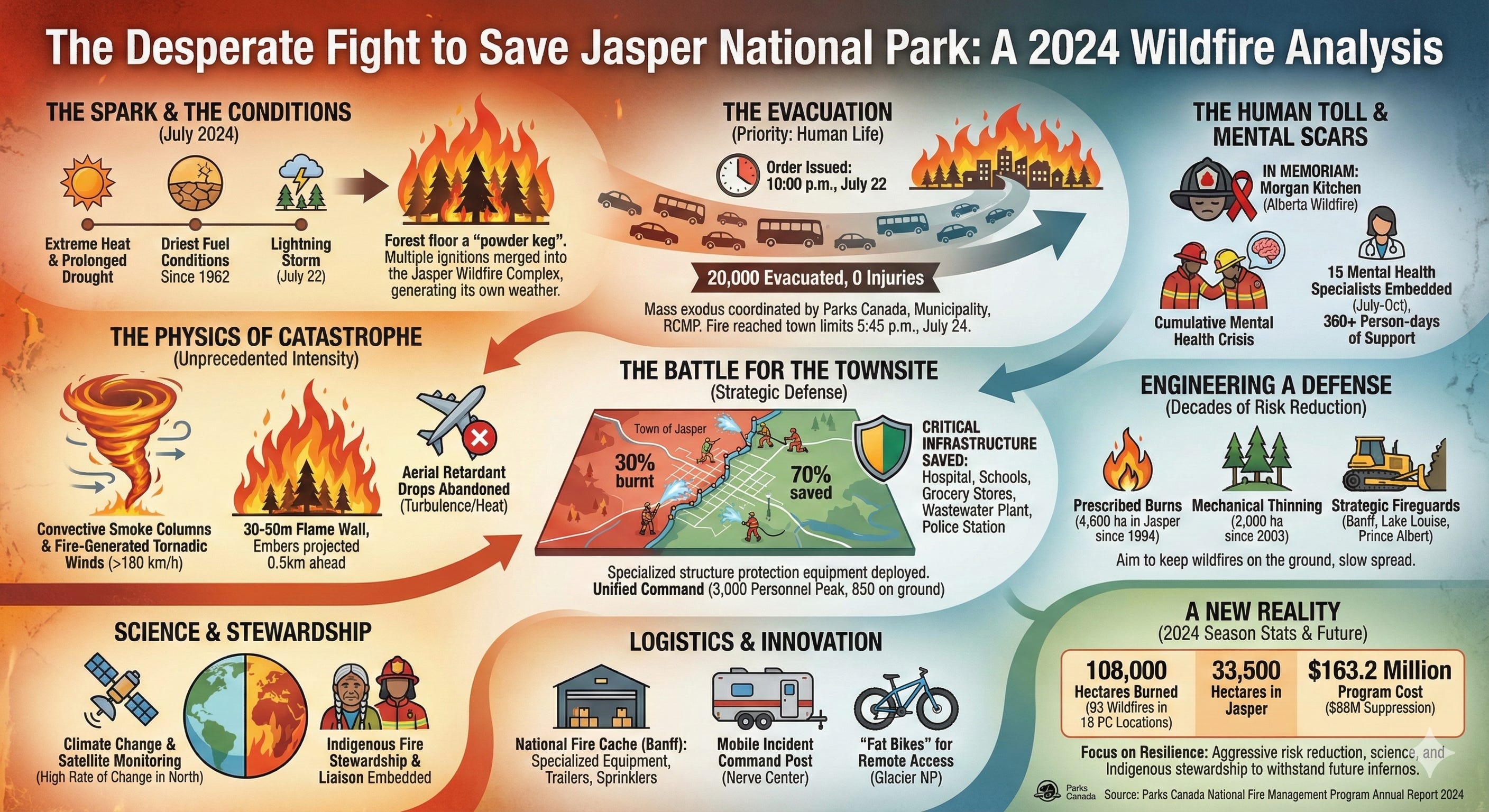
By mid-July 2024, the forest floor of Jasper National Park had become a powder keg. A prolonged period of extreme heat had baked the landscape, resulting in the driest fuel conditions recorded since data collection began in 1962. The stage was set for a catastrophe that would redefine Canadian wildfire management. On the evening of July 22, a single lightning storm ignited the fuse, sparking multiple blazes that would merge into the Jasper Wildfire, a complex so intense it generated its own weather systems and forced the evacuation of 20,000 people.
The speed of the devastation was absolute. Within minutes of the first strike north of the community, three additional fires sparked to the south. Fanned by wind gusts reaching 85 kilometres per hour, the southern fires coalesced into a single, unstoppable entity. In just four hours, the blaze consumed 3,000 hectares. This was not a standard forest fire. It was a wall of flames ranging from 30 to 50 metres high, projecting embers half a kilometre ahead of the main front and igniting spot fires that made containment physically impossible.
The Physics of Catastrophe
The 2024 annual report from Parks Canada details a situation where traditional suppression tactics were rendered obsolete by the sheer physics of the event. By July 24, the fire behavior had escalated beyond extreme. Portions of the blaze developed into convective smoke columns, atmospheric phenomena that occur when the heat of a fire is so intense it overrides the local weather patterns. Inside these columns, the fire generated internal winds exceeding 180 kilometres per hour.
These fire-generated tornadic winds possessed enough force to uproot healthy, mature trees. Entire root systems of trees over 300 years old were ripped from the earth. The conditions were so volatile that aerial retardant drops, usually a staple of wildfire suppression, had to be abandoned. The turbulence and zero visibility made it unsafe for aircraft to operate, and the radiant heat was so severe that water or retardant evaporated before it could reach the ground.
As the fire roared toward the townsite, the priority shifted entirely to the preservation of human life. The evacuation order issued at 10:00 p.m. on July 22 triggered a mass exodus. In a testament to the coordination between Parks Canada, the Municipality of Jasper, and the Royal Canadian Mounted Police, over 20,000 residents and visitors were evacuated without a single injury during the exit. The logistical feat saved thousands of lives, clearing the path for the fire which reached the town limits at 5:45 p.m. on July 24.
The Battle for the Townsite
When the wildfire breached the community, the destruction was swift. By 10:00 p.m. that night, nearly one third of the structures in Jasper had been lost to the flames. The images captured in the aftermath showed rows of homes reduced to ash, a visual scar on one of Canada’s most beloved national parks. However, the narrative of total destruction belies a significant defensive victory achieved by the firefighters who stood their ground.
While 30 percent of the town burned, 70 percent was saved. The report highlights that critical infrastructure identified as “values at risk” prior to the fire remained intact. The wastewater treatment plant, the hospital, schools, grocery stores, fuel stations, and the police station were all defended successfully. Two-thirds of Jasper’s homes were spared. This was not an accident of wind direction but the result of tactical deployment. Specialized structure protection equipment and crews were positioned to defend these vital facilities, ensuring that the town remained viable for re-entry once the smoke cleared.
The scale of the response was massive. Under a Unified Command structure, more than 3,000 personnel from across Canada and international partners mobilized to fight the Jasper Wildfire Complex. At the peak of the operation, 850 personnel were on the ground simultaneously, supported by a fleet of helicopters and air tankers. This coordinated effort was the only thing that prevented the total loss of the municipality.
The Human Toll and Mental Scars
The physical cost of the 2024 fire season was staggering, with Parks Canada spending $163.2 million on fire management, $88 million of which was dedicated directly to suppression. Yet the report makes clear that the human cost was far higher. The tragedy of the season was marked by the death of Morgan Kitchen, a wildland firefighter from Alberta Wildfire. Based out of Rocky Mountain House, Kitchen lost his life while performing critical operations on the Jasper wildfire. His death served as a devastating reminder of the lethal risks inherent in wildland firefighting.
The psychological impact on the first responders was profound. Crews faced the trauma of witnessing the destruction of homes and communities they were sworn to protect. They balanced these operational responsibilities with the personal toll of displacement and the grief of losing a colleague. Recognizing the severity of the mental strain, Parks Canada deployed specialized Mental Health Professionals through a service agreement with Health Canada.
From July 23 to October 23, fifteen mental health specialists were embedded with the incident management teams, logging more than 360 person-days of support. These teams provided crisis management and counseling to over 2,000 personnel involved in the Unified Command and recovery efforts. The integration of psychosocial support into the operational structure acknowledges a shifting reality in fire management: the increasing intensity and duration of fire seasons are creating a cumulative mental health crisis among the workforce.
Engineering a Defense
While the Jasper wildfire dominated the headlines, the 2024 report emphasizes that the battle against wildfire is largely fought before the first spark ignites. Parks Canada has been engaged in a decades-long effort to alter the landscape to make it more resilient to fire, a strategy known as “risk reduction.” In Jasper alone, over 4,600 hectares of land had been treated with prescribed burns between 1994 and 2024. Since 2003, mechanical thinning and vegetation removal had been conducted on 2,000 hectares surrounding the townsite.
These measures, including the reinforcement of a community fireguard and a new guard at Signal Mountain, function as strategic lines of defense. By thinning the forest, managers aim to keep wildfires on the ground rather than allowing them to climb into the treetops where they gain intensity and spread via windblown embers.
This engineering approach extends across the national park system. In Banff National Park, crews made significant progress on the Tunnel Toe Wildfire Risk Reduction project, completing 80 hectares of a fire guard designed to protect the Banff townsite. Similarly, a massive fire guard in Lake Louise is being carved out to stretch nearly five kilometres across the Bow Valley. Once completed, this break will span from Mount St. Piran to the ski resort, acting as a critical barrier for the hamlet of Lake Louise.
Further east, in Prince Albert National Park, the Waskesiu Community Fuel Break utilizes a combination of harvesting and annual prescribed burns. Every spring, crews burn off dead grass to create a “green belt” of fresh growth that slows fire spread. These engineered landscapes are not absolute shields, as the Jasper event proved, but they provide the tactical windows necessary for suppression crews to operate and for communities to evacuate.
Science and Stewardship in the North
The changing climate is forcing Parks Canada to adopt new scientific and cultural approaches to fire management. In the Northwest Territories, a collaboration with the Canadian Forest Service has utilized satellite remote sensing and historical air photo analysis to track vegetation changes in Nahanni and Nááts’ihch’oh National Park Reserves. This region has experienced the highest rate of climatic change in North America over the last century.
The findings are stark. The research indicates varying degrees of forest resilience. While 90 percent of surveyed stands showed evidence of recovery after fires, some areas are experiencing “regeneration failure,” where trees simply do not grow back. However, the data also suggests a shift toward more fire-adapted species and, in some cases, increased growth rates in coniferous trees due to longer growing seasons and warmer temperatures.
Parallel to this western science is a renewed commitment to Indigenous Fire Stewardship. In 2024, Parks Canada hired a national Indigenous Fire Specialist to bridge the gap between the agency and Indigenous communities. This shift was operationalized during the Jasper wildfire, where an Indigenous Liaison was embedded in the National Incident Management Team. This role was critical in identifying culturally significant areas within the fire zone and ensuring that recovery plans respected Indigenous values. In Kluane National Park and Reserve, this collaboration saw Elders and Guardians working alongside fire crews to prepare for prescribed burns, reintegrating traditional knowledge into modern fire operations.
The Logistics of the Long War
Behind the frontline heroism lies a complex logistical machine centered at the National Fire Cache in Banff National Park. This facility serves as the arsenal for the country’s fire operations, maintaining a fleet of specialized trailers and equipment ready for rapid deployment. During the Jasper crisis, the Cache deployed facility protection trailers stocked with industrial sprinklers, pumps, and hoses used to wet down buildings in the path of the flames.
The 2024 season also saw the debut of the Mobile Incident Command Post, a self-supported trailer purchased in 2023 that functions as a nerve center for communications and dispatch. This unit, along with daily supply runs from the Cache, kept the suppression teams equipped with everything from radios to chainsaws. The scale of material consumption is immense; following the season, the Cache staff must inspect, repair, and restock thousands of items to ensure readiness for the next year.
Innovation also found its way to the fireline in unexpected forms. In Glacier National Park, crews utilized “fat bikes”—bicycles with oversized tires—to access a remote fire in the Beaver Valley. With helicopter landings difficult due to terrain, the bikes allowed firefighters to rapidly access the site via a trail, suppress the fire, and pedal out before sunset. It is a small example of the adaptability required in a field where conditions change by the hour.
A New Reality
The 2024 fire season concluded with staggering numbers: 108,000 hectares burned across 93 wildfires in 18 different Parks Canada locations. The Jasper Wildfire Complex alone accounted for 33,500 of those hectares. The total cost of the program reached $163.2 million, a figure that reflects the growing financial burden of climate adaptation.
The “Under Control” status achieved in Jasper on September 7 marked the end of the immediate crisis, but the recovery will take years. Hazardous trees must be removed, trails rebuilt, and infrastructure repaired. Yet, as the report concludes, the focus remains on resilience. Through a combination of aggressive risk reduction, scientific research, and the integration of Indigenous stewardship, the national program is attempting to pivot from a reactive stance to a proactive one. The fires of 2024 demonstrated that while the ferocity of nature cannot always be contained, the systems built to protect lives and heritage can withstand the inferno.
Source Documents
Parks Canada. (2024). National Fire Management Program Annual Report 2024.