


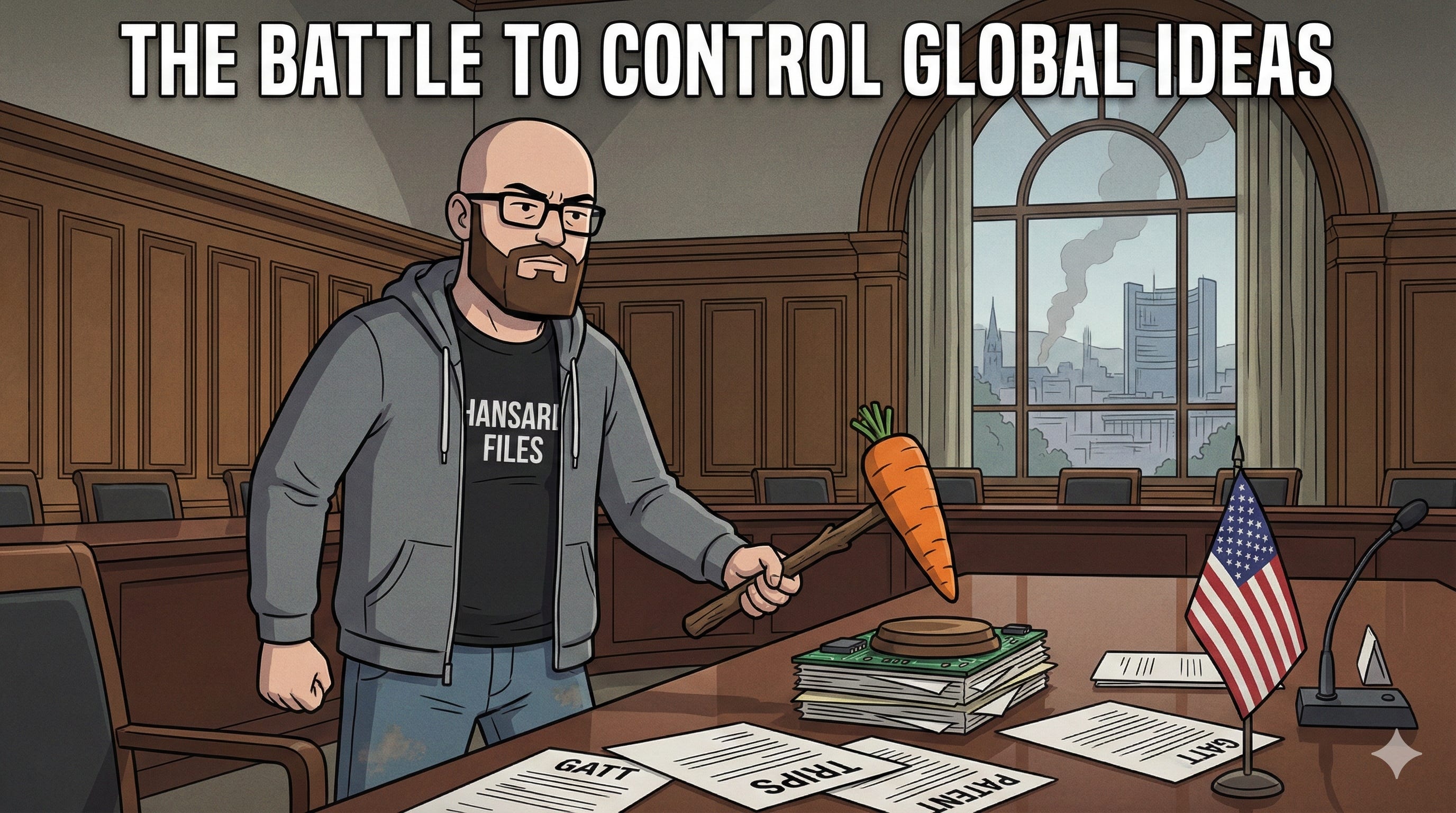
The atmosphere in Geneva in the late 1980s was charged with a tension that had little to do with the traditional commodities of global trade. For decades, diplomats had gathered in these halls to haggle over tariffs on steel, quotas on textiles, and the price of wheat. But as the Uruguay Round of negotiations began to take shape, a new and invisible asset had replaced raw materials as the primary currency of power. The United States had arrived with a grievance and a strategy that would fundamentally rewrite the rules of the global economy.
The issue at hand was intellectual property rights. For the American delegation, the situation had become untenable. Their economy was shifting rapidly from heavy manufacturing to high-technology services and creative industries, yet the international legal framework treated these assets with indifference. American software was being copied in Tokyo, their music tapes were being pirated in Singapore, and their pharmaceutical formulas were being replicated in Brazil. The existing systems meant to protect these ideas were toothless, relying on voluntary compliance that few developing nations had any incentive to offer.
Rodney de C. Grey, writing for the Institute for Research on Public Policy in March 1988, captured this pivotal moment in history. His analysis reveals a world on the precipice of the digital age, struggling to apply 19th-century laws to 20th-century technologies. The document serves as a roadmap to the aggressive, unilateral strategy the United States employed to force the world into compliance—a strategy that moved the protection of ideas out of the obscure offices of bureaucrats and into the high-stakes arena of trade warfare.
The Pirate Economy
To understand the ferocity of the American position, one must look at the landscape of the mid-1980s. The United States was the world’s leading innovator, but it was bleeding value at the borders. In markets like Indonesia and Singapore, unauthorized copies of music tapes and books were flooding the streets. These were not clandestine back-alley operations but booming industries operating in the open, fueled by a total lack of local copyright enforcement.
The problem extended far beyond entertainment. In the burgeoning world of computing, the lines between theft and competition were blurring. American companies found themselves in a legal gray zone when trying to protect their most valuable assets: the complex designs of semiconductor chips and the code that ran them. A shrewd competitor in a foreign market could legally register a trademark belonging to a US franchise before the American company arrived, effectively holding the brand hostage until a ransom was paid.
The United States described these practices as distortions of international trade. They argued that the failure to enforce intellectual property laws was no different than a tariff or a subsidy. It deprived innovators of their reward and artificially lowered the cost of production for foreign competitors. If a factory in Seoul could use stolen computer-aided design software while a factory in Detroit had to pay for it, the playing field was not level.
The Weaponization of Trade Law
The American solution was to stop treating intellectual property as a legal technicality and start treating it as a trade dispute. This was a radical shift in philosophy. Previously, intellectual property was the domain of the World Intellectual Property Organization, an agency that lacked the power to punish non-compliance. The United States wanted to move the jurisdiction to the General Agreement on Tariffs and Trade (GATT), where violations could be met with concrete retaliation.
Grey details how the US began to leverage its domestic laws to police the world. Section 301 of the Trade Act of 1974 became the primary weapon. It allowed the US administration to investigate “unfair” trade practices—including the failure to protect patents and copyrights—and retaliate unilaterally. The message to the developing world was stark: if you do not protect our software and our movies, we will tax your exports.
This approach was codified in the Trade and Tariff Act of 1984. The legislation explicitly linked the Generalized System of Preferences, which gave developing countries duty-free access to the US market, to their protection of intellectual property. It was a “carrot and stick” approach where the carrot was the massive American consumer market and the stick was economic isolation.
The Silicon Valley Problem
The report highlights the specific technological nightmares that drove this policy. The legal systems of the world were utterly baffled by the computer chip. Was a semiconductor design a “drawing” protected by copyright? Was it a “machine” protected by a patent? Or was it something entirely new?
Grey points to the “Video Games Case” at the US International Trade Commission in the early 1980s as a watershed moment. The Commission issued an exclusion order against Japanese imports that infringed on the copyright of a video game, effectively ruling that the code burned into a memory chip was a form of literary work. This decision extended copyright protection from the written page to the machine-readable silicon.
However, the technology was moving faster than the courts. As software evolved into “fourth-generation languages” that users could modify, the ability to define what was actually being owned became harder. The US responded with the Semiconductor Chip Protection Act of 1984, creating a hybrid form of property right specifically for “mask works,” the intricate stencils used to etch microscopic circuits. Crucially, this law offered protection to foreign companies only on the basis of reciprocity. If Japan wanted its chips protected in America, it had to protect American chips in Japan.
The High Cost of Establishment
While the battles over chips and tapes garnered headlines, a quieter but equally significant struggle was taking place in the services sector. Grey distinguishes between services that are “embodied” in goods—like a song on a record or a blueprint on a disk—and services that require a physical presence.
For industries like consulting engineering, banking, and franchising, the barrier to trade was often the “right of establishment.” A US consulting firm building a hydroelectric dam in a developing nation was not just exporting blueprints. It was exporting managerial know-how, organizational systems, and personnel. The trade disputes here often centered on the right of these professionals to enter the country and the right of the firm to set up a local office.
The report notes that for these industries, the protection of trade secrets and trademarks was paramount. A franchise giant like McDonald’s or a major hotel chain could not expand into a market where its brand name could be legally pirated by a local squatter. The “right to do business” was inextricably linked to the right to own the identity of that business.
The North-South Divide
The push to globalize intellectual property rights was not met with universal applause. Developing nations viewed the American agenda with deep suspicion. For countries in the “South,” the international patent system was often seen as a mechanism for the “North” to maintain a monopoly on technology and wealth.
In forums like the United Nations Conference on Trade and Development (UNCTAD), developing nations had long argued for a “transfer of technology” code. They believed that strict patent laws prevented them from accessing the tools they needed to modernize. They viewed the copying of pharmaceutical drugs or agricultural chemicals not as theft, but as a necessary step toward development and public health.
The US proposal to bring these issues under the GATT framework threatened to crush this resistance. By linking IP protection to trade sanctions, the US effectively removed the option for developing nations to opt out of the western property regime. The “special and differential treatment” that developing nations had historically enjoyed was being eroded by the new reality of a knowledge-based economy.
The Canadian Dilemma
Grey’s analysis places Canada in a precarious position between these two blocs. As a developed nation, Canada had a vested interest in the rule of law and the stability of the trading system. However, Canada was also a net importer of intellectual property and technology.
The Canadian government faced a delicate balancing act. On one hand, Canadian artists and software developers benefited from the American crusade against piracy in Asia. If the US Navy was going to clear the seas of pirates, Canadian merchants would sail safer waters. On the other hand, Canada had its own disputes with the US, particularly regarding the compulsory licensing of pharmaceutical drugs—a policy the US vehemently opposed.
The report suggests that Canada, like many other nations, would be swept up in the wake of the American initiative. The bilateral Free Trade Agreement being negotiated at the time would likely force a harmonization of intellectual property laws, bringing Canadian policy closer to the US model. The unilateral pressure exerted by Washington on third countries would eventually create a de facto global standard, whether other nations voted for it or not.
The Legacy of the Invisible War
The negotiations described in Grey’s 1988 report laid the foundation for the world we inhabit today. The aggressive linking of trade and intellectual property succeeded. The resulting agreement on Trade-Related Aspects of Intellectual Property Rights (TRIPS) became one of the pillars of the World Trade Organization.
Today, the idea that a software code or a genetic sequence is a tradeable asset protected by global sanctions is taken for granted. But as this document reveals, it was not an inevitable evolution. It was the result of a deliberate, high-stakes strategy by a superpower realizing that its future wealth lay not in what it could build, but in what it could invent. The era of the invisible war had begun, and the rules of engagement established in those smoke-filled rooms in Geneva continue to govern the global economy decades later.
Source Documents
Grey, R. de C. (1988, March). Services and Intellectual Property Rights. Institute for Research on Public Policy.
This is a valuable reminder that the global IP regime we now take for granted was not inevitable — it was constructed through trade pressure at a specific historical moment. For Canada, that settlement came with a lasting trade-off: we gained predictability and access to key markets, but at the cost of policy room to maneuver, particularly as a net importer of intellectual property.
That bargain made sense in the late 1980s. Its downstream effects — on pharmaceuticals, technology, and now data and AI — are still with us, and deserve closer examination in today’s policy debates.
Thank you Hansard, I am slightly better informed. A limitation of my tech knowledge. Would it be possible for you to explore the issue of the Digital Services Act and US opposition? That one I need help with.