


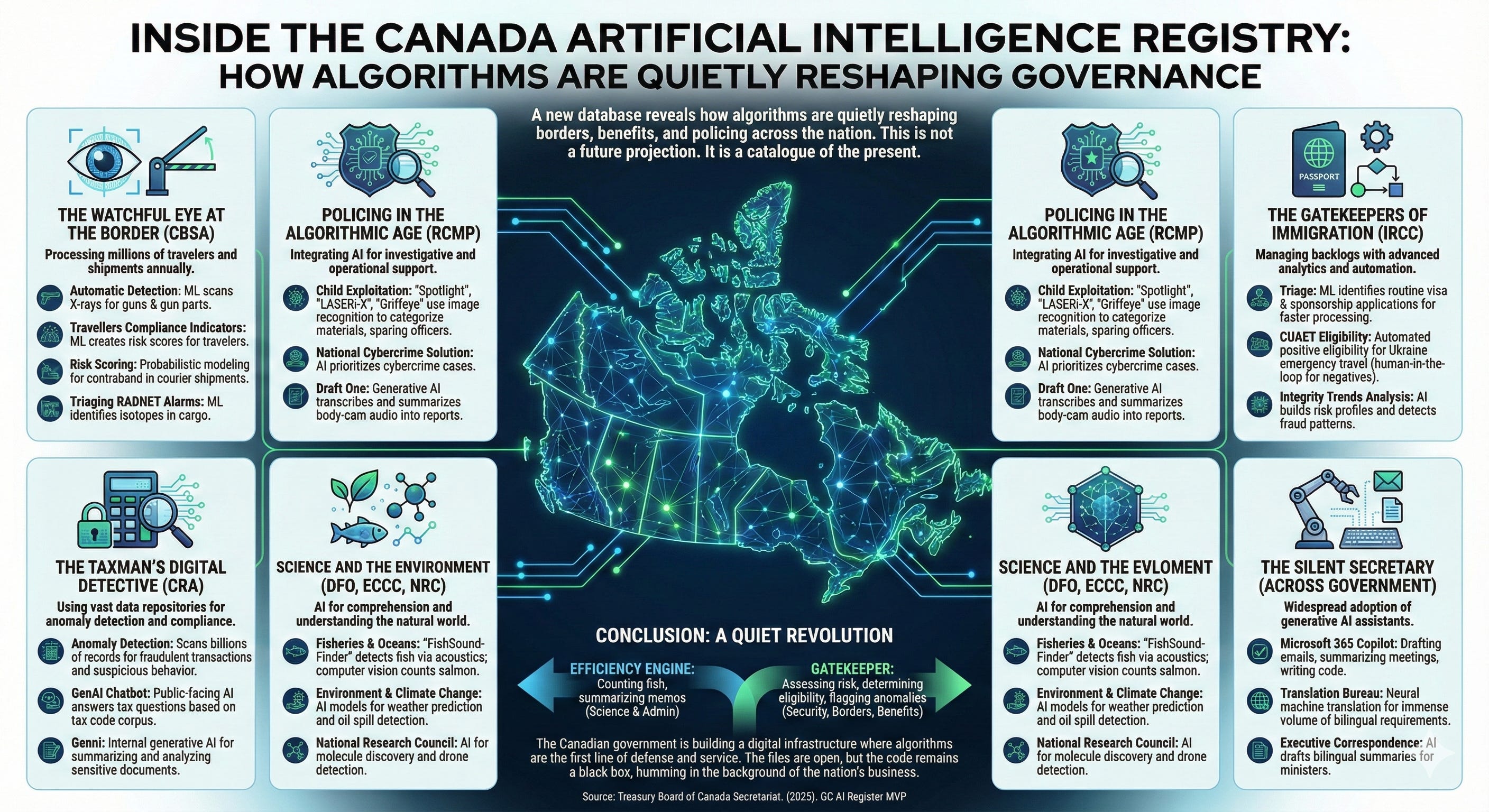
The modernization of the state is rarely a loud affair. It happens in server rooms and software updates, far removed from the marble halls where laws are debated. Yet a newly released dataset, the Canada Artificial Intelligence Registry, offers a rare glimpse into the digital nervous system now operating beneath the surface of the federal government. This is not a future projection. It is a catalogue of the present. Across dozens of departments, from the border to the tax office, artificial intelligence is no longer an experiment. It has become an active participant in the governance of the nation.
The registry details over a hundred distinct systems, some currently in development and others fully operational. They range from the mundane to the critical. Some are designed to summarize emails or translate documents, while others are tasked with detecting firearms in postal shipments or deciding which travelers require scrutiny. The scope is vast. It reveals a government that is rapidly outsourcing the heavy lifting of analysis, detection, and decision-support to machine learning models. As these tools proliferate, the line between human judgment and algorithmic suggestion is becoming increasingly fine.
The Watchful Eye at the Border
The Canada Border Services Agency stands at the forefront of this technological shift. The agency is currently tasked with processing millions of travelers and shipments annually, a volume that makes manual inspection physically impossible. The registry confirms that the agency is turning to machine learning to close the gap.
One of the most significant entries details a system for the “Automatic detection of guns and gun parts.” This tool, currently in development, utilizes machine learning algorithms to scan X-ray images of postal shipments. Its objective is singular. It seeks to identify the silhouettes of firearms and their components before they enter the country. This moves the border agency beyond random checks and human intuition, deploying a tireless digital eye that scans for specific shapes and densities that match known weapons.
The agency is also leveraging algorithms to assess the people crossing the border. A project titled “Travellers Compliance Indicators” uses machine learning to assist border officers in identifying travelers who are likely to comply with regulations. While the description is bureaucratic, the implication is significant. The system creates a risk score or a compliance probability, effectively sorting human beings based on data patterns before they even speak to an officer.
This digital sorting extends to cargo as well. The “Risk scoring for Courier Low Value Shipments” project applies probabilistic modeling to predict the likelihood of contraband within small packages. Similarly, the “Triaging RADNET alarms” system uses machine learning to assess radiation alarms from cargo containers, identifying specific isotopes to determine if a container poses a nuclear threat or merely contains benign medical equipment. These systems suggest a border that is becoming increasingly automated, where the primary filter for security is mathematical rather than human.
Policing in the Algorithmic Age
The Royal Canadian Mounted Police has also integrated artificial intelligence into its investigative toolkit. The registry highlights several systems designed to process vast amounts of digital evidence, specifically in the realm of child exploitation and human trafficking.
A tool named “Spotlight” is used to help locate and identify victims of human trafficking and child exploitation. The registry notes that while the platform possesses facial recognition capabilities, this specific functionality has been disabled for users within the national police force. The system instead relies on image and object recognition to find connections in open-source information. Similarly, the “LASERi-X” and “Griffeye” tools are deployed to categorize and classify images of child sexual exploitation. These systems use AI to pre-qualify images, sparing officers from the psychological toll of viewing known illegal material repeatedly. The machine views the horror so the human does not have to, flagging only new or unclassified material for review.
However, the police force is also exploring AI for operational support. The “National Cybercrime Solution” uses data categorization and entity recognition to coordinate complex cybercrime and fraud cases. It assesses the severity and solvability of incidents, effectively helping the police prioritize which crimes to investigate based on an algorithmic calculation of resources and probable success.
Perhaps most illustrative of the shift in policing is the introduction of “Draft One.” This software utilizes generative AI to transcribe audio from body-worn cameras and summarize the incident into a draft report. The officer reviews and finalizes the text, but the first draft of history—the initial police report—is now being written by a machine. This promises efficiency, reducing the hours officers spend typing in cruisers, yet it also introduces a layer of synthetic interpretation into the foundational documents of the justice system.
The Gatekeepers of Immigration
Immigration, Refugees and Citizenship Canada faces a perpetual backlog of applications. To manage this flow, the department has turned to advanced analytics and automation to triage and process files. The registry details multiple projects aimed at streamlining eligibility assessments for temporary resident visas, work permits, and spousal sponsorships.
The “Advanced Analytics Triage of Overseas Temporary Resident Visa Applications” uses machine learning to identify routine applications. These files are sorted for faster processing, allowing officers to focus their attention on complex cases. A similar system is in place for “Spouse or Common-Law Partner in Canada” applications. The objective is efficiency, but the mechanism involves analyzing large datasets to cluster patterns and predict outcomes.
The department is also using automation to determine eligibility for the Canada-Ukraine Authorization for Emergency Travel. The system is designed to automate positive eligibility determinations. It does not refuse applications. If the system cannot approve a file, it is routed to a human officer. This “human-in-the-loop” approach is a standard safeguard cited throughout the registry, designed to ensure that a machine never has the final word on a rejection. However, the system’s ability to fast-track certain profiles inevitably creates a two-tier process: the algorithmic express lane and the manual slow lane.
Furthermore, the “Integrity trends analysis tool” uses AI to identify fraud risks in temporary resident applications. By integrating data from various sources, the tool builds risk profiles and detects patterns indicative of fraud. This moves the department from reactive verification to proactive risk modeling, where the credibility of an applicant is assessed against a database of historical trends.
The Taxman’s Digital Detective
The Canada Revenue Agency sits on one of the largest repositories of personal and financial data in the country. The registry reveals that the agency is using this data to train sophisticated models for anomaly detection and compliance.
The “Anomaly Detection” project is designed to find fraudulent transactions within the agency’s secure portals. The system scans billions of historical records and access logs to identify suspicious behavior. It looks for digital fingerprints that do not match established patterns, flagging potentially fraudulent activity for review. This is a surveillance tool for the digital ledger, constantly monitoring the flow of interactions to spot the outlier.
The agency is also deploying “Business Intelligence” tools that use text analysis on worker classification and research. But the most direct application for the taxpayer is likely the “GenAI Chatbot.” This public-facing tool leverages large language models to answer tax questions. It represents a shift in service delivery, where the first point of contact for a confused citizen is an AI trained on the massive corpus of the tax code.
Internally, the agency uses a tool called “Genni.” This is a cloud-based solution that allows employees to use generative AI for tasks involving information classified up to “Protected B.” This includes creating summaries and analyzing documents that contain sensitive information. It signifies a high level of trust in the security of these models, allowing them to digest and process confidential government data to speed up bureaucratic workflows.
Science and the Environment
Beyond enforcement and administration, the registry highlights a significant adoption of AI in federal scientific research. These applications are often less about control and more about comprehension—using machine learning to understand the natural world.
Fisheries and Oceans Canada is utilizing a tool called “FishSoundFinder.” This open-source software uses machine learning to detect fish sounds in passive acoustic recordings. By listening to the ocean, the AI can estimate fish presence without the disturbance of physical nets or surveys. Similarly, the “automating salmon counting” project uses computer vision to watch underwater camera footage, counting and identifying species as they pass through fences. This automates a task that previously required thousands of hours of human observation.
Environment and Climate Change Canada is heavily invested in “AI for weather prediction.” The department is developing models that combine traditional forecasting with deep learning to improve the detection of severe weather events. They are also using AI for “automated oil spill detection,” analyzing satellite imagery to identify pollution in Canadian waters.
The National Research Council is pushing the boundaries even further with “AI for molecule discovery.” This project uses algorithms to sort through vast chemical spaces to identify molecules that could be used in clean energy applications or new medicines. They are also developing “drone detection” systems that use AI to identify the acoustic signature of drone propellers, distinguishing them from birds or other noise in cluttered environments.
The Silent Secretary
A recurring theme across almost every department in the registry is the adoption of “Microsoft 365 Copilot” and similar generative AI assistants. From the Department of Justice to Indigenous Services Canada, the government is rolling out tools that assist with drafting emails, summarizing meetings, and writing code.
This represents a fundamental shift in the daily labor of the public service. The “Executive Correspondence Workflow Automation Tool” at Innovation, Science and Economic Development Canada helps draft bilingual summaries of emails sent to ministers. The Department of Justice uses “Westlaw AI” and “Lexis+ AI” to summarize legal cases and generate research memos.
The “Translation Bureau” is utilizing neural machine translation to handle the immense volume of bilingual requirements. Tools like “GCtranslate” provide secure, instant translation for internal documents, allowing public servants to work across languages with a speed that human translators could never match.
These tools are the grease in the gears of the state. They do not make policy decisions or arrest suspects, but they accelerate the administrative machinery that supports those functions. They promise to reduce the drudgery of bureaucracy, yet they also introduce a dependency on proprietary software models to perform the basic cognitive tasks of governance.
Conclusion
The Canada Artificial Intelligence Registry documents a government in the midst of a quiet revolution. The tools listed are not futuristic concepts; they are the current reality of federal operations. The state is observing, calculating, and deciding with a speed and scale that is only possible through automation.
There is a clear bifurcation in how these tools are deployed. In the scientific and administrative realms, AI is an engine of efficiency, counting fish and summarizing memos to save time and money. In the realms of security, borders, and benefits, AI is a gatekeeper. It assesses risk, determines eligibility, and flags anomalies.
The registry is a minimum viable product, a snapshot of a moving target. It admits that formatting varies and entries may be incomplete. However, the picture it paints is consistent. The Canadian government is building a digital infrastructure where algorithms are the first line of defense and the first point of service. As these systems mature, the question will shift from what they can do, to how their silent, high-speed judgments alter the relationship between the citizen and the state. The files are open, but the code remains a black box, humming in the background of the nation’s business.
Source Documents
Treasury Board of Canada Secretariat. (2025). GC AI Register MVP / Registre de l’IA du GC PMV [Data set]. Government of Canada.