


On November 4, Minister of Finance François-Philippe Champagne tabled the new government’s first federal budget, framing it as a “generational investment” to fundamentally reshape the Canadian economy.
The plan, titled “Canada Strong,” responds to what the Prime Minister has called a “profound rupture” in the global trading order, driven primarily by new US tariffs. The budget’s core philosophy is to move Canada from “reliance to resilience” by spending less on government operations and investing heavily in domestic industry, infrastructure, and defence.
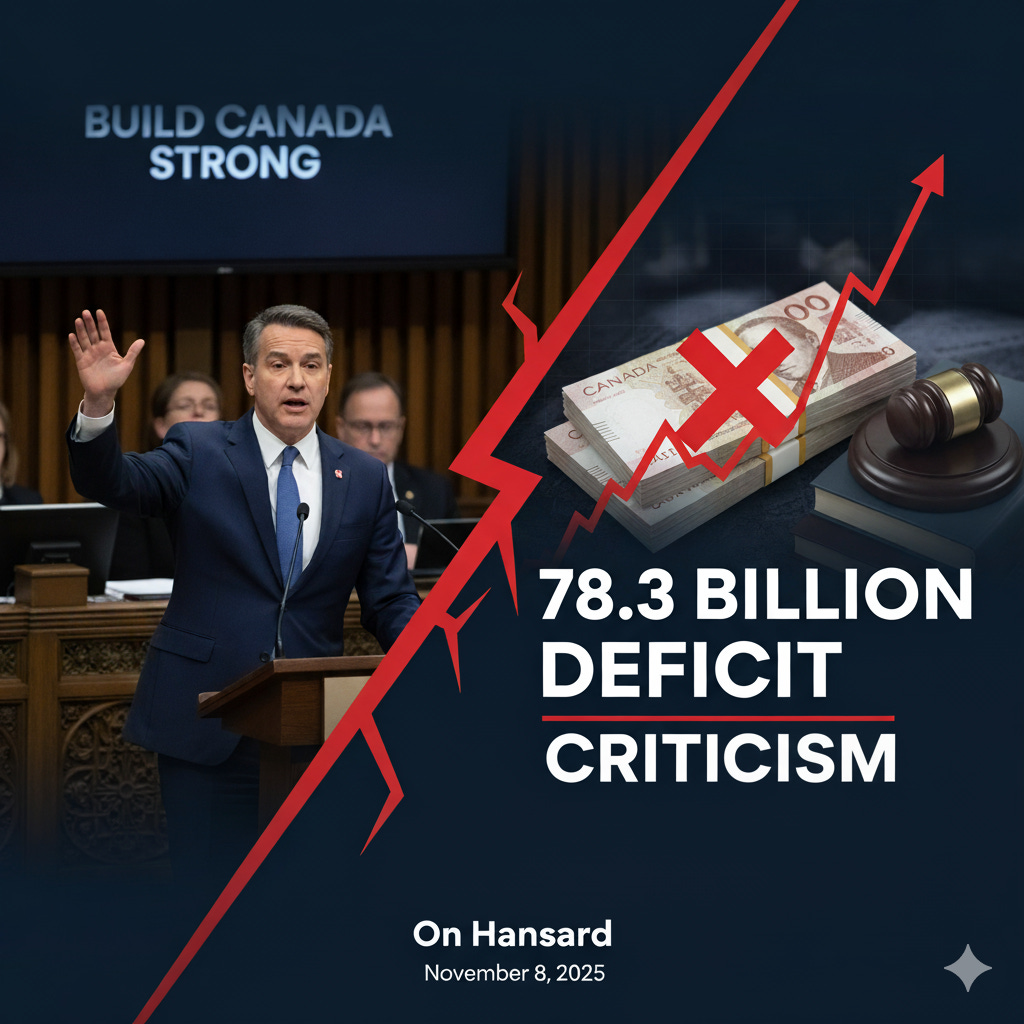
But the plan’s ambitious new spending and creative accounting have drawn sharp criticism. The budget projects a $78.3 billion deficit for the current year, more than $16 billion larger than promised during the recent election and double the deficit left by the previous Trudeau government.
Opposition parties immediately attacked the plan as a “costly budget” that fuels inflation and saddles future generations with crippling debt, pointing out that annual interest payments on the debt will now exceed all federal health transfers to the provinces.
Here is a detailed analysis of the budget debate as it unfolded in the House of Commons.
The New “Rupture” Doctrine
The Finance Minister built his budget speech around a single premise: the world has fundamentally changed, and Canada must adapt or be left behind.
He described the global situation not as a “transition” but as a “generational shift” driven by US trade policy. “The rules-based international order and the trading system that powered Canada’s prosperity for decades are being reshaped,” Champagne said. “There is no place for withdrawal, ambiguity or even standing still, only for bold and swift action.”
The government’s answer is not austerity but massive, targeted investment. “We will not lower our sails,” the minister said. “Quite the opposite, we will raise them to catch the winds of economic change, because we believe in Canada.”
This philosophy is built on four pillars:
Build Canada: Invest in housing, infrastructure, and major projects.
Protect Canada: Invest in defence, security, and vital social programs.
Empower Canadians: Invest in affordability, training, and youth jobs.
Buy Canadian: A new procurement policy to prioritize domestic industries.
Is the Math a “Sham”?
The budget’s central tension is how the government plans to “spend less so we can invest more” while tabling a $78.3 billion deficit.
The answer is a new “capital budgeting framework.” This accounting method separates day-to-day “operating” expenses from long-term “capital” investments. The government claims this will provide a clearer picture of public finances, allowing it to invest in growth without bloating operations.
The government is targeting $60 billion in operational savings over five years, largely through public service attrition and streamlining. Simultaneously, it plans $280 billion in new capital investments over five years, which it projects will catalyze $1 trillion in total public and private investment.
The goal, according to the Finance Minister, is to balance the operating budget by 2028-29.
The opposition was scathing in its response. Bloc Québécois Leader Yves-François Blanchet called the new accounting a “sham,” asking how spending on things like oil company tax credits or hosting FIFA events could possibly be counted as government assets.
Conservative Leader Pierre Poilievre dismissed the framework as “cooking the books,” arguing that a deficit is a deficit, regardless of how the government labels its spending.
Where the Money Is Going
The “generational investment” is concentrated in four key areas.
1. Infrastructure and Housing
The budget includes $115 billion over five years for infrastructure. This is anchored by the new “Build Communities Strong Fund”, a $51 billion, 10-year fund for local projects, including roads, water systems, universities, and new health infrastructure.
On housing, the budget commits $25 billion to a new federal agency, “Build Canada Homes”, with the goal of doubling the pace of construction over the next decade.
2. Defence and Sovereignty
In response to global instability, the budget commits $30 billion in new defence spending over five years, bringing total investment to $81.8 billion. The Finance Minister stated this would allow Canada to meet its 2% NATO spending commitment this year, five years ahead of schedule.
This pillar also includes a new “Buy Canadian” policy to prioritize domestic suppliers for public contracts, with the minister citing steel from Hamilton, aluminum from Saguenay, and lumber from Prince George as examples.
3. Industry and Trade
To counter US tariffs, the budget creates a $5 billion Strategic Response Fund to help affected sectors like auto, steel, and forestry adapt and retool. It also includes a $1 billion liquidity package for small and medium-sized businesses.
To boost lagging output, $110 billion is earmarked for productivity. This includes a new “productivity superdeduction” to incentivize businesses to invest in new machinery and technology, $1.3 billion for AI and quantum computing, and enhancements to the SR&ED tax credit.
4. Affordability and Social Programs
The budget protects existing social programs like dental care, pharmacare, and $10-a-day child care. It also makes the national school food program permanent, a move the government says will save an average family $800 a year.
The Opposition Rebuttals
The Conservative View: “A Costly Budget”
Conservative Leader Pierre Poilievre branded the plan as “the most expensive failure in modern Canadian history.”
His argument centered on the deficit and its consequences. He noted the $78.3 billion deficit is “twice the size of the one Trudeau left behind” and breaks the $62 billion promise made during the election.
The core of his rebuttal focused on the $55.6 billion in annual interest payments on the national debt. “That is more than we transfer for health care to the provinces and more than the government collects in GST,” Poilievre said. “When someone pays GST... every penny is going to paying bankers and bondholders rather than to paying nurses and doctors.”
He argued this new spending, amounting to “$5,400 per family,” will fuel inflation. He specifically attacked the government for keeping the industrial carbon tax, which he called a hidden tax on food and housing, citing food expert Dr. Sylvain Charlebois, who noted that Canada is the only G7 country to see four straight months of rising food inflation.
The Bloc and NDP View: “Conservative Priorities”
The Bloc Québécois and the NDP both condemned the budget as “climate capitulation” and a plan of “Liberal deficits with Conservative priorities.”
BQ Leader Yves-François Blanchet, who tabled an amendment to reject the budget, slammed the government for failing to meet Quebec’s key demands, including:
Increasing the Canada Health Transfer escalator to 6%.
Ending the OAS discrimination for seniors aged 65-74.
Repaying Quebec $700 million for costs associated with asylum seekers.
Both parties heavily criticized the budget’s environmental record. They pointed out that while the emissions cap for oil and gas is gone, tax credits for the industry are being extended and will exceed $100 billion by 2030. “The polluter gets paid,” Blanchet said.
The NDP also highlighted the $60 billion in operational savings, which translates to 40,000 public service job cuts through attrition, at a time when Canadians are struggling with high unemployment.
The Data Brief
Projected Deficit (2025-26): $78.3 billion.
Projected New Debt (5 years): $314 billion.
Projected Interest Payments (2025-26): $55.6 billion (higher than total GST revenue or Canada Health Transfers).
New Capital Investment (5 years): $280 billion.
Projected Operational Savings (5 years): $60 billion (via attrition and streamlining).
New Spending Highlights: $115B for infrastructure, $30B for defence (to meet 2% NATO target), $25B for Build Canada Homes, $110B for productivity.
Affordability Measures: Permanent national school food program, $1.5B for 175,000 youth job placements.
Opposition’s Core Objections: The size of the deficit, the cost of interest payments, the retention of the industrial carbon tax, and the lack of new funding for health transfers and OAS.
Source Documents
House of Commons Debates (Hansard), 45th Parliament, 1st Session, Vol. 152, No. 049 (2025, November 3).
House of Commons Debates (Hansard), 45th Parliament, 1st Session, Vol. 152, No. 050 (2025, November 4).
House of Commons Debates (Hansard), 45th Parliament, 1st Session, Vol. 152, No. 051 (2025, November 5).
House of Commons Debates (Hansard), 45th Parliament, 1st Session, Vol. 152, No. 053 (2025, November 7).