


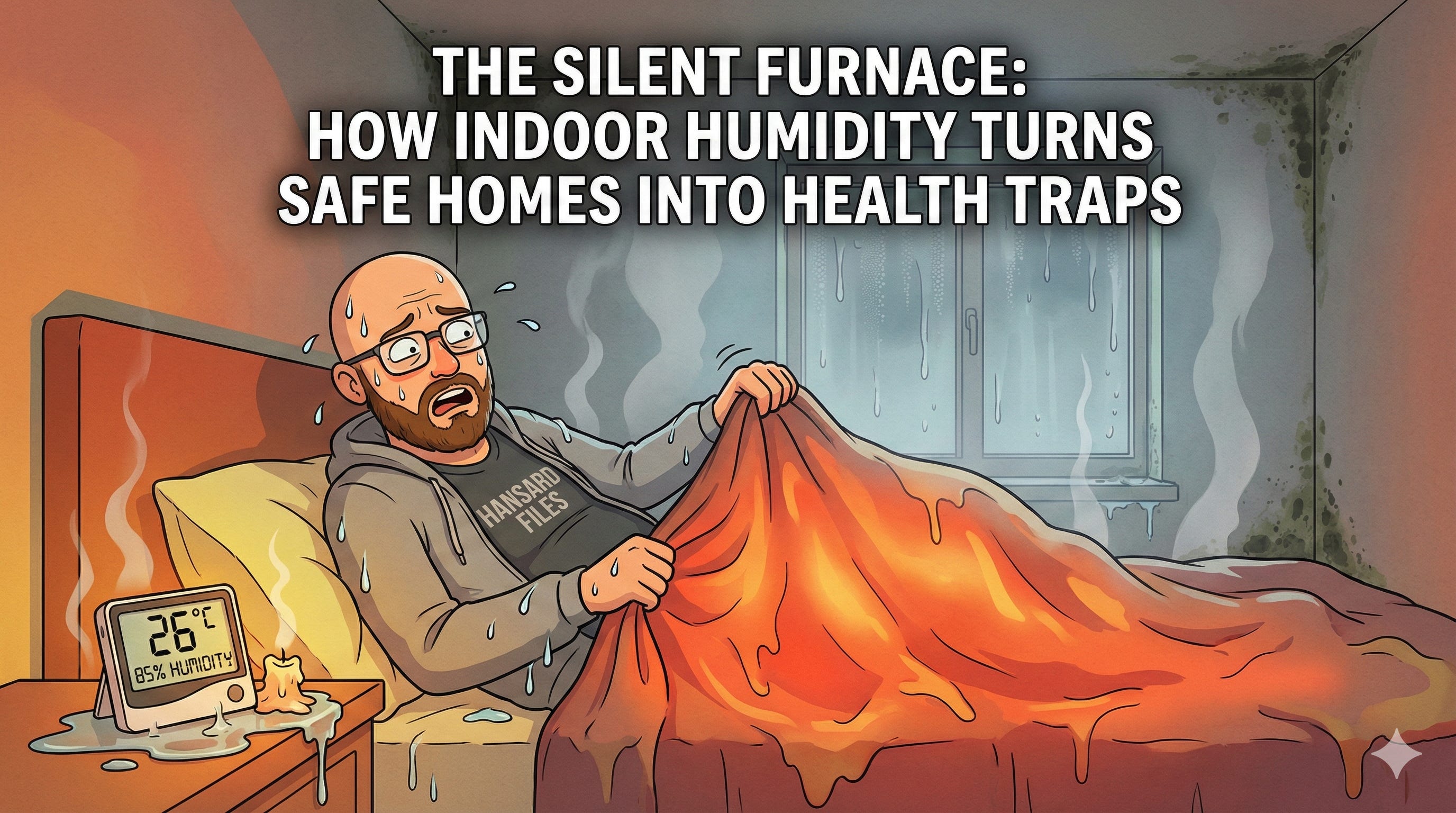
It is 2:00 AM in a second-floor apartment in Ottawa. The windows are closed to keep out the city noise, or perhaps they simply do not open enough to generate a cross-breeze. The thermometer on the wall reads 26C/79F. To the average observer, this is warm, but hardly a crisis. It is not the scorching 40C of a headline-grabbing heat dome. Yet, according to a sweeping new literature review by the National Research Council (NRC), this specific thermal environment, compounded by indoor humidity, may be straining the cooling systems of the people sleeping inside. The report challenges the long-held assumption that our homes are benign shelters, suggesting that as we hermetically seal our buildings for energy efficiency, we may be incubating a hidden health crisis that attacks the body’s most basic cooling mechanisms.
The Physics of “Sweat Failure”
For decades, building codes and public health guidelines have treated temperature and humidity as separate inconveniences. We regulate heat to prevent heat stroke, and we regulate humidity to prevent mold growth. However, the NRC report, titled Effects of humidity on the health of occupants of dwelling units, argues that this compartmentalization is physiologically dangerous.
The human body is an engine that must maintain a core temperature of approximately 37C. When the environment warms, the body deploys two primary cooling systems: vasodilation (increasing blood flow to the skin) and sweating. Vasodilation works well in mild heat, but as temperatures rise, the body relies almost exclusively on the evaporation of sweat to survive.
This is where the physics of indoor humidity turns lethal. In a dry environment, sweat evaporates instantly, cooling the blood. But as relative humidity rises, the air becomes saturated with moisture and refuses to accept more. Sweat drips off the body without evaporating, leading to a “double effect”: the body continues to overheat while simultaneously dehydrating from fluid loss.
The NRC review highlights a critical shift in scientific understanding regarding the “survivability threshold.” Previous models suggested a wet-bulb temperature (a measure combining heat and humidity) of 35C was the upper limit of human endurance. However, recent research cited in the report suggests the true limit is likely lower, around a wet-bulb temperature of 30C, or even 28C for vulnerable populations. Inside a modern, well-insulated home during a heatwave, these conditions are becoming increasingly common, transforming bedrooms into high-risk zones.
The Midnight Danger Zone
The central finding in the NRC report is not about extreme heatwaves, but about the danger of “non-extreme” temperatures that persist through the night. The report explicitly focuses on health outcomes at temperatures around 26C, the proposed upper limit for the 2025 National Building Code.
While a daytime temperature of 26C might seem manageable, the report indicates that sustaining this temperature overnight prevents the body from resetting. A CBC investigation cited in the review measured conditions in dwelling units across five Canadian cities, finding that indoor temperatures often peaked at 7:00 PM and remained above 26C well past midnight, with relative humidity staying above 50%.
Under these conditions, sleep architecture begins to crumble. The review found that as humidity and temperature rise, “slow-wave sleep” (SWS) and Rapid Eye Movement (REM) sleep are significantly reduced. These are the restorative stages of sleep essential for brain function and cardiovascular health. One study noted that in older adults, an indoor temperature increase of just 1C (within the 20C to 29C range) raised the risk of sleep disturbances.
The consequences of this “sleep failure” are not just grogginess. The physiological strain of trying to cool down while sleeping exacerbates cardiovascular disease and sleep apnea. For the millions of Canadians with undiagnosed sleep apnea, high indoor humidity adds a layer of suffocation; the report notes that increased sweating associated with apnea is further complicated by humid air, potentially reducing the efficacy of CPAP machines.
The 26C Tipping Point
The report attempts to answer a specific question for the National Building Code: Is 26C safe? The evidence suggests that without controlling for humidity, the answer is a resounding no.
The review analyzed morbidity data (specifically emergency calls)and found distinct “tipping points” where health systems begin to overload.
Respiratory Distress: Distress calls for respiratory issues began to increase when the Heat Index rose above 26C.
Diabetic Crises: Emergency calls for diabetes-related issues spiked when the Heat Index moved from 30C to 31C.
These findings illustrate that the “danger zone” is far lower than the extreme temperatures typically associated with heat warnings. A home sitting at 27C with high humidity is not merely uncomfortable; for a diabetic resident or an older adult with a weakened thermoregulation system, it is a medically hazardous environment.
The Canadian Data Deficit
A later section of the NRC report is what it reveals about the state of our knowledge. In trying to formulate a “Made-in-Canada” building code, researchers are forced to rely on data that isn’t Canadian.
The researchers applied the Köppen climate classification system to the studies included in their review. They found that the vast majority of research on indoor heat and humidity comes from “Humid Subtropical” (Cfa) climates like Shanghai, Atlanta, and Tokyo. Only two studies in the entire review utilized data from climates actually found in Canada, such as the “Warm-summer humid continental” (Dfb) zone.
This is a critical gap. A building in Shanghai is constructed differently than a building in Edmonton. Canadian homes are designed to retain heat during brutal winters, often making them exceptionally prone to overheating in summer, a phenomenon known as the “thermos effect.” By basing health standards on data from populations acclimatized to tropical summers, we risk underestimating the vulnerability of Canadians who are physiologically adapted to cooler climates.
Implications for the 2025 Building Code
The NRC report concludes with a cautious but significant warning: the interacting effects of temperature and humidity are “conceivable” threats to health even at temperatures previously considered safe 20C. While the committee has accepted 26C as a temperature cap, the authors note that this limit does not explicitly account for the “interacting effects of indoor humidity”.
As global warming increases environmental water evaporation, outdoor humidity levels are set to rise, making passive cooling (opening windows) less effective. If the 2025 National Building Code ignores this moisture variable, it may sanction the construction of dwellings that meet the letter of the law while failing to protect the lives of their occupants. The “safe” home of the future must be more than just energy-efficient; it must be physiologically compatible with human survival in a wetter, hotter world.
Hansard Files digs through thousands of pages of government reports and technical reviews so you don’t have to. The archive stays free. A paid membership funds the hours to work the next file.
Source Documents
Nixon, A., & Laouadi, A. (2024, December 23). Effects of humidity on the health of occupants of dwelling units: a literature review (Report No. A1-024303.1). National Research Council Canada.
Exactly why I’m happy that my 1952 (well that’s how old my furnace is, and still just fine thank you) house is a tad “leaky.” Sometimes there’s an “over compensate switch.”
Very interesting, and confirms what I’ve been feeling with inside humidity for a long time.