


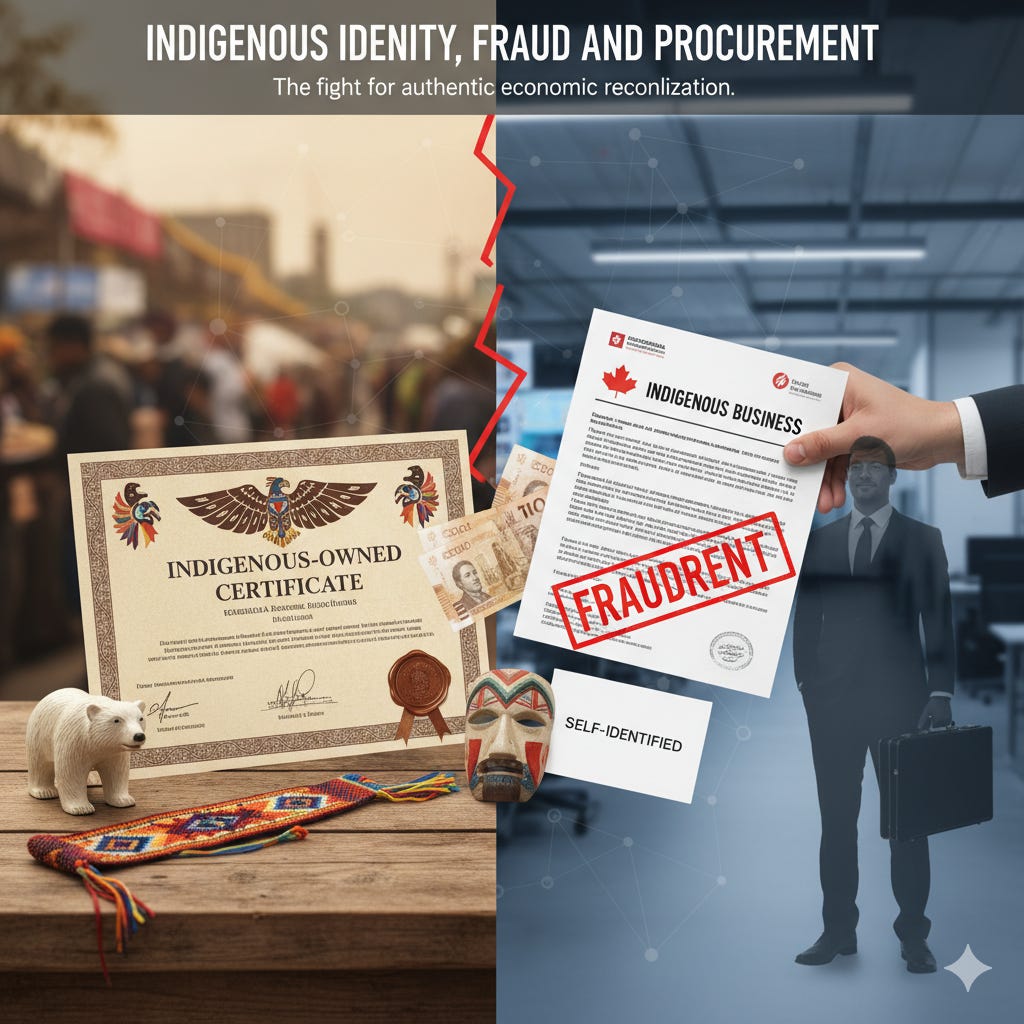
In October 2025, the Standing Committee on Indigenous and Northern Affairs tabled a report with a sharp focus: the growing problem of individuals and businesses falsely claiming Indigenous identity to win federal contracts. This isn’t just a matter of cultural appropriation. It’s an economic issue that directly undermines the government’s reconciliation efforts by diverting opportunities and resources away from the communities they are meant to benefit. The report, building on earlier work from 2022, delves into the complex intersection of identity, colonialism, and federal policy, ultimately asking a critical question: how can the system verify Indigenous identity to prevent fraud without penalizing those disconnected from their communities by past government actions?
The Crisis of “Pretendianism”
At the heart of the issue is the rise of what witnesses call “pretendianism”. This refers to individuals falsely claiming an Indigenous identity for personal, financial, or social gain. The committee heard that this trend has been increasing since a 2003 Supreme Court decision clarified Métis rights, leading to a surge in fraudulent claims in academia, the arts, and, most relevant here, federal procurement.
Witnesses made a crucial distinction. The report highlights the need to separate those knowingly committing fraud from individuals who are rightfully Indigenous but are not formally registered due to discriminatory colonial policies, like the sex discrimination in the Indian Act. Historical policies like residential schools and the Sixties Scoop have disconnected many from their communities, making verification a delicate process.
The current system often relies on self-identification, a process witnesses described as well-intentioned but “not enough” and “very easily exploited”. With no accountability, self-identification has become a loophole, allowing non-Indigenous actors to access benefits, funding, and contracts reserved for First Nations, Inuit, and Métis peoples.
How Identity Fraud Undermines Economic Reconciliation
The economic stakes are high. In 1996, the federal government launched the Procurement Strategy for Indigenous Business (PSIB), a policy designed to promote Indigenous economic development by setting aside federal contracts for Indigenous-owned companies. In 2021, the government mandated that a minimum of 5% of the total value of all federal contracts must be awarded to Indigenous businesses.
This policy is a cornerstone of economic reconciliation. Testimony before the committee explained that when the system works, it allows communities to reinvest profits into scholarships, infrastructure, and other projects, creating a “cycle of prosperity and resilience”.
However, the report makes it clear the system is being exploited. Witnesses raised alarms about two primary forms of fraud:
False Claims: Individuals with no legitimate connection to an Indigenous community register on the federal Indigenous Business Directory.
Token Partnerships: Non-Indigenous companies install “token Indigenous partners with no real decision-making authority” to qualify for set-asides.
The report notes that while the value of contracts awarded to Indigenous businesses has reportedly reached $1.6 billion, there is “a strong and compelling reason to question the validity of this data” due to the rise in fraudulent bids. This practice not only diverts funds but also erodes trust in the entire procurement system and demoralizes legitimate Indigenous entrepreneurs.
The Path Forward: Verification and Indigenous-Led Reform
So, what is the solution? Witnesses and the committee converged on a clear set of principles for reform. The consensus is that the federal government must move away from simple self-identification and work directly with First Nations, Inuit, and Métis to establish robust, credible verification systems.
The report’s recommendations center on three key areas:
A New Federal Policy on Identity: The government must partner with Indigenous peoples to create a federal policy to verify Indigenous sovereignty and membership. This policy needs to be flexible enough to account for those disconnected by colonialism but strong enough to have enforcement mechanisms for non-compliance.
An Indigenous-Led Business Directory: The current Indigenous Business Directory, managed by Indigenous Services Canada, should be reformed to be Indigenous-led. Several witnesses pointed to existing Indigenous-run business registries, like those managed by the Manitoba Métis Federation and the Otipemisiwak Métis Government, as effective models.
Stronger Enforcement: The system needs “real teeth”. Witnesses called for a stronger enforcement framework to identify and penalize those who make false claims, with legal consequences for fraud.
A promising model highlighted in the report is the University of Saskatchewan’s Indigenous Truth Policy. The policy requires applicants to provide documentation of their Indigenous membership or citizenship when it could lead to a material advantage, like a scholarship. Crucially, Indigenous governments themselves tell the university what documentation is acceptable, putting the authority back in the hands of Indigenous communities.
The Data Brief
The Problem: Individuals and businesses are falsely claiming Indigenous identity (”pretendianism”) to illegitimately access federal procurement contracts set aside for Indigenous peoples.
The Impact: This fraud diverts significant economic opportunities away from legitimate Indigenous communities, undermining a key tool for reconciliation and eroding trust in the system.
The Cause: The current system’s reliance on self-identification for verification is easily exploited and lacks meaningful enforcement mechanisms or penalties for non-compliance.
The Solution: The committee recommends creating a new federal identity verification policy co-developed with Indigenous partners, reforming the Indigenous Business Directory to be Indigenous-led, and establishing a stronger enforcement framework to penalize fraud.
From Policy to Practice
Ultimately, this report is about more than just bureaucratic reform. It’s about honouring the original intent of programs designed to advance Indigenous self-determination and economic security. The challenge for the government now is to translate these recommendations into action, building a system where verification is not a barrier but a guarantee, ensuring that when a contract is for an Indigenous business, it actually means it.
Source Documents
Standing Committee on Indigenous and Northern Affairs. (2025, October). First Nations, Inuit and Métis Identity and Participation in Federal Procurement. House of Commons.