


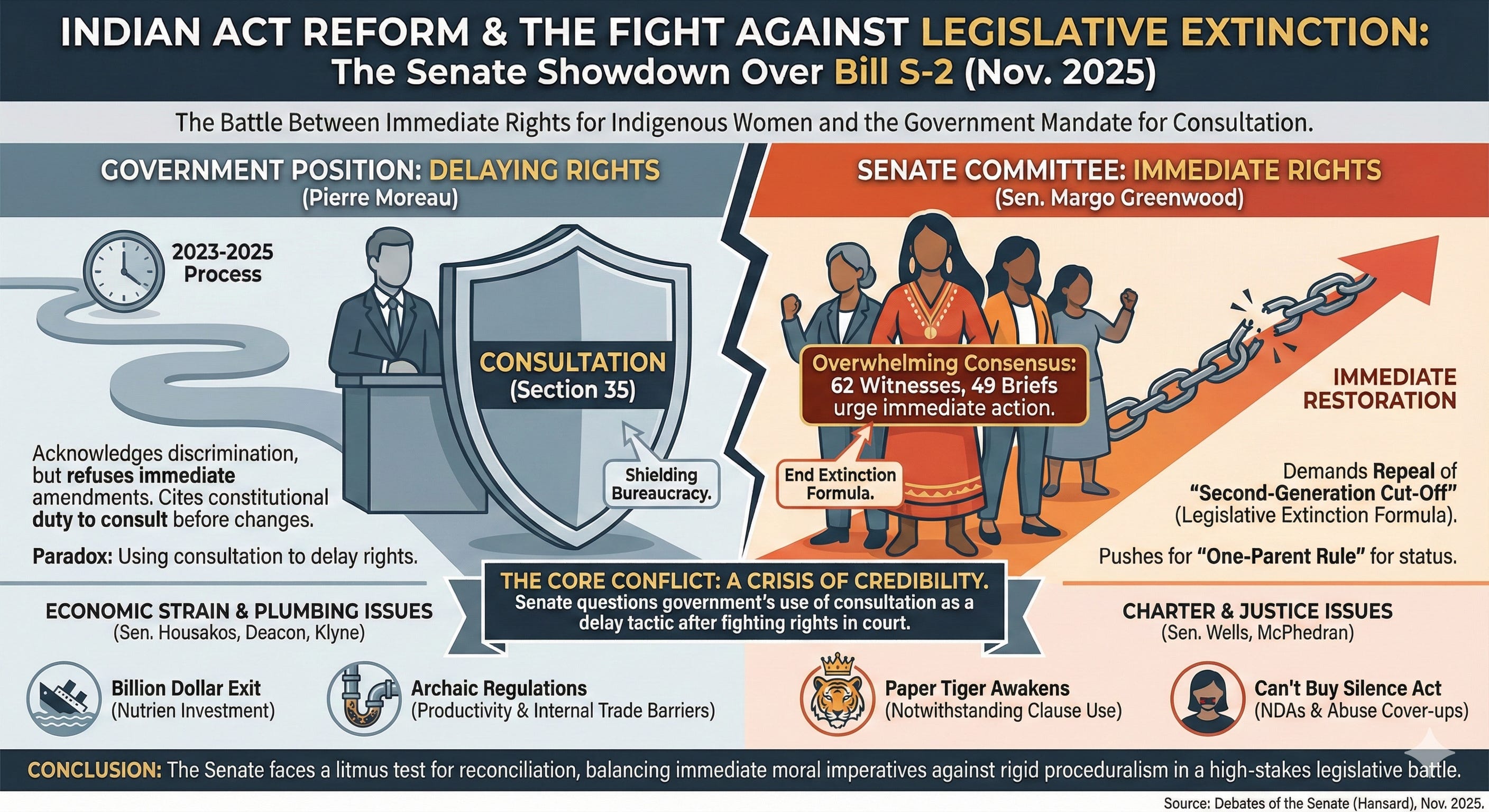
The air in the Red Chamber was thick with the weight of history as senators debated the future of Indian Act reform. For decades, the machinery of the Canadian state has operated what critics call a slow-motion erasure of Indigenous identity, and now, in November 2025, the Senate stands at a breaking point. While the government touts economic stabilization and lower inflation, a fierce constitutional battle has erupted over Bill S-2, a piece of legislation that has exposed a deep rift between the slow gears of bureaucracy and the urgent demands for human rights.
At the heart of this conflict is the “second-generation cut-off,” a provision in the Indian Act that terminates Indigenous status after two generations of parenting with non-status individuals. For the Indigenous senators who have lived under the shadow of this act, it is not merely a policy flaw. It is, in the words of witnesses cited by the committee, a “legislative extinction formula” designed to make status Indians disappear over time.
The government, represented in the Senate by Pierre Moreau, finds itself in a precarious position. They agree that the discrimination exists. They agree it must end. Yet, they refuse to accept the Senate’s amendments to fix it immediately, citing a constitutional duty to consult. This paradox—using the duty to consult Indigenous peoples as a shield to delay granting rights to Indigenous women—has set the stage for one of the most significant legislative confrontations of the 45th Parliament.
The Spectre of Legislative Extinction
The debate centered on the First Report of the Standing Senate Committee on Indigenous Peoples regarding Bill S-2. The bill was originally intended to address specific inequities raised by the British Columbia Supreme Court’s Nicholas decision, which dealt with enfranchisement issues. However, the committee, led by Deputy Chair Senator Margo Greenwood, decided that a piecemeal approach was no longer acceptable.
Senator Greenwood, a scholar of Cree ancestry, laid out the stakes with surgical precision. She detailed how the committee heard from sixty-two witnesses and received forty-nine briefs. The consensus was overwhelming. Witnesses told the committee that they could not simply enact another bill with “incrementally tiny steps” while maintaining an “iron grip on the legislative extinction.” The committee responded by passing amendments to repeal the second-generation cut-off entirely, effectively moving to a “one-parent rule” where status is passed down regardless of who the other parent is.
This was not a minor adjustment. It was a fundamental rewriting of how Canada defines Indigenous identity, aimed at halting the gradual statistical elimination of First Nations people. Senator Greenwood cited Cora McGuire-Cyrette of the Ontario Native Women’s Association, who warned that continuing the cut-off results in the number of registered Indians declining over time, eventually leading to the extinction of entire communities. For the committee, the time for half-measures had passed. They voted to remove the liability clauses that protected the government from compensation claims and pushed to restore rights immediately.
The Shield of Consultation
Government Representative Pierre Moreau rose to respond, acknowledging the “shameful colonial past” and the deep emotions involved. However, his defense of the government’s refusal to accept the amendments rested on a rigid interpretation of constitutional law. He argued that the Crown has a Section 35 obligation to consult with Indigenous communities before making such sweeping changes.
Moreau insisted that the government was not opposed to the “what” but the “how.” He explained that Minister Gull-Masty, the first Indigenous person to hold the portfolio of Indigenous Services, was personally committed to fixing the issue but was bound by the duty to consult. The government’s position was that rushing these amendments without a formal consultation process, which began in 2023 and was set to conclude in December 2025, would render the legislation vulnerable to court challenges.
The tension in the chamber was palpable as Senator Michèle Audette, an Innu woman and the bill’s sponsor who had recused herself from the chair role, challenged Moreau. She cited the Mikisew Cree decision, suggesting the Crown has no legal duty to consult during law-making in the parliamentary process. She asked why her rights as an Indian woman had to be subject to a lengthy process that wasn’t required by the court for other bills. Moreau held his ground, arguing that a “nation-to-nation” relationship meant one nation could not dictate solutions to another without asking them what they wanted first.
A Crisis of Credibility
The debate quickly turned to the issue of trust. Senator Scott Tannas pointed out the glaring credibility gap. This bill was not born from the government’s goodwill but was forced upon them by a court loss in the Nicholas case. He asked how it was credible for a government to fight tooth and nail to deny these rights in court, only to grant them later while pleading for more time to consult.
Senator Kim Pate added to the pressure, noting that previous ministers had made similar promises for decades without delivering stand-alone legislation. The fear among senators was that passing Bill S-2 without the amendments would leave the second-generation cut-off in place for years, forcing future generations to fight the same battles in court. Senator Mary Coyle questioned the Senate’s reputation as a chamber of sober second thought if it ignored the “Make it Stop!” report and the pleas of witnesses.
Moreau’s defense relied on the political credibility of Minister Gull-Masty, arguing that her personal history as an Indigenous leader and victim of discrimination made this time different. He urged senators not to let the perfect be the enemy of the good, noting that 3,500 people were waiting for the specific fixes in Bill S-2 that would be jeopardized if the bill stalled due to a fight with the House of Commons. The standoff left the Senate with a difficult choice: accept a flawed bill to help a few thousand people now, or hold the line for justice for all, potentially risking the entire legislation.
The Billion Dollar Exit
While the Senate wrestled with the soul of the nation, the economic machinery outside the chamber showed signs of severe strain. The debates revealed a government under siege on the economic front, struggling to maintain investor confidence despite claiming victory on inflation targets.
Senator Leo Housakos, Leader of the Opposition, launched a blistering attack on the government’s economic record, highlighting a devastating blow to Canada’s supply chain reputation. Nutrien, a flagship Canadian company and the world’s largest potash producer, had chosen to invest one billion dollars into a new export terminal in Longview, Washington, rather than in Canada. Housakos framed this as a humiliating loss for Prime Minister Carney’s government, attributing it to congested ports, labour disruptions, and a regulatory environment that suffocates investment.
The government’s defense, articulated by Moreau, pointed to Bill C-5 and new budget measures intended to streamline major projects and invest in infrastructure. However, the recurring theme was an economy caught in a “vicious circle of weak productivity,” a term attributed to the Bank of Canada’s Deputy Governor. With productivity down and the deficit persisting, the Opposition painted a picture of a nation that had become a net exporter of capital, forcing Canadian companies to look south for reliability.
Plumbing the Depths of the Economy
Amidst the high drama of constitutional debates and billion-dollar losses, a quieter but equally critical conversation was taking place regarding the “economic plumbing” of the nation. Senator Colin Deacon and Senator Marty Klyne championed technical bills designed to modernize the archaic regulations holding back Canadian innovation.
Senator Deacon spoke on Bill S-3, describing the current state of Canada’s economic infrastructure as a toilet about to back up. He highlighted that the Weights and Measures Act had not been substantially updated since he was in the fifth grade. This legislative neglect meant that for years, electric vehicle charging stations could not legally bill customers by the kilowatt-hour, a regulatory absurdity that disincentivized the installation of chargers in condos and rental buildings. Bill S-3 aims to fix these outdated rules, allowing for temporary permissions for new technologies and modernizing inspections.
Simultaneously, Senator Klyne pushed for Bill S-239, the Canadian Prosperity Act, which seeks to empower the Competition Bureau to tackle internal trade barriers. The fragmentation of the Canadian market was laid bare, with it often being cheaper and easier for a British Columbia winemaker to ship a bottle of Pinot Noir to South Korea than to Ontario. The bill proposes to give the Competition Bureau the power to recommend the removal of anti-competitive regulations, forcing the federal government to respond within a set timeframe. These technical reforms represented a desperate attempt to unclog the arteries of the national economy before productivity stagnated further.
The Paper Tiger Awakens
The Senate’s attention also turned to the eroding conventions of the Constitution itself. Senator Kristopher Wells delivered a passionate defense of Bill S-218, legislation designed to limit the federal use of the “notwithstanding” clause. He described a sea change in Canadian politics where the clause, once considered a “paper tiger” or a nuclear option of last resort, was now being used as a tool of political convenience by provinces to override the rights of vulnerable minorities.
Wells cited recent invocations in Alberta and Saskatchewan targeting transgender youth and labour rights as evidence that the restraint which held for thirty years had evaporated. He argued that when governments use the clause pre-emptively, before a court has even ruled on a law’s constitutionality, they are governing through fear rather than confidence. The proposed bill would require any federal use of the clause to undergo rigorous debate and judicial referral, an attempt to put the genie back in the bottle before the Charter of Rights and Freedoms loses its binding power entirely.
This sparked a sharp exchange with Senator Denise Batters, who argued that limiting the clause would strip Parliament of its supremacy and that there are cases—such as sentencing for mass murderers—where the clause might be the only tool available to ensure justice. The debate highlighted a growing anxiety within the Senate that the fundamental rules of Canadian democracy were shifting beneath their feet.
Silence and Survival
The proceedings were not devoid of the human cost that often gets lost in policy papers. Senator Marilou McPhedran reintroduced the “Can’t Buy Silence Act,” Bill S-232, aiming to prohibit the use of non-disclosure agreements (NDAs) to cover up harassment and violence in federally funded workplaces. She described NDAs as malevolent tools used to protect predators and silence victims, disproportionately affecting women, racialized groups, and Indigenous peoples.
The reality of these agreements was stark. Victims trade their silence for privacy or settlement money, allowing perpetrators to move on to other organizations with clean records. McPhedran invited senators to hear directly from survivors who had broken their agreements, emphasizing that 93 percent of those who sign such NDAs report negative mental health consequences. It was a call to stop using public money to enforce silence and protect reputations at the expense of justice.
The chamber also paused to pay tribute to the late Honourable Ione Christensen, a trailblazer from the Yukon who broke barriers as the first female Justice of the Peace, Mayor of Whitehorse, and Senator for the territory. Her legacy as a woman who carried a knife and ran a trap line in her youth, yet served with grace and humility in the Senate, stood in stark contrast to the modern bureaucratic paralysis the Senate now fought to overcome.
Conclusion
As the Senate adjourned, the battle lines were drawn. On one side stood the urgent moral imperative to end the legislative extinction of First Nations people and the silencing of abuse victims. On the other stood the rigid proceduralism of the government, hiding behind the shield of consultation and constitutional caution.
With the economy straining under productivity woes and internal trade barriers, and the very fabric of the Charter being tested by the normalization of the notwithstanding clause, the Upper Chamber found itself not just reviewing legislation, but fighting for the foundational values of the country. The fate of Bill S-2 and the amendments to the Indian Act now hang in the balance, a litmus test for whether the government’s commitment to reconciliation is stronger than its commitment to bureaucracy.
Source Documents
(2025, November 27). Debates of the Senate (Hansard), 154(39). Senate of Canada.
(2025, November 26). Debates of the Senate (Hansard), 154(38). Senate of Canada.
(2025, November 25). Debates of the Senate (Hansard), 154(37). Senate of Canada.