


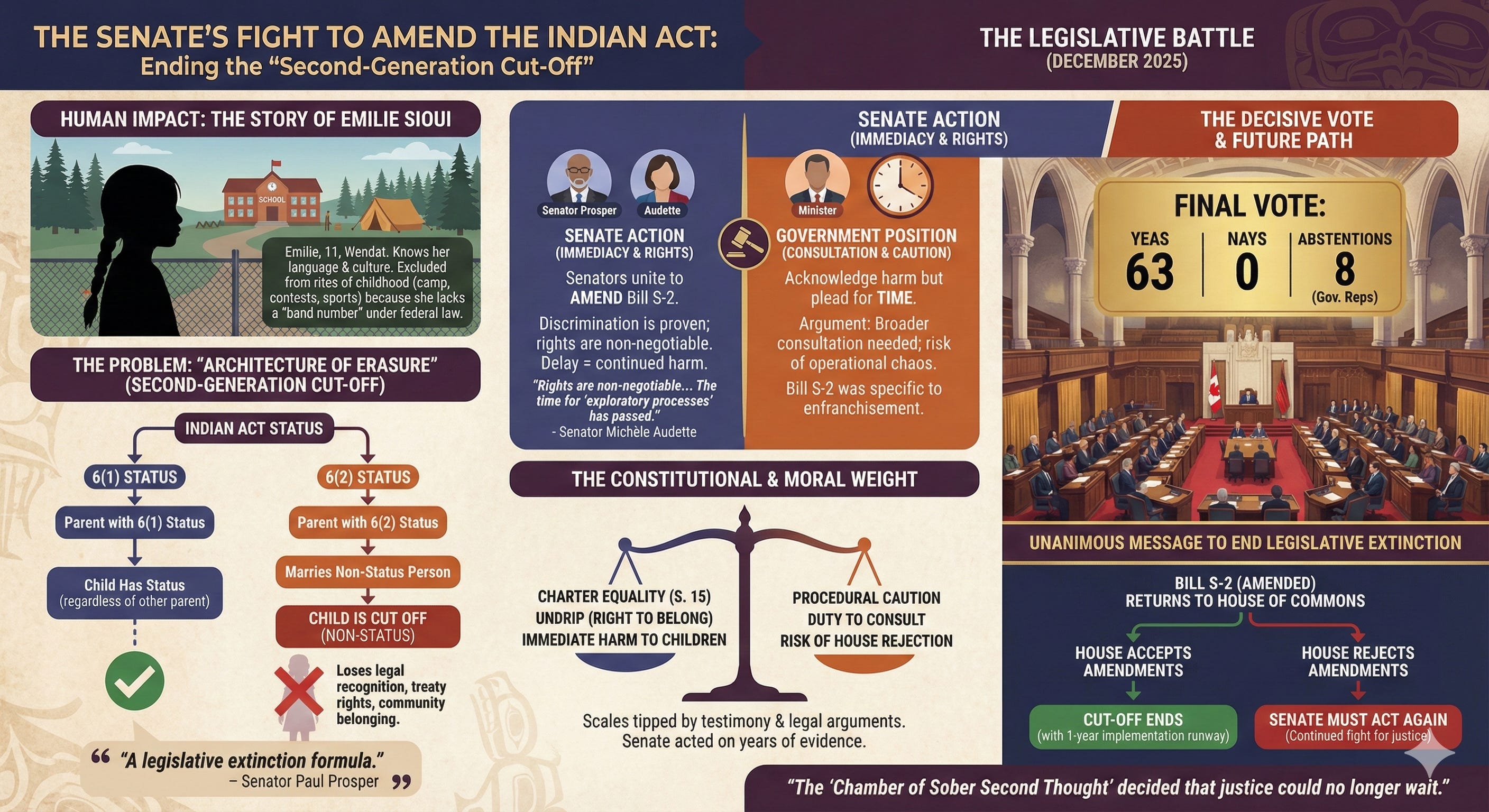
Emilie Sioui is eleven years old. She lives in Wendake and attends the local elementary school where she excels in learning the Wendat language. She knows she is Wendat. Her mother is Wendat. Her ancestors are Wendat. Yet when her class went to a cultural summer camp in the forest, Emilie had to stay behind. When she won a writing contest about her ancestors, her text was disqualified. When she tried to sign up for the local hockey tournament, she was rejected. Emilie was excluded from these rites of childhood because she does not have a band number. According to the federal government, she does not belong.
Her story, read aloud to a hushed chamber by Senator Mary Jane McCallum, pierced the legalistic air of the Senate of Canada this week. It served as a devastating human anchor to a historic legislative battle regarding the Indian Act and the future of Indigenous identity in Canada.
For three days in early December 2025, the Upper Chamber became the site of an intense collision between political procedure and moral urgency. At stake was Bill S-2, government legislation intended to correct specific historical wrongs regarding enfranchisement. However, the Standing Senate Committee on Indigenous Peoples decided the bill did not go far enough. In a move that defies the usual deferential role of the appointed chamber, senators rallied to amend the Indian Act to immediately eliminate the “second-generation cut-off,” a legal mechanism that critics call a slow-motion genocide.
The debate revealed a profound shift in the Senate’s identity. No longer content to merely review legislation, senators from all groups united to challenge the government’s timeline on reconciliation. They argued that when a law is admittedly discriminatory, Parliament has a duty to fix it not in the future, not after more consultation, but now.
The Architecture of Erasure
To understand the fury in the Senate, one must understand the math of extinction embedded in the Indian Act. Since 1985, the federal government has classified Status Indians under two primary subsections: 6(1) and 6(2). A person with 6(1) status can pass their status to their child regardless of who they marry. A person with 6(2) status, however, can only pass status if they parent a child with another status holder. If a 6(2) parent has a child with a non-status person, that child is cut off. They become non-status. They lose their legal recognition, their treaty rights, and their ability to live and be buried in their community.
Senator Paul Prosper, a Mi’kmaq lawyer and former Chief, rose on December 2 to explain the brutal efficiency of this system. He described it as a legislative extinction formula designed to reduce the number of registered Indians over time. The cut-off splits families down the middle. It creates scenarios where cousins, or even siblings, possess different rights based solely on birthdates and parentage.
The government, represented in the Senate by Senator Pierre Moreau, acknowledged the discrimination. The Minister of Indigenous Services had even conceded that the cut-off is harmful. However, the government’s position was one of restraint. They argued that Bill S-2 was a specific response to a British Columbia court decision, the Nicholas case, which dealt with enfranchisement. The government insisted that broader reforms, including the removal of the second-generation cut-off, required extensive consultation with First Nations communities to determine how to implement such sweeping changes. They warned that moving too fast could trigger lawsuits or operational chaos for bands determining their membership.
This argument for patience did not sit well with the Indigenous senators who have lived under the shadow of the Act for generations. Senator Prosper rejected the call for delay. He noted that the committee heard from sixty-two witnesses and received nearly fifty briefs. The overwhelming consensus from Grand Chiefs, grassroots organizations, and legal experts was that the cut-off must go.
He asked his colleagues a fundamental question about their role. When the Speaker asks if they are ready for the question, they are really being asked if they trust the work of the committee. The committee had voted ten to one in favour of the amendments. Prosper argued that a vote to adopt the report was a vote of confidence in the Senate’s ability to protect minority rights against a lethargic state bureaucracy.
The Wolverine and the Minister
The emotional core of the debate was found in the words of Senator Michèle Audette. Describing herself as a “wolverine,” she spoke of the deep scars left by the Indian Act on Indigenous women. For decades, Indigenous women who married non-status men were stripped of their status, exiled from their communities, and buried outside their reserves. While previous amendments attempted to fix this, the second-generation cut-off continues to disproportionately punish women and their descendants.
Senator Audette expressed her deep respect for the current Minister of Indigenous Services, noting the historic nature of having the first Indigenous woman in that role. However, she drew a sharp line between respect for the person and acceptance of the system. She refused to accept a “nation-to-nation” relationship built on a crooked foundation. She argued that one cannot build an honest relationship on a policy as unacceptable as the Indian Act.
The senator dismantled the government’s argument regarding the duty to consult. She pointed out that the Supreme Court of Canada has ruled that the government has no legal duty to consult when enacting legislation, a victory the current Liberal government fought for in the Mikisew Cree case. Yet now, faced with a demand to end discrimination, the government was using the duty to consult as a shield to delay action.
Senator Audette declared that her rights as an Indigenous woman are non-negotiable. She rejected the idea that the government needs to consult on whether to end discrimination. The courts have already ruled that the inability to transmit status violates equality rights under the Charter. The discrimination is proven. The harm is known. For Audette, the time for “exploratory processes” and “collaborative tables” had passed.
The Crossroads of Justice
As the debate moved to its final stages on December 4, Senator David Arnot framed the moment as a crossroads for the Senate. He posed three critical questions. Should procedural rules trump the need to respond to structural injustice? Should the Senate remain silent in the face of colonial mechanisms that deny rights? Should a chamber entrusted with protecting minorities decline to act?
Arnot argued that by voting for the amendments, the Senate was answering “no” to silence and “yes” to justice. He credited the new independence of the Senate for this boldness. In a partisan chamber, whipped votes might have crushed the amendments to protect the government’s agenda. In this independent chamber, senators were free to act on moral clarity.
He warned, however, that the victory might be symbolic. The amended bill must return to the House of Commons, where the government could simply reject the Senate’s changes. Arnot urged his colleagues not to view rejection as a failure but as a call to further action. If the door closes in the House, he said, the Senate must open another one. He called for an inter-committee mandate to hold the government accountable for forty years of fiduciary failure.
The debate was not without its internal tensions. Senator Judy White, a Mi’kmaw senator from Newfoundland, initially expressed hesitation. On December 2, she spoke of the principle of “Two-Eyed Seeing,” balancing Indigenous knowledge with Western law. She worried that rushing amendments without the Minister’s full consultation process could jeopardize the progress Bill S-2 offered to those waiting for enfranchisement remedies. She urged support for the Minister.
However, the tide of the chamber was turning. By the time the final speeches were made, the consensus was undeniable. The stories of exclusion, like that of Emilie Sioui, outweighed the procedural caution of the government. The argument that equality could be delivered incrementally had been demolished by the reality of generations of lost identity.
The Constitutional Argument
A significant portion of the debate centered on the legal interaction between the Indian Act, the Constitution, and international law. Senator Mary Coyle visualized Lady Justice balancing the scales. On one side lay the government’s plea for time, the need for consultation, and the risk of the House rejecting the bill. On the other side lay the immediate violation of Charter rights, the United Nations Declaration on the Rights of Indigenous Peoples (UNDRIP), and the tangible harm to children.
For Senator Coyle, the scale tipped decisively toward passing the amendments. She noted that UNDRIP creates a statutory requirement for Canadian laws to be consistent with the declaration, which guarantees the right to a nationality and the right to belong to an Indigenous community. The second-generation cut-off violates these articles. Furthermore, section 15 of the Charter guarantees equality under the law. The government had already conceded in court that the inability to transmit status was discriminatory. Therefore, maintaining the status quo, even for another year of consultation, was a constitutional violation.
Senator Pierre Dalphond, a former judge, provided a counter-argument rooted in the complexity of UNDRIP. He noted that while Article 9 guarantees the right to belong, Article 19 requires states to consult and cooperate with Indigenous peoples before adopting legislative measures. He asked if a committee of twelve senators could truly substitute for the broad consultation promised by the government’s action plan. He raised the difficult question of who decides membership in a nation. Is it the federal government through the Indian Act, or is it the Indigenous nations themselves?
Despite these legal nuances, the moral weight of the testimony heard by the committee proved insurmountable. Senator Brian Francis, a former Chair of the committee, reminded the chamber that the “Make it Stop!” report of 2022 had already demanded the repeal of the cut-off. The Senate was not acting on a whim; it was acting on years of evidence.
The Shadow of Minority Government
Looming over the entire debate was the precarious nature of the current minority parliament. Senator Prosper and Senator Audette both alluded to the political instability. Budget 2025 had survived a confidence vote by a razor-thin margin. There was a palpable fear that if the Senate waited for the Minister to introduce a perfect, co-developed bill in the spring, the government might fall before it could be passed.
The amendments to Bill S-2 included a one-year delay in coming into force. This was a strategic compromise proposed by Senator Scott Tannas. It gave the government a twelve-month runway to complete its consultations and introduce stand-alone legislation if they wished. But if the government failed, or fell, or dragged its feet, the amendments would kick in as a fail-safe. It was an insurance policy for Indigenous rights against the volatility of Ottawa politics.
Senator Jim Quinn, a former public servant, expressed skepticism that one year would be enough for the government to act, given the history of delays. However, Senator Audette countered that the government cannot consult on discrimination. The discrimination exists; it must be removed. The consultation should focus on how to implement the changes and support communities, not whether to grant rights.
The Final Vote
On the afternoon of December 4, the bells rang in the Senate of Canada. For fifteen minutes, the chamber waited. When the doors were secured, the Speaker called for the vote.
The result was decisive. Sixty-three senators voted in favour of the bill as amended. Zero voted against it. Eight senators, including the Government Representative and his deputies, abstained.
The unanimity of the “Yeas”—spanning the Independent Senators Group, the Canadian Senators Group, the Progressive Senate Group, and the Conservative opposition—sent a thunderous message to the House of Commons. The Senate of Canada had declared that the era of the second-generation cut-off must end.
The bill now travels back to the House of Commons. The elected Members of Parliament face a choice. They can accept the Senate’s amendments and end a forty-year policy of legislative extinction, or they can strip the amendments and insist on a slower path of consultation.
For Emilie Sioui in Wendake, and for hundreds of thousands of others like her, the Senate has done its part. The “Chamber of Sober Second Thought” looked at the law, looked at the lives it destroyed, and decided that justice could no longer wait for the perfect moment. It had to happen now.
Source Documents
Senate of Canada. (2025, December 2). Debates of the Senate (Hansard), 154(40).
Senate of Canada. (2025, December 3). Debates of the Senate (Hansard), 154(41).
Senate of Canada. (2025, December 4). Debates of the Senate (Hansard), 154(42).
Thank you for this piece. This is an important amendment to an outdated act.