


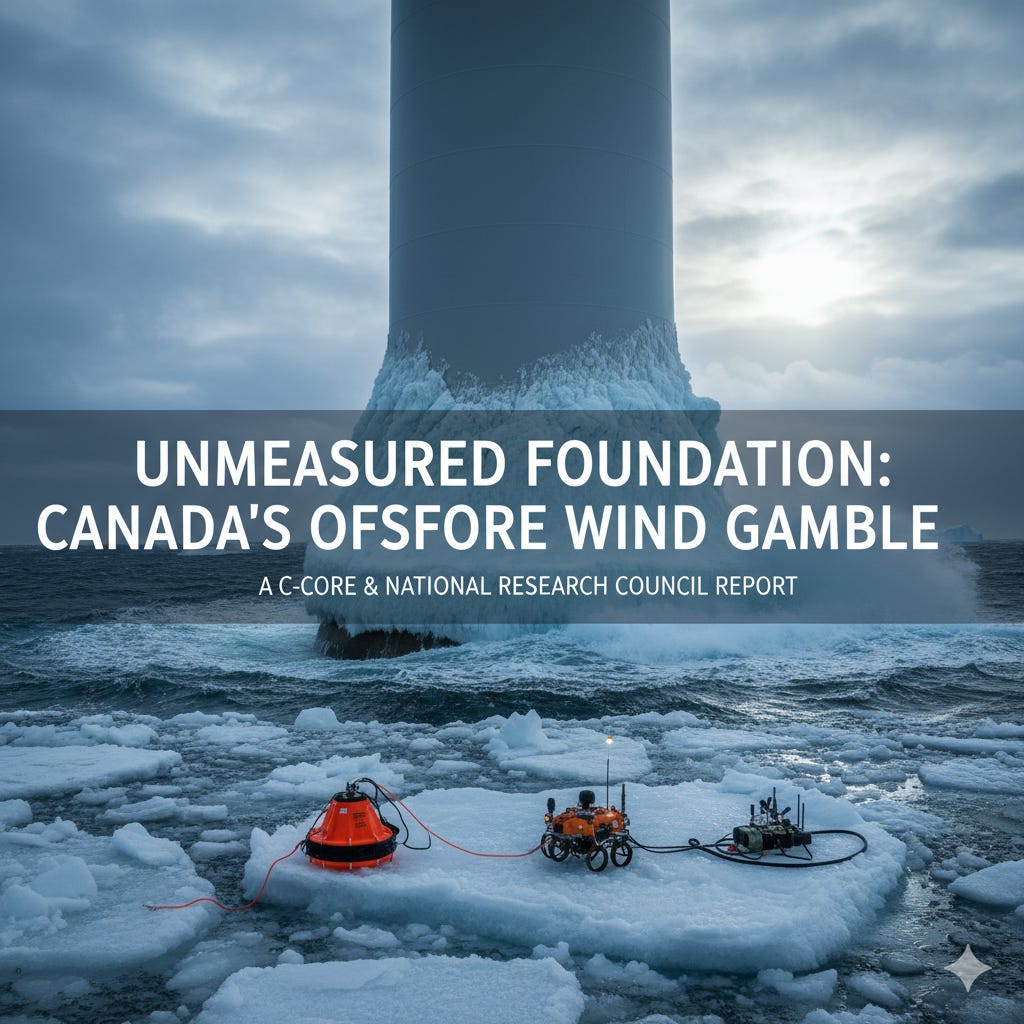
A recent technical paper, published by engineers with C-CORE and the National Research Council of Canada, offers a crucial dose of reality for Canada’s ambitious green energy plans. The report, titled Evaluation of Monopile Wind Turbine Platforms for Extreme Design Conditions, is not a political document. It is a sober, methodical assessment of the engineering challenges of building offshore wind farms in the harsh environment of Atlantic Canada. While political discourse often centers on targets, subsidies, and timelines, this analysis points to a far more fundamental challenge. It reveals that for all our ambition, we are planning to build massive, multi-billion dollar infrastructure on a foundation we have not yet properly measured.
The study examines the forces a 15-megawatt wind turbine would face off the coast of Newfoundland, considering 50-year storms and even 500-year hurricanes. The engineering is complex, impressive, and suggests that we have the technical ability to design for these extremes. But robust design is only as good as the data you feed into it. The report’s quiet, persistent conclusion is that when it comes to the unique challenges of our northern waters, we are operating with critical blind spots. It asks a vital question that our national conversation has largely ignored: how can you build for forces you cannot yet accurately quantify?
The Data Blind Spot
The central problem identified in the report is not a failure of technology or will, but a failure of measurement. The authors state this plainly, emphasizing “gaps in environmental data, particularly regarding sea ice conditions and ice load models.” While wind and wave patterns in Atlantic Canada are well-documented, the behavior of sea ice is a far more complex and under-studied variable.
Here’s the detail I find most revealing: to simulate the impact of ice on a turbine foundation, the engineers had to use assumed ice thicknesses of 0.5 meters and 1.0 meter “for illustration.” This is the engineering equivalent of a shrug. It is not a criticism of the researchers, but an honest admission of the data deficit they face. They are working with incomplete information because the detailed, long-term environmental surveillance of sea ice in the specific areas targeted for development has not been done. The report notes that while the Canadian Ice Service provides invaluable charts, “more detailed environmental surveys and modelling of the movement and fate of sea ice... are critical for understanding and predicting sea ice loads.”
Borrowing Blueprints for a Unique Shoreline
This data gap is compounded by a standards problem. The primary international standards for offshore wind turbine design, written by the International Electrotechnical Commission (IEC), are not purpose-built for the unique conditions of Atlantic Canada. Our environment is not the North Sea, where much of the industry’s experience has been gained.
The report highlights that the Canadian Standards Association (CSA) is in the process of adapting these international rules for our national context. One of the most significant proposed changes is for ice loading. The CSA suggests using a different international standard, ISO 19906:2019, because it “better captures the complexity of Canadian sea ice (including drifting floes, pressure ridges, and regional variability) and icebergs.”
This points to a critical truth. We cannot simply import “off-the-shelf” solutions for our energy transition. The presence of thick, mobile sea ice, pressure ridges, and even the occasional iceberg presents a design challenge that is fundamentally different from that faced in more temperate climates. Our government must not only gather the missing data but also develop the uniquely Canadian expertise and regulations required to act on it.
Building on an Undocumented Shoreline
The situation creates a powerful analogy. Imagine our national energy strategy as a plan to build a massive, permanent coastal city. The political and public debate is currently focused on the city’s architecture. We argue about the height of the buildings (megawatt targets), the style of the towers (which turbine technology to use), and the financing model for the mortgages (subsidies and carbon taxes).
This engineering report is the geological surveyor’s assessment. The surveyors have returned from the field and are calmly stating that while the blueprints for the buildings are sound, no one has done the core sampling on the shoreline itself. The ground upon which we intend to build this entire future city is, from a data perspective, largely undocumented. We are assuming the stability of the ground instead of measuring it.
Proceeding with massive capital investment without this foundational data is not a bold strategic choice, it is a gamble. It places the risk of unforeseen costs, delays, and even structural failures squarely on the public. The report’s most important recommendation is not to build faster or bigger. It is a call for patience and prudence: “to initiate enhanced surveillance of wind, wave, current, and ice conditions and movements at locations... where wind power production is feasible.”
The Principle of Prudent Investment
This analysis connects back to a foundational principle of good governance: due diligence. Before the state commits public funds and national credibility to a decades-long infrastructure project, it has a primary responsibility to do the foundational work. True progress is not measured by the ambition of an announcement, but by the rigour of the preparation that precedes it. The unglamorous, slow, and methodical work of scientific data collection is the most critical and overlooked component of our energy transition. This report is not an argument against offshore wind. It is an argument for doing it properly. Before we can build our energy future, we must first commit to measuring the ground on which it will stand.
Sources:
Stuckey, P., Derradji-Aouat, A., Fuglem, M., & Turnbull, I. (2025). Evaluation of monopile wind turbine platforms for extreme design conditions. Proceedings of the 28th International Conference on Port and Ocean Engineering under Arctic Conditions (POAC’25).