


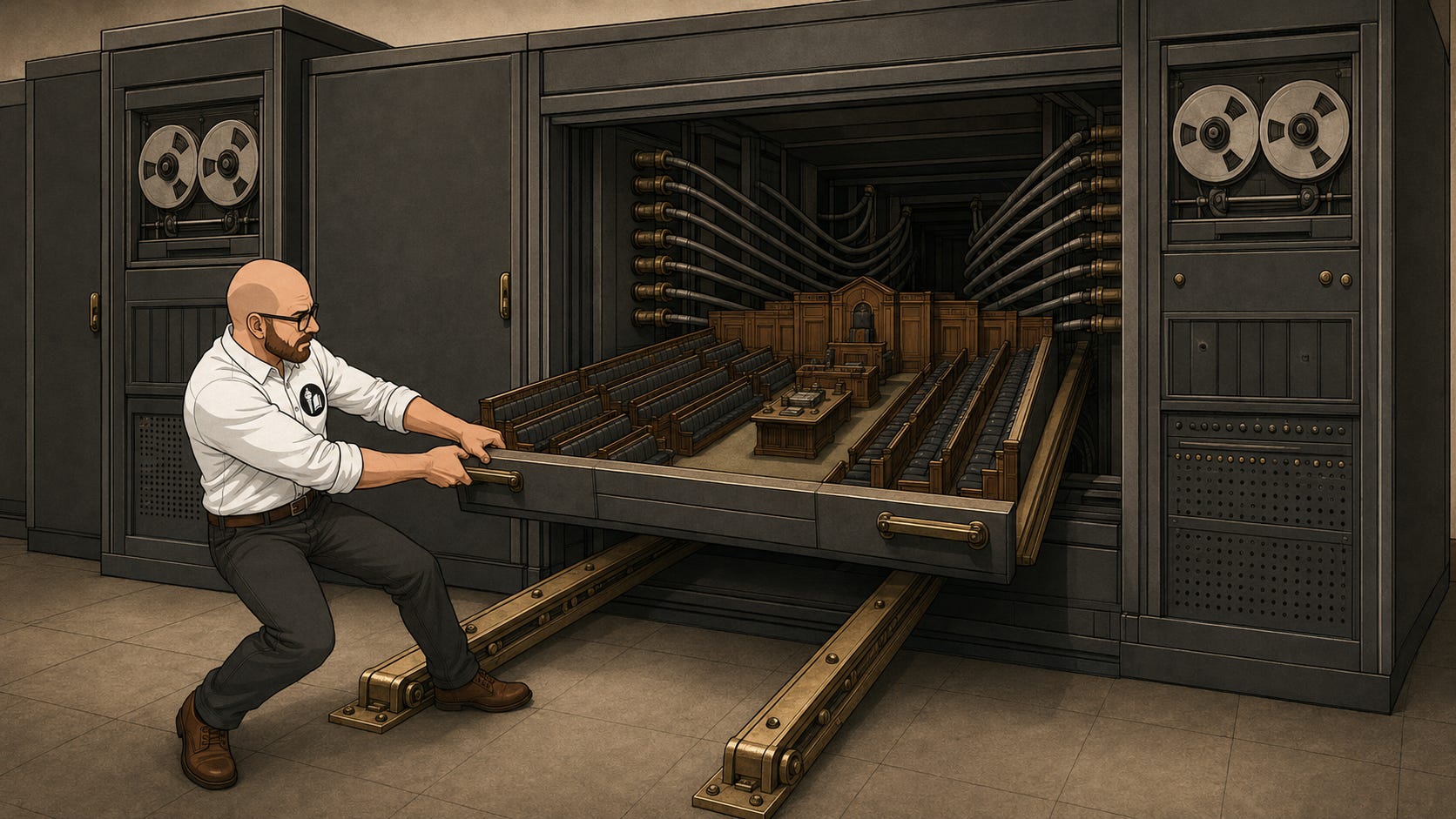
In the mid-1970s, Ottawa was gripped by a specific, high-voltage anxiety. It wasn’t just the specter of inflation or the energy crisis; it was the silent, algorithmic takeover of the national economy by multinational giants. At the center of this storm stood IBM Canada, a subsidiary so powerful, efficient, and integrated into the American mothership that it functioned almost as a state within a state.
The mood was captured by a single, haunting line in the introduction of a government report filed in December 1976: “This is a Tale of Power.”
The document was Study No. 14 of the Royal Commission on Corporate Concentration. Authored by Marcel Côté, Yvan Allaire, and Roger-Emile Miller, it was not merely a financial audit. It was an autopsy of the “branch plant” economy at its most sophisticated. While politicians debated sovereignty in the House of Commons, IBM Canada was operating a machine so profitable and so dominant that it forced the Canadian government to ask a fundamental question: In the age of the mainframe, does the state control the corporation, or does the corporation control the state?
The “New Leviathan”
To understand the stakes of 1976, one must appreciate the sheer gravity of “Big Blue.” The Royal Commission noted that if U.S. Steel was the paradigmatic corporation of the early 20th century, and General Motors defined the middle decades, IBM was the undisputed avatar of the modern era.
By 1975, the IBM Corporation sat on a cash hoard of $4.7 billion—a war chest that exceeded the reserves of many nations. In Canada, its dominance was absolute. The Commission estimated that IBM controlled approximately 35% to 36% of the entire computer systems market. But this figure masked the true extent of its influence. In the “mainframe” sector—the heavy iron that ran banks, insurance companies, and government payrolls—IBM’s grip was tighter.
The Commission’s researchers found that IBM Canada’s profitability was staggering. In 1975, while the average Canadian manufacturing firm scraped by with a 7.8% profit on sales, IBM Canada posted an 18% margin. This discrepancy wasn’t just good business; in the political climate of the 1970s, it was a liability. It suggested that IBM possessed “market power”—the ability to set prices above competitive levels without fear of reprisal.
The researchers even attempted to calculate the “allocative inefficiency” caused by this dominance—the deadweight loss to the Canadian economy due to monopoly pricing. Their estimate was $3.2 million for the year 1975. While a small fraction of IBM’s $500 million in sales, the number was symbolic. It represented the “tax” Canada paid for relying on a single foreign provider for its digital nervous system.
The World Product Mandate: “Autonomy by Isolation”
The heart of the Commission’s study—and its most enduring lesson for Canadian economic policy—was its analysis of the “World Product Mandate.”
Critics of foreign ownership often viewed subsidiaries as “miniature replicas” of their parents, inefficiently producing a full line of products for a protected local market. IBM was different. It didn’t just make what Canadians bought; it integrated Canada into a global assembly line through a policy of “rationalization”.
Under this system, IBM Canada fought for the exclusive right to manufacture specific products for the entire world. In exchange, it imported almost everything else.
The Commission detailed how this system played out on the factory floor. The plant in Toronto was designated as a “General Systems” facility, while the plant in Bromont, Quebec, became the battleground for a fierce internal corporate struggle. Originally built to produce substrates (component bases), the Bromont facility faced obsolescence as technology shifted. To save the plant, IBM Canada’s management had to lobby the parent company in Armonk, New York, for a new mission.
They won the mandate for typewriters and “key entry” products.
This victory, however, exposed the friction between corporate strategy and national ambition. The Canadian Department of Industry, Trade and Commerce (ITC) was reportedly frustrated. They wanted IBM Canada to produce “high technology” hardware—CPUs, memory units, the “brains” of the computer. Instead, under the rationalization plan, Canada was assigned the “fingers”—typewriters and keyboards.
The Commission authors defended IBM’s choice, arguing that software and electromechanical devices offered a more stable employment base than the volatile semiconductor industry. Yet the tension remained: Canada was a net exporter of office products but deeply dependent on the U.S. for the high-end computing logic that ran the nation.
The “Bohemian Grove” Hypothesis
Beyond economics, the Royal Commission was tasked with investigating “Political Power.” Did IBM Canada use its size to subvert democracy?
The authors examined what sociologists called the “Bohemian Grove” hypothesis—the idea that elites coordinate policy through interlocking directorships and private clubs. They scrutinized the Board of Directors and the company’s lobbying efforts, which were channeled discreetly through the Canadian Business Equipment Manufacturers Association (CBEMA) rather than via flashy public campaigns.
The verdict was surprising. The Commission found little evidence of heavy-handed political interference. In fact, they discovered that IBM Canada was often too careful. The company was so terrified of being perceived as a “bad corporate citizen” that it over-corrected.
For example, in 1973—years before the strict language laws of Bill 101 were enacted in Quebec—IBM Canada voluntarily published a policy to establish fully bilingual operations in the province. They didn’t do this out of altruism, but out of survival instinct. As a multinational, they knew their “legitimacy” was fragile. They had to be more Canadian than the Canadians.
However, this corporate citizenship had limits. The report noted that IBM’s “self-imposed decision rules” included adherence to U.S. laws regarding political donations, which once “unwittingly contravened” Canadian practices. The subsidiary was autonomous, but the leash to Armonk was never cut.
The Verdict on Breaking Up Big Blue
By the end of the 1970s, the U.S. government was deep into a massive antitrust suit aimed at breaking up IBM. The Canadian Commission asked the “What If?” question: Would Canada be better off if IBM were shattered into smaller companies—one for CPUs, one for peripherals, one for maintenance?
The authors concluded with a warning. A breakup, they argued, would likely hurt the consumer. A spin-off “CPU Company” would lack the integrated sales force and maintenance network that corporate clients relied on. The “Peripherals Company” would face brutal competition and likely fail to support the R&D pace required to keep the systems running.
“It is our contention,” the authors wrote, “that the marketplace is benefitting from IBM’s expertise”.
It was a pragmatic, almost resigned conclusion. IBM had successfully woven itself into the fabric of the nation. It provided the efficiency Canada needed, even if the price was a permanent dependency on American innovation. The “Tale of Power” ended not with a revolution, but with a renewed contract: Canada would accept the dominance of the multinational, provided it kept the factories in Bromont open and the mainframes running on time.
If you enjoyed this deep dive into the archives of corporate power, consider subscribing to the Hansard Files. We dig through thousands of pages of forgotten commissions and reports to uncover the history that shaped the modern economy.
Source Documents
Côté, M., Allaire, Y., & Miller, R. (1976). IBM Canada Ltd.: A Case Study (Study No. 14). Royal Commission on Corporate Concentration.
Great article! I'm surprised I haven't come across this Royal Commission until now. Unfortunately, a similar Royal Commission today would likely reach the same conclusion: that the current Microsoft monopoly is beneficial to the market.
Typical Canada... "The authors concluded with a warning. A breakup, they argued, would likely hurt the consumer.
Dominion of Canada policies prefer oligopolies over competitive marketplaces.
I hadn't realized that fully until I was active with GOSLING (Getting Open Source Logic INto Government), founded in 2002.
(Some articles from that era that are still partly online)
https://www.cbc.ca/news/science/an-open-door-for-open-source-1.810739
https://openhealthnews.com/news-clipping/2012-05-09/open-source-government-can-save-canada-billions-group
(Last snapshot of the website before we gave up the domain name - Group was most active the first decade, but before the 20th anniversary had fizzled out)
https://web.archive.org/web/20221006020517/http://www.goslingcommunity.org/
During that era I found that several government agencies explicitly indicated they wanted to source from sole-source-sole-proprietorship software vendors (some call “proprietary software”), and didn't want the “complexity” of a competitive market for support possible with Free/Libre and Open Source Software (FLOSS). There were claims about TCO (Total Cost of Ownership) that really only applied if agencies continued to treat FLOSS the same as sole-source software, with policies continuing to treat software as something that is outsourced entirely to large private sector vendors.
In the 1970's when that report was written, software wasn't yet clearly under copyright, so the oligopolies only applied to the hardware. Now that Canada has followed the USA in allowing software patents, software oligopolies are created by government policy via procurement policies, software patents and software copyright. The control of Canadian government by predominantly US entities has continued. Unlike hardware, software is a set of rules that should be seen as a form of policy directly impacting the sovereignty of governments to implement their own policies.
https://lessig.org/product/codev2/