


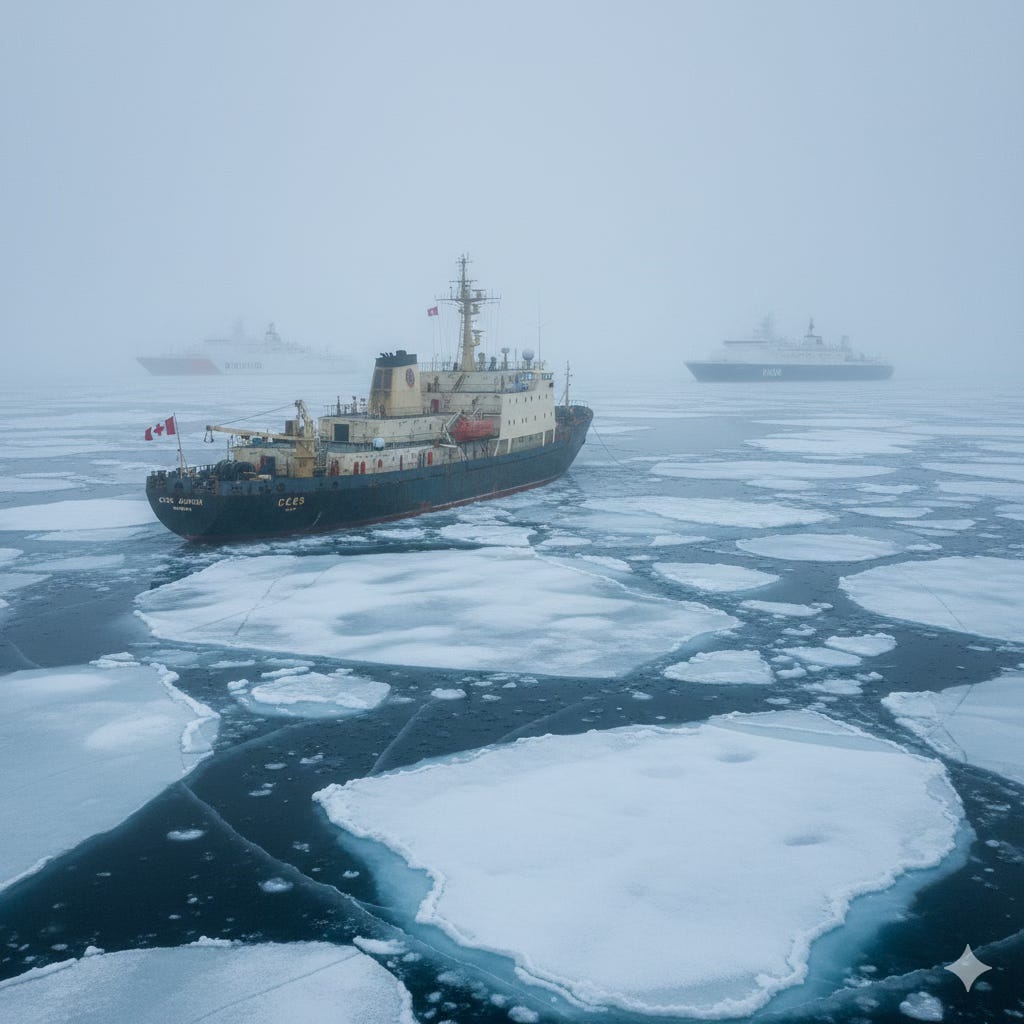
You probably think Canada is a global leader in the Arctic. It’s our backyard, after all. We have the second-largest Arctic territory on Earth. We see the photos of polar bears, we hear the speeches, and we assume someone, somewhere, has a plan.
That assumption is dangerously wrong. A new parliamentary report reveals a stunning gap between the crisis unfolding in the North and Canada’s ability to respond. The Arctic is warming at a terrifying rate, but our response is underfunded, uncoordinated, and unprepared.
But here's what everyone misses... this isn't an environmental story. Your view of this problem isn't wrong because of ideology. My data shows it's because this is being framed incorrectly.
This is a story about national sovereignty. It’s about houses washing into the sea, supply chains breaking down, and foreign powers noticing our absence. The real crisis isn't just melting ice; it's the slow-motion collapse of Canada's control over its own territory.
The Ground is Literally Disappearing Beneath Their Feet
Before we get to the government's response, you need to understand the scale of the problem. Witnesses told Parliament that the Arctic is warming two to six times faster than the global average. This isn't a distant, abstract number. It has brutal, real-world consequences.
Think of it like this: the Arctic’s foundation is ice. Sea ice is the highway for travel and hunting. Permafrost, ground that's been frozen for years, is the foundation for buildings, roads, and airstrips.
Both are disappearing.
Melting Sea Ice: Unpredictable ice makes travel and hunting, essential parts of life and culture, incredibly dangerous.
Thawing Permafrost: This causes buildings and runways to become unstable. One expert testified that 50% of Arctic infrastructure could be at risk of damage by 2050.
Extreme Weather: Wildfires and floods are becoming more common. One witness shared the story of a former grand chief who lost her home to a flood in 2021, rebuilt in a nearby community, and then lost her new house to a wildfire two years later.
This isn't just about infrastructure. It’s about food security, as changing ecosystems disrupt hunting. It's about health, as new diseases emerge in the warming climate.
Canada’s Research Plan: A Single, Aging Ship and A Lot of Paperwork
So, how is Canada responding to this five-alarm fire? The report paints a picture of a system that is well-intentioned but fundamentally broken.
We have research stations like the Canadian High Arctic Research Station (CHARS). But witnesses noted it’s in the western Arctic, leaving a massive gap in the east. It's like having one fire station in Vancouver and expecting it to cover everything to Toronto.
We have funding programs. But they are described as "intermittent" and not keeping pace with the sky-high costs of northern research. One researcher said a single charter flight that cost $7,000 a few years ago was expected to cost $10,000 in 2024.
Then there’s our flagship research vessel.
Did You Know? Canada’s only Arctic research icebreaker, the Amundsen, is 45 years old. A typical ship's lifespan is 30 to 50 years. Parliament was told it’s taken Canada 18 years just to build a new (non-research) icebreaker.
This is the core problem: a "fly in-fly out style" of research where southern scientists arrive, gather data, and leave. There's not enough long-term funding, not enough coordination between government departments, and not enough local infrastructure to support a real, sustained presence.
The Big Revelation: This Isn't About Climate, It's About Sovereignty
This failure to invest in Arctic research and infrastructure has created a vacuum. And other countries are noticing.
Witnesses warned Parliament that China is attempting to invest in and purchase property and businesses in Canada's Arctic. The United States still denies Canada's claim over the Northwest Passage. And Russia is testing our maritime boundaries.
While we struggle with unreliable internet and a housing crisis so severe that overcrowding is at 55%, other nations are moving in. One witness highlighted the absurdity of the main hotel in Iqaluit being fabricated in and imported from China due to a lack of local construction capacity.
Our inability to monitor our own territory is alarming.
Only 20% of the Arctic ocean floor has been mapped to modern standards. We can't manage shipping, protect ecosystems, or assert our sovereignty if we don't even know what’s there.
The report’s quiet conclusion is that our research deficit is a national security threat. Without a permanent, well-funded, and coordinated presence, we are effectively abandoning our northern border.
From Passive Reader to Informed Watchdog
The Standing Committee on Science and Research issued 20 recommendations. They call for everything from replacing the Amundsen to developing a comprehensive, cross-departmental Arctic research strategy.
These are not small tweaks. They represent a fundamental overhaul of Canada's approach to its own territory.
You're not just a passive citizen reading another government report. You're now an informed watchdog. You understand that the stories of melting permafrost are directly linked to our national security. You see that an aging icebreaker isn't just a maintenance issue; it's a symbol of a massive strategic failure.
This isn't about the North. It's about Canada. Share this with someone who thinks Canada has its act together. Ask your elected officials what they are doing to implement these 20 recommendations. The fog in Ottawa is thick, but the melting ice in the Arctic waits for no one.
For more deep dives into Canadian governance, follow OnHansard at onhansard.substack.com.
Sources:
House of Commons Standing Committee on Science and Research. (2024, December). Science and Research in Canada's Arctic in Relation to Climate Change. 44th Parliament, 1st Session.