


The fog on the water was thick enough to hide the world. It was June 1928, and the Canadian Government Ship Montcalm was cutting through the grey swell of the North Atlantic, headed for the icy throat of the Arctic. On board was B.W. Taylor, a biologist charged with a task that seemed almost impossible amidst the gale-force winds and crushing ice floes. He was there to document the invisible life of the ocean, to drop nets into the freezing black depths and see what stared back. But as the Hudson Strait Expedition pushed further north, Taylor would find that his greatest adversary was not the biting cold or the towering icebergs, but the crushing weight of logistics and a mission that often treated science as a nuisance.
Taylor’s diary of that summer reads less like a clinical log of specimens and more like a testament to human persistence. It captures the repetitive, freezing grind of early oceanography, where data was bought with frostbitten fingers and sleep deprivation. He was a passenger in a chaotic world of supply runs, plane crashes, and lost men, trying desperately to lower a glass bottle into the sea before the captain ordered full steam ahead.
Into the Mist
The expedition began with a deception of weather. Leaving Quebec on June 24, the air was a manageable 11 degrees Celsius, but the omens were immediate. By the time they reached Father Point at 3:00 A.M., the mist had already descended, and a sick man had to be offloaded into the dark. Taylor wasted no time. His routine was punishingly simple: wake at 4:00 A.M., stand on the heaving deck, and throw drift bottles into the wake every fifteen minutes. These bottles, numbered 9390 to 9523, were silent messengers sent to track the currents of the Gulf, bobbing away into the fog that would plague the ship for weeks.
By June 27, the sun was a rumor. Taylor noted that while they could see the sky directly overhead, the ship was walled in by a dense mist on all sides. The temperature of the surface water began to drop, sliding from 11 degrees to 7 degrees as they pushed toward the Strait. Then came the ice. On the evening of June 28, a small iceberg materialized a quarter of a mile off the bow. It was the vanguard of the frozen armada waiting for them.
The Montcalm was not a dedicated research vessel; it was a workhorse, heavy with supplies and iron ballast. This reality struck Taylor early. On June 29, they anchored in Forteau Bay to escape bad weather, and he discovered the ship’s compass was thirteen degrees off. The culprit was a load of iron ballast stored in the forward launch. It was a detail that foreshadowed Taylor’s summer: the tools of his trade would constantly be at war with the heavy, industrial reality of the expedition.
The Life Beneath the Ice
As July broke, the Montcalm entered the true north. The water temperature plummeted to 4 degrees Celsius. On July 3, snow-capped mountains appeared through the drizzle, and the ship arrived at Port Burwell. While the crew unloaded supplies, Taylor went to work. He wasn’t looking for the charismatic megafauna of the Arctic; he was hunting the small, the strange, and the overlooked.
He scrambled along the rocky shorelines, collecting amphipods and “sea lice” from the tidal pools. He found periwinkles, barnacles, and the remains of dead crabs. In a small brook, he accidentally squashed a black ant with a swollen abdomen, noting its spherical shape with scientific regret. The life here was tenacious. He observed mosquitoes and black flies that were already present, waiting for the brief explosion of summer warmth.
But the ocean was where the true mystery lay. On July 5, en route to Wakeham Bay, the ship smashed through heavy ice. The surface temperature was a near-freezing 1 degree Celsius. The fog was so thick the world was reduced to the ship’s rail and the grinding white pans below. In this whiteout, tragedy and brutality were constant companions. A polar bear, weighing nearly a ton, was shot late one night while feeding on a square-flipper seal. Taylor, ever the scientist, hoped to secure the os penis—the penile bone—of the great beast for his collection. He was disappointed to learn it was reserved for the Deputy Minister, a stark reminder of the political hierarchy even in the desolate north.
Science on the Fly
The central conflict of Taylor’s diary is the struggle to get his equipment in the water. He was tasked with making “sections”—taking systematic samples of water and life at specific depths across the Strait. But the Montcalm had other priorities. On July 11, at Sugluk Creek, Taylor borrowed the skipper’s dory to tow his nets. He managed two tows before Captain Hearn ordered him out of the water.
The ship’s own launch was useless to him. It was built for speed, not the slow, steady pace required to drag delicate silk nets through the water without ripping them apart. When he tried to use it on July 20, the speed was too great, and his Number 18 net was damaged. He was forced to retreat to the poop deck, casting his nets from the stationary ship like a man fishing off a pier, hoping the tide would do the work for him.
Despite these handicaps, Taylor’s collection grew. He bottled jellyfish, ctenophores, and “sea cherries”—strange red tunicates that looked like fruit but were animals. He collected sculpins with roundworms in their bellies and a “fish doctor,” a large ectoparasite taken from a codfish. His cabin became a cabinet of curiosities, filled with jars of formalin preserving the alien biology of the Strait.
The weather conspired against him at every turn. For days at a time, the Montcalm would roll in gale-force winds, making delicate microscopy impossible. On August 18, he finally had a chance to use his reversing thermometers, precision instruments designed to record deep-water temperatures. They failed. One refused to reverse; the other was erratic. In the same attempt, the rope snapped, and he lost a net to the depths. It was a crushing blow. The gear, stored in the damp between-decks rather than his cabin, had likely been jostled out of alignment.
The Lost Men and the Glowing Sea
The expedition was not just biologically challenging; it was physically dangerous. On August 1, near the base at Cape Hopes Advance, Taylor went ashore with a construction gang. Two men attempted a shortcut back to the ship and vanished into the fog. The Montcalm sounded its siren every five minutes through the night, firing sky rockets into the gloom. The next morning, Taylor joined the search parties, tramping over the rocky, unforgiving terrain. The men were eventually found, but the incident underscored the fragility of life in the Strait.
Yet, amidst the danger, there were moments of ethereal beauty. On the night of August 31, anchored in Eric Cove, Taylor threw small objects into the black water to test for luminescence. The sea answered. flashes of pale yellow-green light erupted in the dark. He hauled up a dredge from the bottom, and the mud and nets were sparkling with the same ghostly fire.
He traced the light to large amphipods—shrimp-like crustaceans that seemed to glow when agitated. He filled a bucket with seawater and these creatures, watching the flashes illuminate the dark deck. It was a moment of pure discovery, a glimpse of the bio-luminescent fireworks hidden beneath the ice, seen only by a man awake at 2:00 A.M. while the rest of the ship slept.
The Fight to Stay
By September, the season was turning. The “summer” had been a wet, foggy disappointment. Snow began to fall on September 2. Taylor’s frustration reached a breaking point. He had successfully calibrated a section between Eric Cove and Nottingham Island, but his gear was failing, and the ship’s itinerary left him little time for real science.
On September 3, he sent a radiogram to Dr. Huntsman at St. Andrews, New Brunswick. The message was terse and desperate: “Gear not satisfactory. Major McLean informs no further sections possible... Anxious to arrive McGill for fall term.” He wanted to salvage what he could of the season by getting back to the university.
But the Arctic does not release its grip easily. Taylor requested to be put ashore at Wakeham Bay to wait for the Canadian Voyageur, a ship that would not sail until October. He argued that he could do more work on the shore, collecting specimens from the tidal pools, than he could trapped on the Montcalm. Major McLean refused. No reason was given. Taylor was forced to stay aboard, unpacking his crate of apparatus to catch whatever scraps of opportunity the schedule allowed.
The Long Voyage Home
The end of the expedition was a slow, rolling endurement. Taylor eventually transferred to the Morso, a small three-masted schooner equipped with oil motors, for the journey back to Newfoundland. The quarters were cramped, and the ship pitched violently in the autumn gales.
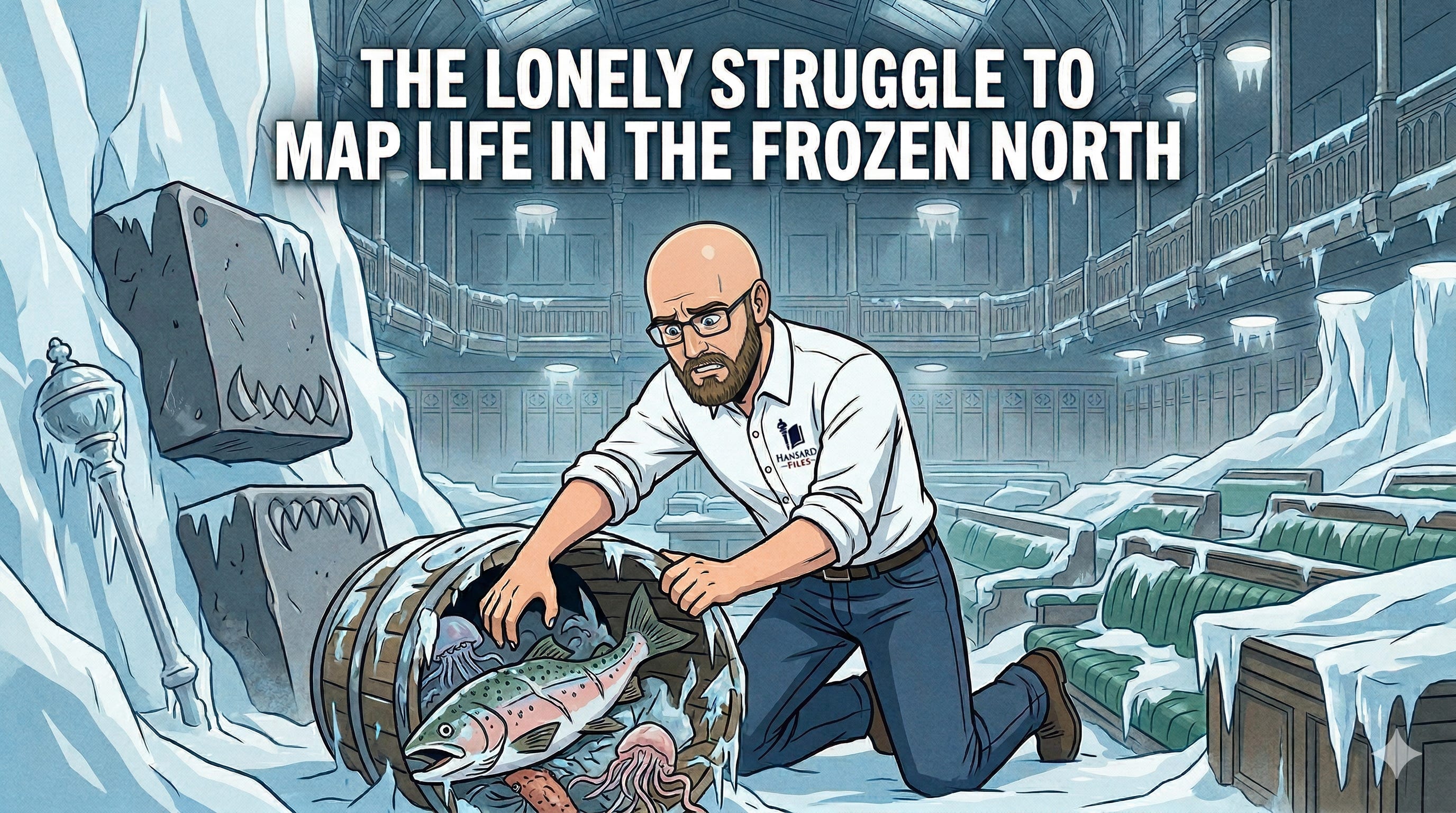
The final entry of the diary records a heartbreaking loss that serves as a perfect metaphor for the entire trip. Taylor had been given a magnificent specimen: a trout weighing between eight and nine pounds, measuring 70 centimeters in length. He had preserved it in a large barrel, a prize meant for the laboratories in Toronto.
Somewhere in the heaving Atlantic, as the Morso fought the waves, the ballast in the hold shifted. The heavy rocks crashed into the barrel, smashing it open and crushing the contents. The giant trout, the bird specimens, the sculpins—months of work—were destroyed. Taylor was forced to shovel the mangled remains of his prize collection overboard, returning them to the ocean he had fought so hard to document.
He arrived in St. John’s on October 7, thirteen days after leaving the Strait. He had his jars of amphipods, his notes on the glowing sea, and the memory of the fog. He had battled the ice, the bureaucracy, and the iron ballast, and though the sea had reclaimed his greatest trophy, he had dragged a piece of the unknown north back to civilization.
The Hansard Files digs through the archives to find the human stories buried in the dust of official reports. Subscribe today to support independent historical investigation.
Source Documents
Taylor, B. W. (1928). Diary of B. W. Taylor on Canadian Government Expedition to Hudson Strait. Biological Board of Canada.
Boy, doesn't that sound like a fun summer!! lol