


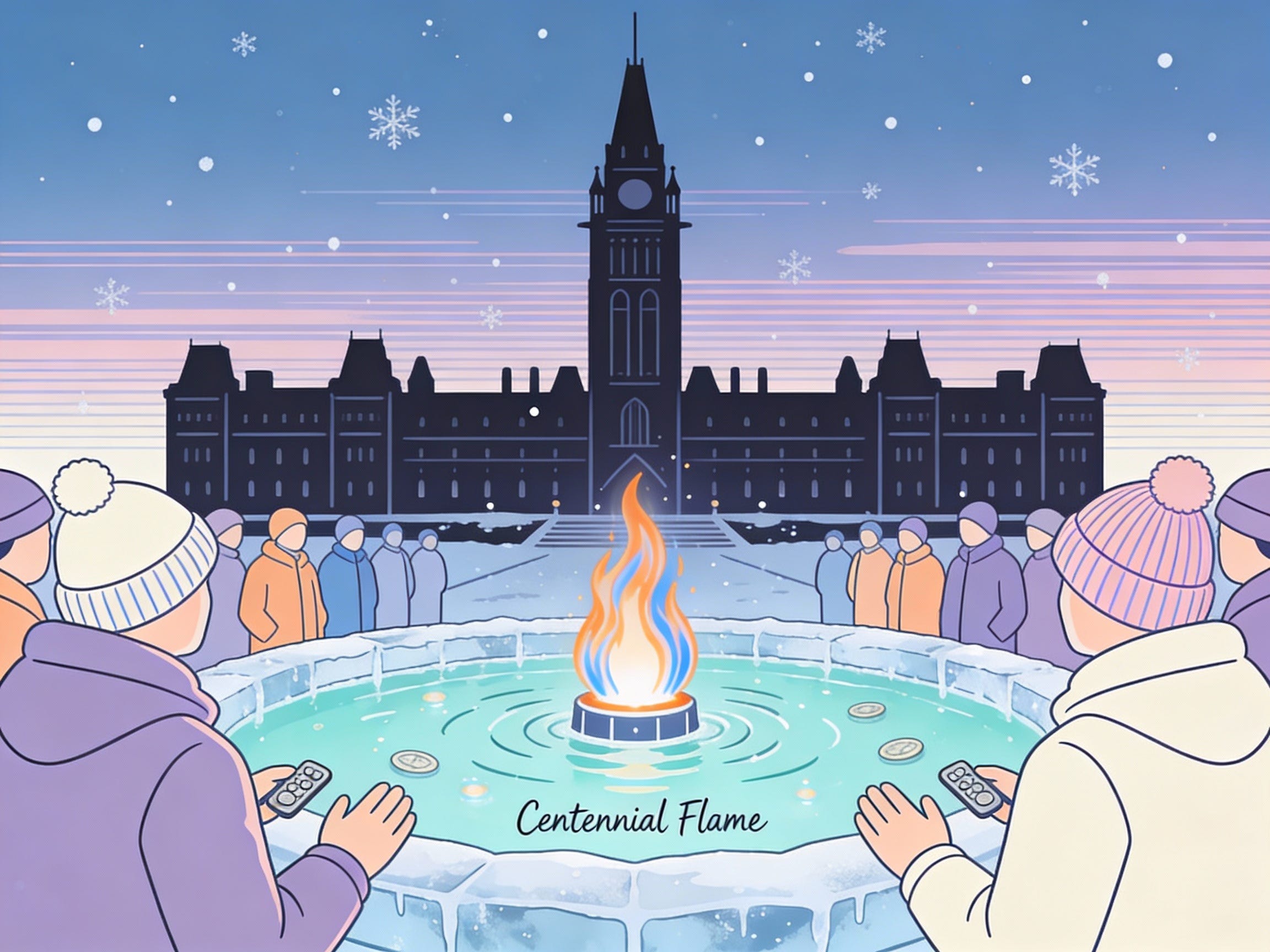
It was twelve degrees below zero on the lawn of Parliament Hill, and the wind coming off the Ottawa River made it feel like the end of the world. But on the night of December 31, 1966, twenty-five thousand Canadians stood shoulder-to-shoulder in the snow, waiting for a Prime Minister who looked older than his years to light a fire. They were gathered for the birth of the Centennial Flame, a monument that—like the country it celebrated—was fragile, experimental, and not expected to last.
The narrative of Canada’s 100th birthday is often remembered through the hazy, technicolor lens of Expo 67, a summer of miniskirts and monorails. But the reality of that New Year’s Eve was starkly different. The year 1966 had been a bruising, ugly period in Canadian politics, defined by the Munsinger sex scandal, a minority government teetering on collapse, and a vicious, personal bitterness between Prime Minister Lester B. Pearson and Opposition Leader John Diefenbaker. As the clock ticked toward midnight, the flame wasn’t just a party favor. It was a desperate act of illumination in a capital city consumed by political darkness.
A Light in the Frozen Dark
To understand the tension on the Hill that night, one must understand the fragility of the nation in the winter of 1966. The “Quiet Revolution” in Quebec was becoming louder and more volatile; the Front de libération du Québec (FLQ) had already begun its campaign of bombings, and the spectre of separatism haunted every federal decision. The Great Flag Debate of 1964 had left deep scar tissue across the electorate, with many traditionalists still mourning the loss of the Red Ensign.
Pearson, the diplomat who had won a Nobel Peace Prize for solving the Suez Crisis, found himself unable to broker peace in his own Parliament. He was tired. His government was surviving day-to-day. The Centennial celebrations were viewed by cynics as a billion-dollar distraction for a country that might not survive to see its 101st year.
The plan for New Year’s Eve was audacious in its simplicity. The government would light a natural gas flame in a fountain at the foot of the Peace Tower. The symbolism was heavy-handed: fire and water coexisting, just like the French and English, or the federal and provincial governments. But the engineering was precarious. Natural gas would be bubbled up through the water, ignited at the surface to create the illusion of fire dancing on liquid. The constant motion of the bubbles would prevent the water from freezing in the Ottawa winter.
Or so the engineers hoped. As the temperature plummeted on New Year’s Eve, the metal of the fountain—embossed with the shields of the twelve provinces and territories (Nunavut was decades away)—contracted in the cold. The crowd, bundled in wool and fur, pressed against the barricades. They hadn’t come for the politics. They had come to see if the government could actually make something work.
The Temporary Monument
The most striking fact about the Centennial Flame was that it was never designed to be permanent. It was a prop. The Department of Public Works had authorized its construction solely for the duration of the Centennial year. It was listed as a temporary installation, destined to be dismantled and scrapped on January 1, 1968.
This impermanence was a fitting metaphor for the anxiety of the era. In 1967, Canada felt temporary. The map was shifting. The British connection was fading—”God Save the Queen” was slowly being displaced by “O Canada,” though the latter wouldn’t become the official anthem until 1980. The United States was bogging down in Vietnam, and draft dodgers were drifting north, changing the cultural fabric of Canadian cities. The tectonic plates of the culture were grinding together, and the flame was merely a cosmetic patch over the fault lines.
Yet, as the clock struck midnight, something shifted.
The bells of the Peace Tower began to toll. A roar went up from the crowd that reportedly shook the snow from the trees. Prime Minister Pearson, flanked by his nemesis Diefenbaker and Secretary of State Judy LaMarsh, stepped forward. He ignited the gas.
It didn’t explode. It didn’t fizzle. It roared to life, a jagged crown of orange and blue fire dancing atop the black water. The heat radiated outward, hitting the faces of the people in the front row. For a moment, the cynicism of 1966 evaporated. The press reported that strangers hugged strangers. In a rare moment of suspended hostility, the political class stood silent, illuminated by the same fire.
The Fire That Refused to Go Out
The flame was supposed to burn for twelve months. But a curious phenomenon began almost immediately. The fountain became a pilgrimage site.
In the days and weeks following the lighting, visitors began throwing coins into the water. It wasn’t just pennies; tourists tossed silver dollars, quarters, and foreign currency into the bubbling basin. It became a “wishing well” for the national conscience. The fire, fighting against the sub-zero temperatures and the snowstorms of January and February, became a stubborn symbol of resilience. It was a technical impossibility—fire in water—that mirrored the political impossibility of Canada itself.
By the time 1967 drew to a close, the public sentiment had shifted aggressively. The idea of extinguishing the flame was met with outrage. Letters poured into the Prime Minister’s office. The flame, the public argued, was no longer a prop. It was the hearth of the nation.
The government capitulated. The “temporary” gas lines were hardened. The maintenance schedules were revised. The Centennial Flame was granted a stay of execution, transforming from a birthday candle into an eternal flame.
A Legacy of Paradox
Today, the flame still burns, fueled by the same natural gas, bubbling through the same water. It remains a site of paradox. It is a monument to unity that has been the site of fierce protests. It generates heat in a city often accused of being cold. The coins thrown into the fountain are now harvested to fund a research award for persons with disabilities—a legacy of practical goodwill born from a symbolic gesture.
But looking back at the transcript of history, the true miracle wasn’t the engineering. It was the timing. On that freezing night in 1966, when the country felt like it was drifting apart, the flame provided a focal point. It forced the nation to look at the center, rather than the periphery.
Lester B. Pearson would retire a year later, his minority government having survived the storm. The Centennial year would go down as a triumph, a “last good year” before the October Crisis of 1970 shattered the peace once again. But on that first morning of January 1967, as the sun rose over a hungover and hopeful Ottawa, the fire was still burning. Against the odds, and against the ice, it stayed lit.
Source Documents
Canadian Broadcasting Corporation. (1966, December 31). New Year’s Eve ceremony celebrating Canada’s Centennial year. CBC Archive Sales.
Government of Canada. (n.d.). Parliament Hill grounds and the Centennial Flame. Public Services and Procurement Canada.
Library and Archives Canada. (n.d.). Lester B. Pearson: 1963-1968.
McIntosh, A. (2013). 1967 Centennial Celebrations. The Canadian Encyclopedia.
Pearson, L. B. (1975). Mike: The Memoirs of the Right Honourable Lester B. Pearson. University of Toronto Press.
What a moving article, on this new year. Canada exists and thrives despite all the internal and external influences. Challenging times are ahead and sometimes Canada moves as fast as a boulder stuck in a slow moving glacier. We’ll continue the journey.
Thank you!
This… I don’t think I ever heard the story in detail; only that the flame was initially lit in honour of our hundredth year as a nation. I was 16, a military dependent living on a Cold War base in Germany, and much more preoccupied with things other than the fate of our nation at that time. My interest in history and the events that post-dated WWII had barely begun.
Thanks for setting this reminder squarely in front of us at another historical milestone; the end of the year that saw Canada take a stand for its nationhood.