


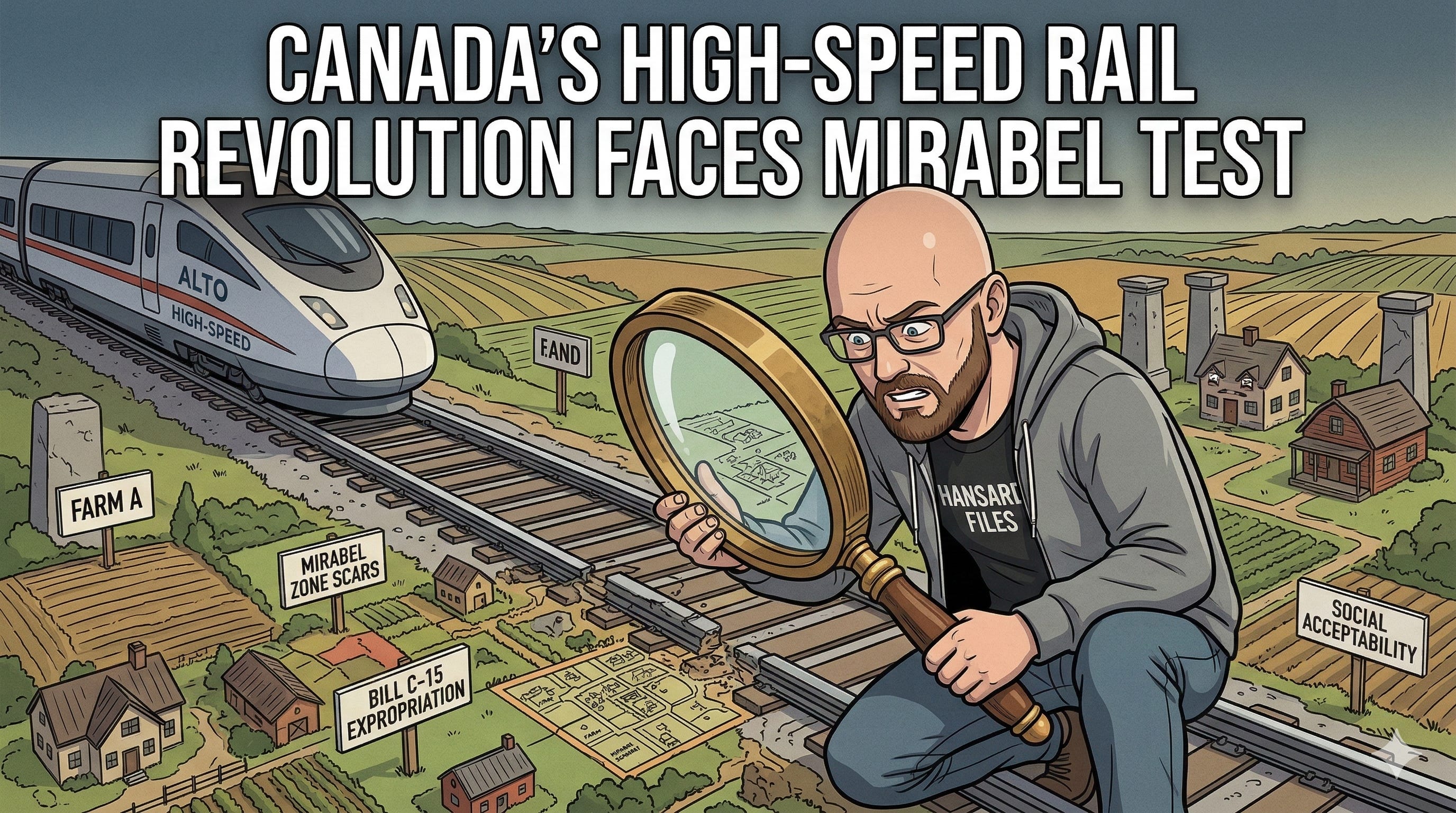
In the Senate chamber on February 24, 2026, Martin Imbleau, President and CEO of Alto, faced senators on the Standing Senate Committee on National Finance. The subject was the transformative high-speed rail Canada project linking Toronto to Quebec City over nearly 1,000 kilometres of fully electrified, dedicated passenger tracks. Fast, frequent and reliable service would cut travel times in half, ease pressure on highways and airports, and improve productivity in the corridor. Yet as Imbleau spoke, the human cost of progress loomed large.
The government chose the high-speed option over a conventional alternative last February, selected Cadence consortium as private partner, and funded development and pre-construction. In September it committed to a four-year construction start target and designated the project transformative. Phase one would connect Ottawa to Montreal via Laval, with construction eyed for 2029-30.
The Bold Vision for High-Speed Rail Canada
Imbleau described rapid progress. In 2025 the project moved from idea to reality. Four weeks earlier, corridor-wide consultations launched with open houses, virtual sessions and roundtables. Nearly 6,000 people attended open houses, 100,000 visited the online platform, and 6,000 comments poured in. Later that day an open house was set for Mirabel.
Imbleau stressed the need for a clear regulatory framework, including measures in Bill C-15, to deliver with certainty, on time and on budget. Without greater predictability, delays and cost overruns would follow.
Mirabel’s Scars Haunt the High-Speed Rail Canada Project
In Mirabel the past remains fresh. Government intervention left deep scars. The discussion was not starting today; it was ongoing. Public promoter credibility hinged on approach: arrive early, explain what remained undecided, listen before choices were made. Social acceptability would be decided here.
Indigenous consultations continued in parallel. Feedback from the broad corridor would refine the route for public presentation that fall. Environmental studies required for impact assessment were underway.
The bill modifies certain expropriation measures. Alto might resort to them, but in 2026 priority remained consultation, field studies, route identification and market purchases where possible. Tools such as right of first refusal would prevent land speculation and stop non-essential work from inflating values.
Balancing Farmland Protection and Progress
Senator Éric Forest raised concerns about sensitive areas and high-quality farmland, an asset vital to the country. Imbleau, a Saint-Hyacinthe native, replied that every square metre counts. The approach followed best practices: track existing infrastructure such as highways or power lines, branch off along water’s edge or property lines to avoid cutting land, and acquire only when no option existed. The line required 60 metres of right of way for two electrified tracks and an access road, far less than Mirabel airport scale. Voluntary agreements remained preferred. Fair, reasonable compensation and compassionate handling were non-negotiable.
Workforce, Connectivity and Senate Scrutiny
Senator Andrew Cardozo asked about Ottawa stations, use of existing lines, and youth employment. Imbleau noted the project would need 50,000 workers, many currently in high school or Indigenous communities. Partnerships with universities, colleges and training centres were already underway. The project had to feel “sexy” to attract tomorrow’s workforce.
Stations and intermodal links were critical. Options remained open for Ottawa, including Tremblay Road. Connections to Quebec City’s future tramway, Montreal’s REM and Ottawa light rail would enable integrated mobility. Airports could be served with separation; Canadians must be able to hop on high-speed rail Canada to reach them.
Cost remained a working assumption of $60 to $90 billion, a class-5 order-of-magnitude figure pending alignment and detailed engineering this fall. Economic analyses, including macro and micro studies plus third-party work from the C.D. Howe Institute and Statistics Canada job modelling, were advancing.
A Pivotal Week Across Senate Committees
The National Finance hearing unfolded amid intense Senate activity. The Agriculture and Forestry committee heard Fertilizer Canada urge formal recognition of 4R Nutrient Stewardship in Bill S-230, a national soil health strategy. The sector contributes over $42 billion annually and supports 118,000 jobs; 4R practices improve efficiency, protect soils and bolster food security and climate resiliency. The Banking committee examined Bill S-3 for regulatory flexibility on biofuels and low-carbon fuels. Transport and Communications received updates on climate resilience programs, including $4.1 billion already invested through the National Trade Corridors Fund and new Budget 2025 funds. Other panels covered Official Languages Act Part VII regulations and border security measures in Bill C-12.
The Path Forward for High-Speed Rail Canada
Predictability, voluntary agreements and genuine listening would decide whether high-speed rail Canada becomes a legacy of unity or repeats past mistakes. As Imbleau told senators, the approach mattered as much as the tracks themselves. The coming months would test whether Canada could build the future while honouring its past.
Hansard Files digs through dense parliamentary archives to surface these pivotal moments. Subscribe to support independent investigative journalism into Canada’s legislative heart.
Source Documents
Canada. Parliament. Senate. Standing Senate Committee on National Finance. (2026, February 24). Evidence.
Canada. Parliament. Senate. Standing Senate Committee on Agriculture and Forestry. (2026, February 24). Evidence.
Canada. Parliament. Senate. Standing Senate Committee on Transport and Communications. (2026, February 24). Evidence.
Canada. Parliament. Senate. Standing Senate Committee on Banking, Commerce and the Economy. (2026, February 25). Evidence.
Canada. Parliament. Senate. Standing Senate Committee on Official Languages. (2026, February 23). Evidence.
Canada. Parliament. Senate. Standing Senate Committee on National Security, Defence and Veterans Affairs. (2026, February 23). Evidence.
Canada. Parliament. Senate. Standing Senate Committee on Rules, Procedures and the Rights of Parliament. (2026, February 24). Evidence.
"As Imbleau told senators, the approach mattered as much as the tracks themselves. The coming months would test whether Canada could build the future while honouring its past." We hope.
High speed rail makes sense in some markets; Canada isn't one of them. Listening to the Laurentian Elites described the proposed project as "nation building" highlights how truly small is their vision of Canada... just Quebec to Toronto... Everything outside of that is irrelevant.