


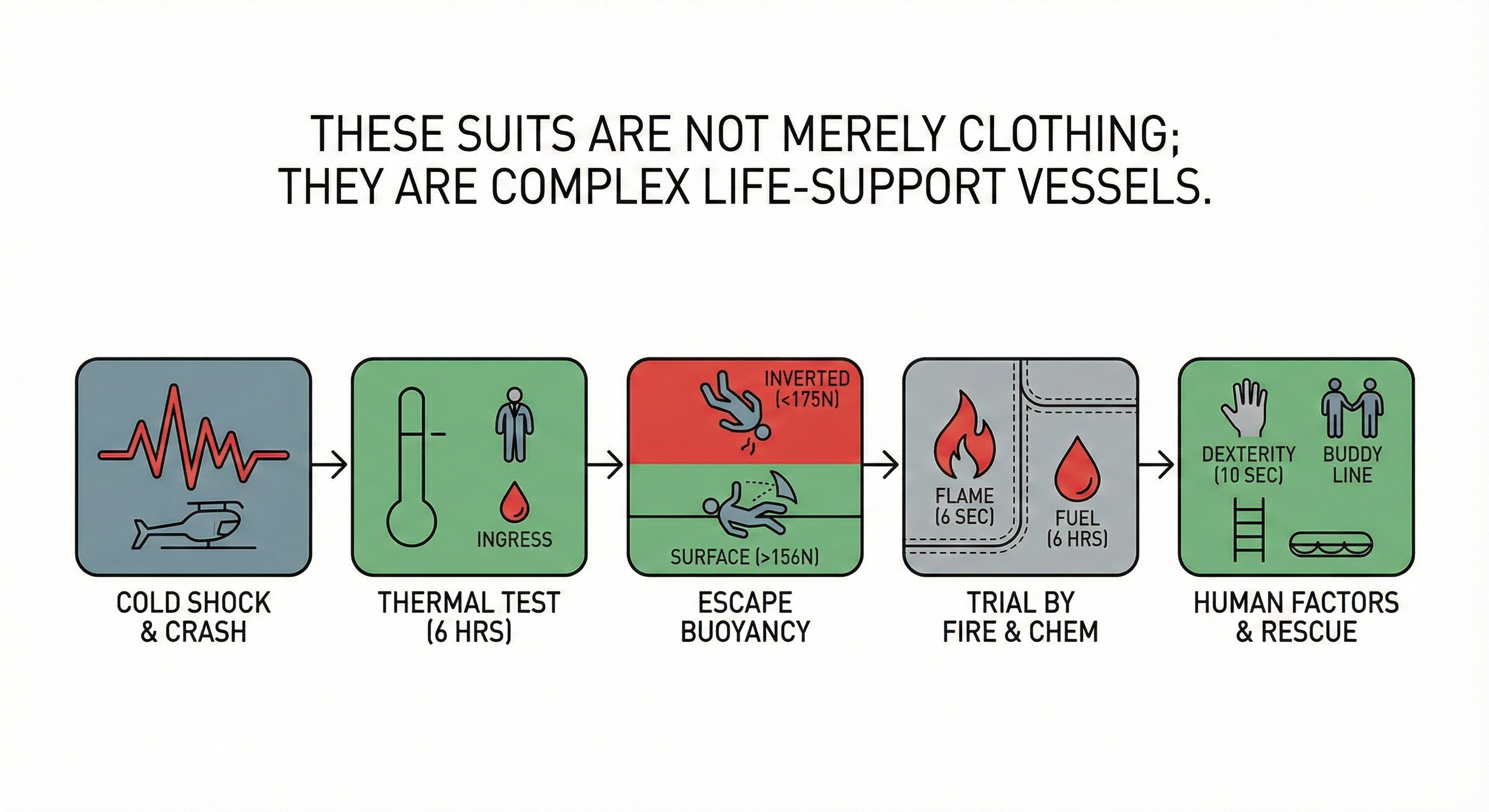
The shock of hitting freezing water triggers an involuntary gasp that can be fatal in seconds. For those travelling offshore, helicopter passenger transportation suit systems are the only barrier against the lethal combination of cold shock, hypothermia, and drowning. These suits are not merely clothing; they are complex life-support vessels designed to keep a human being alive in the most hostile environments on Earth. The Canadian General Standards Board has codified exactly what survival looks like in a document that was reaffirmed in December 2025. It outlines a gauntlet of trials involving fire, chemical baths, underwater inversions, and freezing tanks.
The standard defines the thin line between a recoverable survivor and a casualty. It assumes that help will come, but not immediately. It assumes the water will be near freezing. It assumes the helicopter may be upside down. Every stitch, seal, and valve in these suits is subjected to a battery of tests designed to replicate the violence of a crash and the slow, creeping lethality of the North Atlantic.
The Cold Equation
The primary enemy of the offshore traveller is not just the water, but the temperature. The standard sets a rigorous bar for thermal performance based on the realities of Canadian geography. A suit system must provide enough insulation to ensure that a wearer’s core body temperature does not drop more than two degrees Celsius over a six-hour immersion period in calm, fresh water between zero and two degrees Celsius.
This six-hour window is critical. It represents the time needed for search and rescue assets to locate and extract a survivor. The testing methodology to prove this capability is exhaustive. It involves human subjects or sophisticated thermal manikins submerged in controlled tanks. For human testing, subjects are instrumented with rectal probes to monitor core temperature and heat flux transducers taped to thirteen specific points on their skin, including the forehead, chest, and extremities. They float in near-freezing water, tethered in place, while technicians monitor their vital signs. If their core temperature drops by that critical two degrees, or if their finger or toe temperatures drop below five degrees, the test is terminated.
The standard acknowledges that a dry suit rarely stays perfectly dry in a crash. To simulate reality, researchers introduce a specific amount of water into the suit before the thermal test begins. This “water ingress” is calculated based on previous crash simulation tests. The test subject must maintain thermal equilibrium not in a pristine, dry suit, but in one that has potentially been compromised by the chaos of a ditching. This ensures that the insulation value holds up even when damp, preventing the water trapped inside from conducting body heat away too rapidly.
The Escape Paradox
A survival suit faces a contradictory engineering challenge: it must provide enough buoyancy to keep a survivor floating with their airway clear of the water, but not so much buoyancy that they are pinned to the ceiling of a sinking, inverted helicopter. This is the concept of “escape buoyancy.”
If a helicopter ditches and rolls over—a common scenario due to the high center of gravity of the rotor assembly—the occupants find themselves upside down, underwater, and disoriented. If their suits are too buoyant, the upward force will trap them against the seat or the fuselage ceiling, making it physically impossible to unbuckle and swim out through an exit window.
The regulations impose a strict cap on this force. The escape buoyancy cannot exceed 175 Newtons. To verify this, test subjects are strapped into an Underwater Escape Simulator (UES). This device is a facsimile of a helicopter fuselage, complete with four-point harnesses and aisle seats. The simulator is lowered into a pool and rotated 180 degrees, fully inverting the subject.
In this disorienting position, the subject must wait for all motion to stop. They hang suspended, holding their breath, while divers watch. They must then release their harness and egress through a window exit. The test requires that the suit’s inherent buoyancy does not fight the user so aggressively that they cannot escape. It is a terrifying validation of physics: ensuring the device meant to save you from drowning does not first cause you to drown inside the cabin.
Once the survivor clears the fuselage and reaches the surface, the requirements flip. Now, maximum buoyancy is required. The suit must provide a minimum flotation buoyancy of 156 Newtons. The wearer inflates auxiliary buoyancy elements—bladders typically located on the chest—to achieve this. The standard mandates that the suit must have enough stability to turn an unconscious person from a face-down position to a face-up position within five seconds. This “righting” capability is essential for survivors who may be injured or unconscious after the impact.
Trial by Fire and Chemistry
Before a passenger ever reaches the water, they may have to survive a fire. The crash environment is often awash in aviation fuel. The standard demands that the exterior fabric of the suit system be tested for resistance to flame exposure. In these tests, the suit is subjected to a propane flame. It must not sustain burning or continue melting for more than six seconds after removal from the fire.
Crucially, the integrity of the suit must remain intact even after this thermal assault. Researchers verify this by measuring water penetration before and after the burn test. The suit is submerged, and the wetted surface area on the undergarments is compared. A suit that survives the fire but melts into a sieve offers no protection against the freezing ocean that follows.
Beyond fire, the materials must withstand chemical degradation. Aviation turbine fuel, specifically kerosene-type fuels like Jet A-1, can dissolve or weaken synthetic fabrics and glues. Test samples of the suit’s exterior fabric and seams are immersed in fuel for six hours. After this exposure, they are subjected to tensile strength tests. The seams must retain a breaking strength of 150 Newtons, and the fabric must show no signs of cracking or swelling. The suit effectively has to be armor against the chemical environment of a crash site.
The durability testing extends to the physical violence of abandoning a platform or vessel. The “impact of jumping” test requires a subject to jump feet-first into a pool from a height of 4.5 meters—roughly the height of a helicopter deck or a ship’s lower rail. The suit must not tear, the inflatable bladders must not burst, and no components can detach. The subject must emerge uninjured. This simulates the desperate leap a survivor might make from a burning rig or a hovering aircraft.
The Breath of Life
Survival on the surface presents a new set of dangers, specifically the inhalation of water and the buildup of carbon dioxide. To protect the airway from breaking waves and wind-driven spray, suits are equipped with a spray shield. This transparent visor deploys over the face, creating a micro-environment for the survivor.
However, a sealed visor can become a trap if it does not ventilate properly. The standard requires rigorous testing of carbon dioxide levels inside the deployed shield. Test subjects float in a pool for five minutes with the shield down. A gas analyzer probes the air near their nose. The carbon dioxide level must not exceed 5 percent by volume at any point, and the average level must stay below 2.5 percent. This ensures that a survivor, likely hyperventilating from panic and cold shock, does not succumb to CO2 narcosis while waiting for rescue.
Visibility is another critical factor. The survivor must be able to see the horizon to orient themselves and spot rescue craft. The spray shield must be transparent and resist fogging. Furthermore, the suit itself must be highly visible. The exterior material must fall within specific chromaticity coordinates for yellow, orange, or red. Retro-reflective tape—material that reflects light back to its source—must be applied generously. At least 300 square centimeters of this tape must be visible above the waterline, with specific patches located on the hood and forearms. In the dark churn of the ocean, these reflective patches are often the only thing a searchlight will catch.
The Human Factor
A survival suit is useless if it cannot be donned quickly or if it renders the wearer immobile. The regulations recognize that dexterity is often compromised in emergencies. If the manufacturer’s instructions allow for the suit to be worn unsealed inside the helicopter, the wearer must be able to fully close all seals and don the hood within ten seconds. This “ten-second rule” accounts for the sudden rush of water into a cabin.
Once in the water, the survivor must be able to perform “critical survival actions” within two minutes. These actions include inflating the buoyancy bladders, deploying the spray shield, and activating any locator beacons. The testing accounts for different configurations of hand protection. If the wearer is wearing thick gloves, the controls and pulls must be designed to be operable with reduced tactile feedback.
The “buddy line” is another mandatory component that speaks to the psychology of survival. It is a length of cord or webbing that allows survivors to tie themselves together, preventing drift and offering mutual support. The standard requires this line to withstand a pull of 750 Newtons—roughly the weight of an average person—without breaking. However, it must also have a quick-release mechanism operable under load, ensuring that if one survivor sinks or is caught by debris, they do not drag the group down with them.
Finally, the suit must not prevent the survivor from helping themselves. Mobility tests measure the time it takes for a wearer to climb a ladder and walk a distance of 120 meters. The suit cannot increase the time required for these tasks by more than 10 percent compared to a person not wearing the suit. If a survivor manages to reach a life raft, they must be able to board it unassisted. In testing, ten out of twelve subjects must successfully haul themselves from the water into a raft while wearing the fully inflated suit.
The Margin of Safety
The document CAN/CGSB-65.17-2020 is a catalog of worst-case scenarios translated into engineering metrics. It quantifies the hostile forces of nature and mechanics—fire, ice, pressure, and impact—and sets the threshold that human ingenuity must meet to defeat them.
Every requirement, from the 150 Newton seam strength to the 120-millimeter freeboard, represents a lesson learned from past maritime tragedies. The standard ensures that when a helicopter passenger steps onto a flight over water, the bulky, uncomfortable suit they wear is not just a regulatory formality. It is a tested, validated system designed to buy them the most precious commodity in a disaster: time. The difference between a recovery mission and a rescue mission is often measured in the degrees of insulation and Newtons of buoyancy mandated by these pages.
Source Documents
Canadian General Standards Board. (2025, December). Helicopter passenger transportation suit systems (CAN/CGSB-65.17-2020). Government of Canada.