


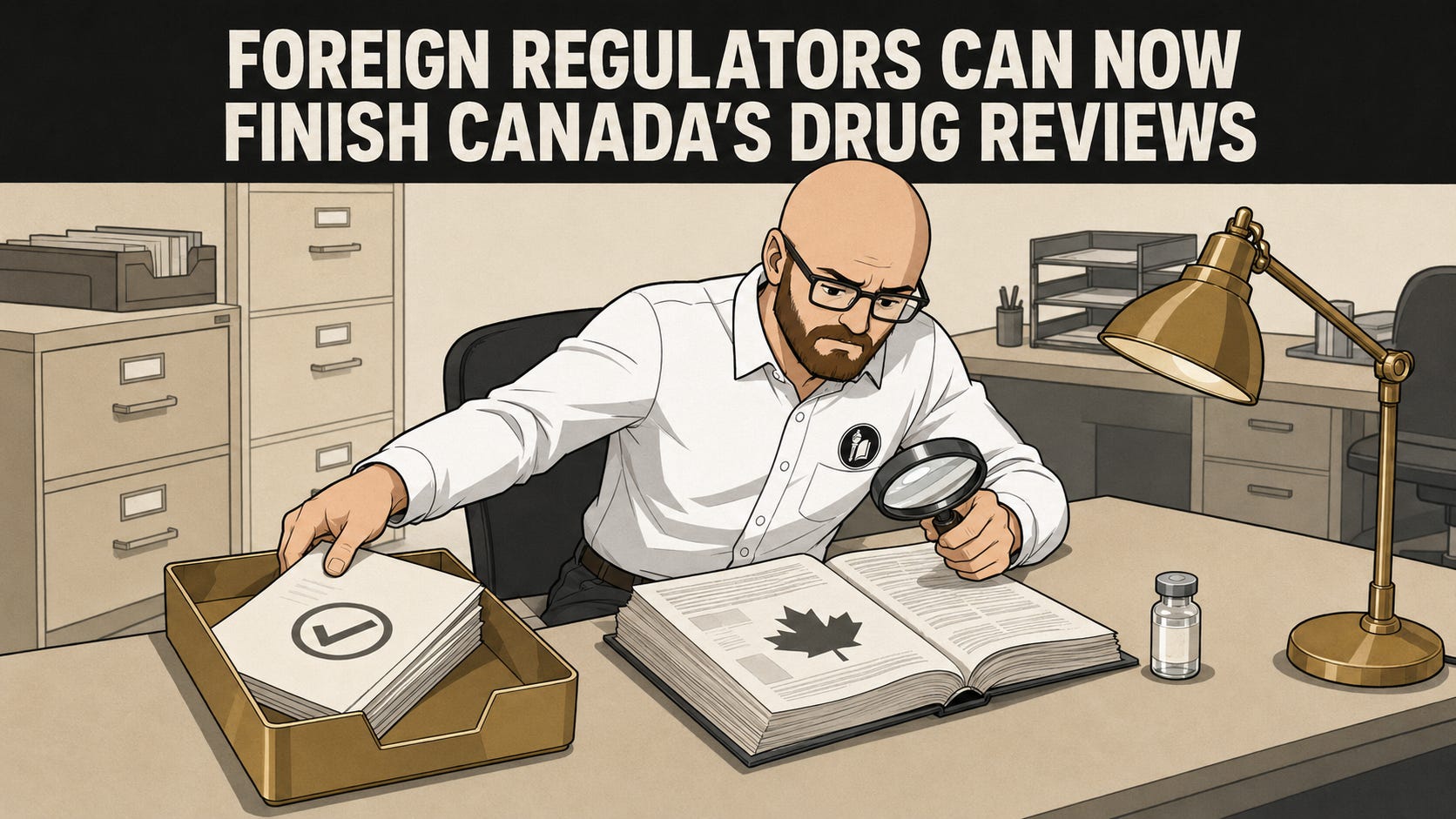
On July 15, 2026, injectable ibuprofen lysine for premature infants became eligible for a new regulatory process in Canada.
Under a federal list published that day, a manufacturer seeking Canadian approval may ask Health Canada to treat parts of the drug review as complete if regulators in the United States, the European Union, the United Kingdom or Switzerland have authorized the same medicine.
The list covers more than one injection. It includes child-focused tuberculosis medicines, certain epilepsy treatments, bile acids, colony-stimulating factors, albendazole, hydroxyurea and glucarpidase. Each entry names the foreign regulators whose work Health Canada may rely on for that drug class.
This is not automatic approval. It changes who must review which parts of the file.
The Order Providing for Reliance on Decisions of, or Documents Produced by, Foreign Regulatory Authorities in Respect of Certain Drugs allows the federal health minister to deem parts of a Canadian drug review complete based on work done abroad. Clinical evidence, non-clinical evidence, and chemistry and manufacturing information may all qualify.
Health Canada expects some review times to be up to 40 per cent shorter by the end of 2028.
The Review Health Canada No Longer Has to Repeat
Before a new drug can be sold in Canada, its manufacturer must file a submission. The minister reviews evidence of safety, effectiveness and quality, then decides whether to issue a notice of compliance and a drug identification number.
That system remains. The filing requirements remain. The minister still makes the Canadian decision.
What changed is the examination within that process.
A manufacturer can now request “deeming.” If every condition is met, Health Canada treats specified parts of its examination as complete because a listed foreign authority has already made a decision or produced review documents covering that material.
The order creates three routes. General deeming applies after a foreign regulator has authorized the corresponding drug. A 120-day route allows a manufacturer to file in Canada within 120 days of filing abroad, before the foreign decision. Joint review allows Health Canada and one or more foreign regulators to divide the work and rely on documents produced by the others.
The first human-drug list is narrower than the legal framework.
General deeming for new human drugs focuses on treatments with pediatric indications. The 120-day section contains no eligible human-drug classes. The joint-review section covers most major therapeutic groups, but the U.S. Food and Drug Administration and the European Medicines Agency are not named as joint-review partners. The listed partners are regulators in Australia, Singapore, Switzerland and the United Kingdom.
Generic drug applications and their supplements are also absent from the first human-drug phase. So are public-health-emergency drugs and extraordinary-use submissions. Health Canada says generics and biosimilars may be considered later.
The order took effect immediately. The list can change without rewriting the order.
A Canadian Decision Built on a Foreign File
“Foreign approval” comes with detailed conditions.
The proposed Canadian medicine must have the same medicinal ingredient, strength, dosage form and route of administration as the foreign drug. Its proposed conditions of use must fall within those authorized abroad. If the Canadian version differs in any part of the submission that the manufacturer wants deemed complete, the manufacturer must disclose the difference and show that it would not affect safety or effectiveness.
Health Canada reviews those differences. It also continues to examine Canadian-specific material, including labelling. If the department concludes that a difference could affect safety or effectiveness, deeming does not apply to that part of the file. A full Canadian examination follows.
The manufacturer must also disclose foreign refusals or withdrawals involving corresponding drugs when it has access to that information. It must provide the foreign decision, explain why the reasons would not affect the Canadian drug, and supply current foreign labels and descriptions of post-market measures.
A foreign decision generally cannot support deeming in Canada if the listed regulator based its authorization on another regulator’s examination. The exception is a recognized joint review involving another regulator listed for the same drug class.
Once Health Canada authorizes the drug, the usual Canadian post-market requirements apply.
The system permits reliance under set conditions, not recognition by default.
The First List Is About Children
The human-drug list makes the government’s first priority clear.
It names medicines for children whose dosage forms or indications may not already be approved in Canada. The tuberculosis entry, for example, covers pediatric powders, granules, chewable products, liquids, mini-tablets, capsules, inhaled preparations, nasal preparations, rectal preparations, skin preparations, patches and injections. Certain antiepileptic products receive similar treatment.
Other entries are more specific. Injectable ibuprofen lysine qualifies only when intended to close a clinically significant patent ductus arteriosus in premature infants. A fish-oil fat emulsion qualifies when administered intravenously for parenteral nutrition-associated cholestasis in pediatric patients. Hydroxyurea qualifies in specified oral forms when the indication includes children.
The record explains why this matters. Some drugs approved in Canada for adults are used off label in children. Moving a pediatric use from off label to an approved indication could reduce uncertainty about dosage and potentially reduce adverse reactions in children, according to Health Canada’s regulatory analysis.
But the order does not authorize any medicine by itself. Manufacturers must still decide to file in Canada. Health Canada must still determine that the order’s conditions are met. The regulatory analysis identifies federal pricing oversight, health-technology assessment, and provincial or territorial reimbursement decisions as separate parts of the drug-access process.
Canada’s market size is part of the problem the order is meant to address. The regulatory analysis says some gaps in drug availability arise from manufacturers’ business decisions in a country that represents a relatively small share of the global market. The new route is designed to make a Canadian filing less repetitive and less expensive.
The Savings Are Precise. The Uptake Is Not.
Health Canada could not reliably estimate how many manufacturers will use the order.
An earlier analysis considered a minimum of 19 submissions a year. The final version dropped an annual total because the drug classes and eligible regulators can change, and manufacturers remain free to use the ordinary review route.
Instead, the government calculated the effect on a single submission.
Industry told Health Canada that deeming could eliminate an average of 1.5 information requests per submission. One response can require up to 20 hours of expert and regulatory work and cost an average of $18,450. The estimated saving is $27,675 per submission.
Qualifying is expected to cost manufacturers an average of $9,600. That includes demonstrating eligibility and explaining differences between the Canadian and foreign drugs. The estimated net saving is $18,075 per submission.
The department’s savings are less certain. Health Canada will have to verify eligibility, assess differences, maintain the incorporated list, alter its submission-tracking system and keep pace with changes to the international electronic filing format. The record says the required effort will become clearer only after the department gains experience.
The file identifies another trade-off. Manufacturers whose drugs are sold only in Canada may not possess a foreign decision or foreign review documents they can use. The government acknowledges that greater reliance on foreign work could put these domestic firms at a disadvantage against multinational companies.
For now, Health Canada is proceeding in stages.
The legal framework is broad. The first human-drug list is not. It begins with selected pediatric medicines and joint reviews, leaves several routes empty, and allows the department to add or remove drug classes and regulators later.
The Canadian decision remains in Ottawa. Parts of the reading have moved abroad.
Hansard Files reads the regulatory record so you don’t have to. If work like this matters to you, subscribe to keep it independent.
Source Documents
Health Canada. (2026, July 15). Order Providing for Reliance on Decisions of, or Documents Produced by, Foreign Regulatory Authorities in Respect of Certain Drugs. Canada Gazette, Part II, 160(14), 2721–2790.
Health Canada. (2026, July 15). List of classes of drugs and foreign regulatory authorities for the purposes of reliance on decisions or documents: Human drugs.
Not sure if this is good news or not. Trust but verify?