


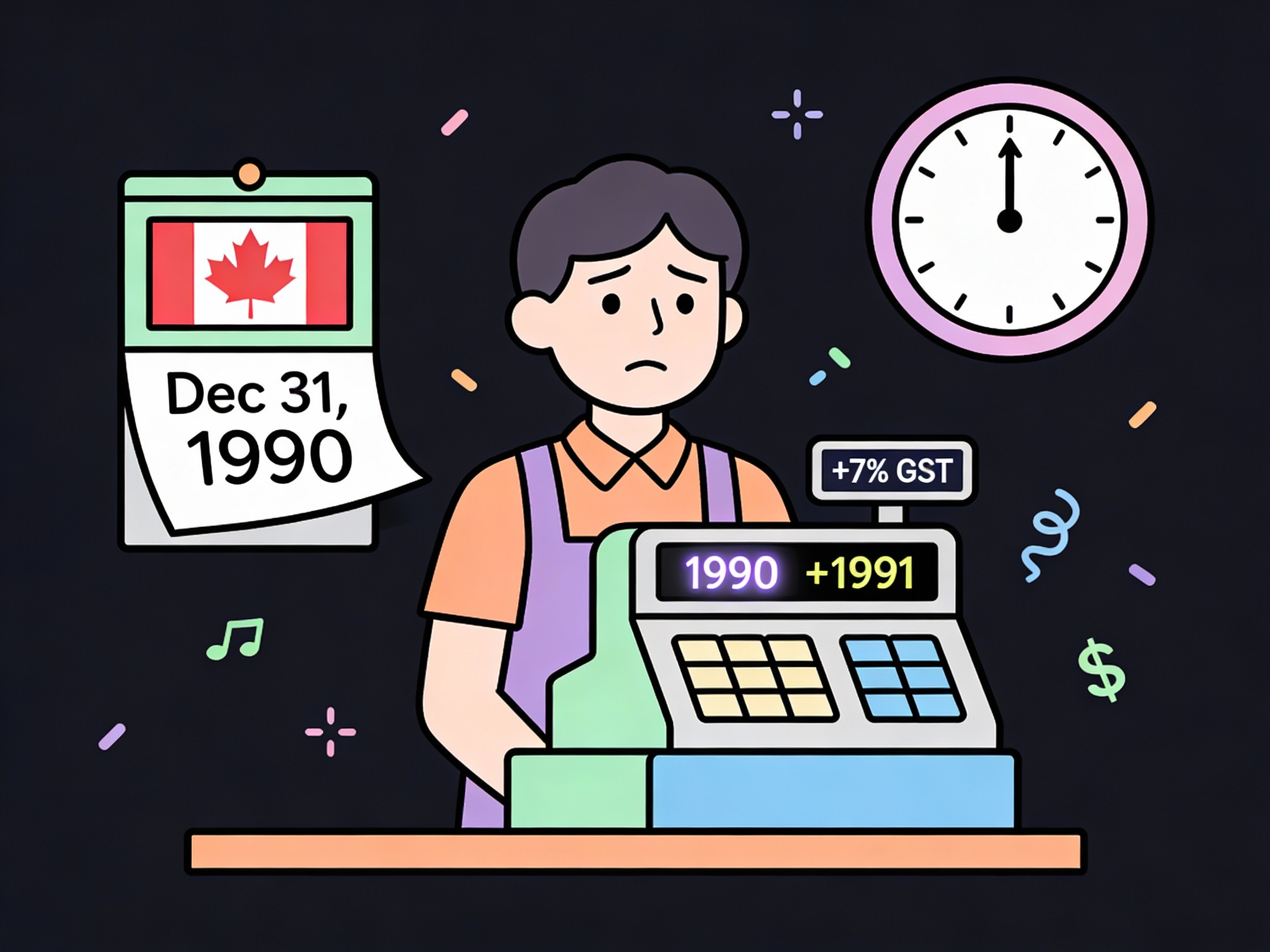
While the rest of the world prepared to sing “Auld Lang Syne,” Canadian business owners were engaged in a frantic, less festive ritual: reprogramming their cash registers before the clock struck twelve. The GST implementation on January 1, 1991, was not merely a fiscal policy shift; it was a national psychological break. As the final seconds of 1990 ticked away, a 67-year-old invisible tax system was dying, and a highly visible, 7 percent “tax on everything” was being born in its place.
In the backrooms of department stores and the kitchens of small diners, the mood was not celebratory. It was panic. For months, the country had been convulsed by legislative brawls, Senate kazoos, and mass protests. But on this specific New Year’s Eve, the abstraction of parliamentary debate crashed into the reality of retail. At midnight, the price of a haircut, a stamp, and a funeral would change forever.
The Invisible Enemy
To understand the chaos of that New Year’s Eve, one must understand what was being destroyed. Since 1924, Canada had relied on the Manufacturers’ Sales Tax (MST). It was a silent killer of economic efficiency—a hidden 13.5 percent levy applied at the factory gate. Because it was buried in the wholesale cost, consumers never saw it. They paid it unknowingly on every refrigerator, car, and television they bought.
Prime Minister Brian Mulroney and his Finance Minister, Michael Wilson, viewed the MST as an anchor dragging down Canadian competitiveness. It punished exporters and favored imports. Their solution was the Goods and Services Tax (GST), a value-added tax that would be transparent, refund input costs to businesses, and theoretically boost the economy by $9 billion annually.
There was just one problem: it was visible. Every time a Canadian bought a coffee or a newspaper, they would be reminded that Ottawa was taking a cut. As the implementation date of January 1 approached, the political capital of the Progressive Conservative government evaporated. They were asking Canadians to accept a headache in exchange for an economic theory.
15,000 Calls a Day
By the final week of December 1990, the government’s “smooth transition” had devolved into administrative bedlam. The Revenue Canada hotline, set up to assist confused merchants, was melting down. Operators were fielding up to 15,000 calls a day. The questions ranged from the technical to the absurd. Was a single donut taxed? (Yes). What if you bought six? (No). What about a taxi ride? (Taxed). A music lesson? (Exempt).
The confusion was absolute. In Ottawa, hotline operators reported being abused by callers who questioned their moral integrity. One operator told the Ottawa Citizen that callers demanded to know how she “could possibly work for such a horrible tax system.”
Small business owners were the front line. Unlike major retailers like Woolco or Loblaws, which had armies of accountants to prepare their systems, independent shopkeepers were adrift. Many had waited until the last minute, hoping the Senate would kill the bill or the government would blink. Neither happened. Now, on New Year’s Eve, they were scrambling to manually calculate the tax or frantically waiting for technicians to update their point-of-sale systems. Technicians warned that many units wouldn’t be ready until March.
The Senate’s Last Stand
The road to this midnight anxiety had been paved with one of the most vicious parliamentary battles in Canadian history. Just weeks prior, the Liberal-dominated Senate had attempted to kill the legislation. In response, Mulroney utilized a never-before-used clause in the Constitution Act, 1867—Section 26—to stack the Senate with eight extra regional senators, dubbed the “GST Senators.”
The ensuing spectacle was undignified and unforgettable. Liberal senators blew kazoos and staged round-the-clock filibusters to block the vote. They read names from petitions for hours, turning the Red Chamber into a circus of procedural warfare. But the government held firm. The bill passed, and the January 1 deadline was locked in.
As December 31 dawned, the fight moved from the Senate floor to the street. In downtown Toronto, the mood was insurrectionary. A croissant shop owner reported being screamed at by customers over an 11-cent price hike on coffee. A bookstore chain, Edwards Books and Art, declared a defiant “No GST” sale, discounting everything by 7 percent to shield their customers from the federal grasp.
The Stroke of Midnight
When the ball dropped, the hangover began immediately. The Toronto Star reported on the sombre realization that hit the hospitality industry first. As patrons finished their New Year’s Eve drinks, bar owners faced a logistical nightmare: they could not simply stop serving to reprogram registers at midnight.
“When you have a bar full of people demanding drinks, you can’t put your cash registers out of action,” said Don Eastcott of the Canadian Organization of Small Business. The result was a messy, manual transition where servers had to explain to intoxicated patrons why the same beer they ordered at 11:55 PM now cost 7 percent more at 12:05 AM.
The implementation was not just a pricing adjustment; it was an inflationary shock. The Consumer Price Index spiked. The Bank of Canada, fearing an inflationary spiral, kept interest rates punishingly high, deepening the recession that had already begun to bite.
The Political Cost
The sun rose on January 1, 1991, to a changed Canada. The “hidden” tax was gone, replaced by a line item on every receipt that served as a daily irritant to the electorate. The GST did exactly what Michael Wilson promised it would do: it stabilized government revenue and made Canadian exports more competitive.
But the political bill came due two years later. In the 1993 election, the Progressive Conservatives were reduced from a majority government to two seats—the worst defeat of a governing party in the democratic world. The GST was the weapon that destroyed them.
Yet, despite the midnight panic of 1990 and the electoral annihilation of 1993, the tax survived. Jean Chrétien’s Liberals, who campaigned on scrapping it, kept it. It remains today, a permanent legacy of that chaotic New Year’s Eve when Canada frantically repriced its entire economy while the rest of the world slept.
Source Documents
Grenier, É. (2020, June 28). The House of Commons just had one of its slowest years in a century, thanks to the pandemic. CBC News.
Library of Parliament. (2000). The Goods and Services Tax: 10 Years Later (PRB 00-03E).
McArthur, G. (2016, January 1). ‘Mean-spirited, right-wing ideology’: Why Canadians rebelled against Mulroney’s GST. TVO Today.
Parliament of Canada. (1990). Canadian Parliament Debates Goods and Services Tax (GST) Implementation.
A fascinating trip down memory lane on the GST — and a reminder of how deeply tax visibility shapes political behaviour, then and now.
I remember the anger around the GST well. It wasn’t brief, and it wasn’t shallow — it lasted years, and for many Canadians it never fully went away. What this piece captures so vividly is how visibility mattered as much as substance. A tax that had long been hidden suddenly appeared on every receipt, and it changed how people felt about the state, regardless of the economic rationale behind it.
In a strange way, that history helps explain why tariffs have such political appeal in the U.S. today. Americans are deeply resistant to the very idea of a visible tax of any kind. A 10% sales tax would be radioactive. A 10% tariff on imports, by contrast, feels abstract — even though consumers ultimately pay either way. Poorly understood tariffs provoke far less immediate backlash than transparent taxation.
Canada lived through that lesson the hard way. The GST was economically defensible, even necessary — but politically devastating. This article is a reminder that fiscal policy isn’t just about revenue or efficiency; it’s about psychology, trust, and what voters are willing to see — and be reminded of — every time they buy a coffee.