


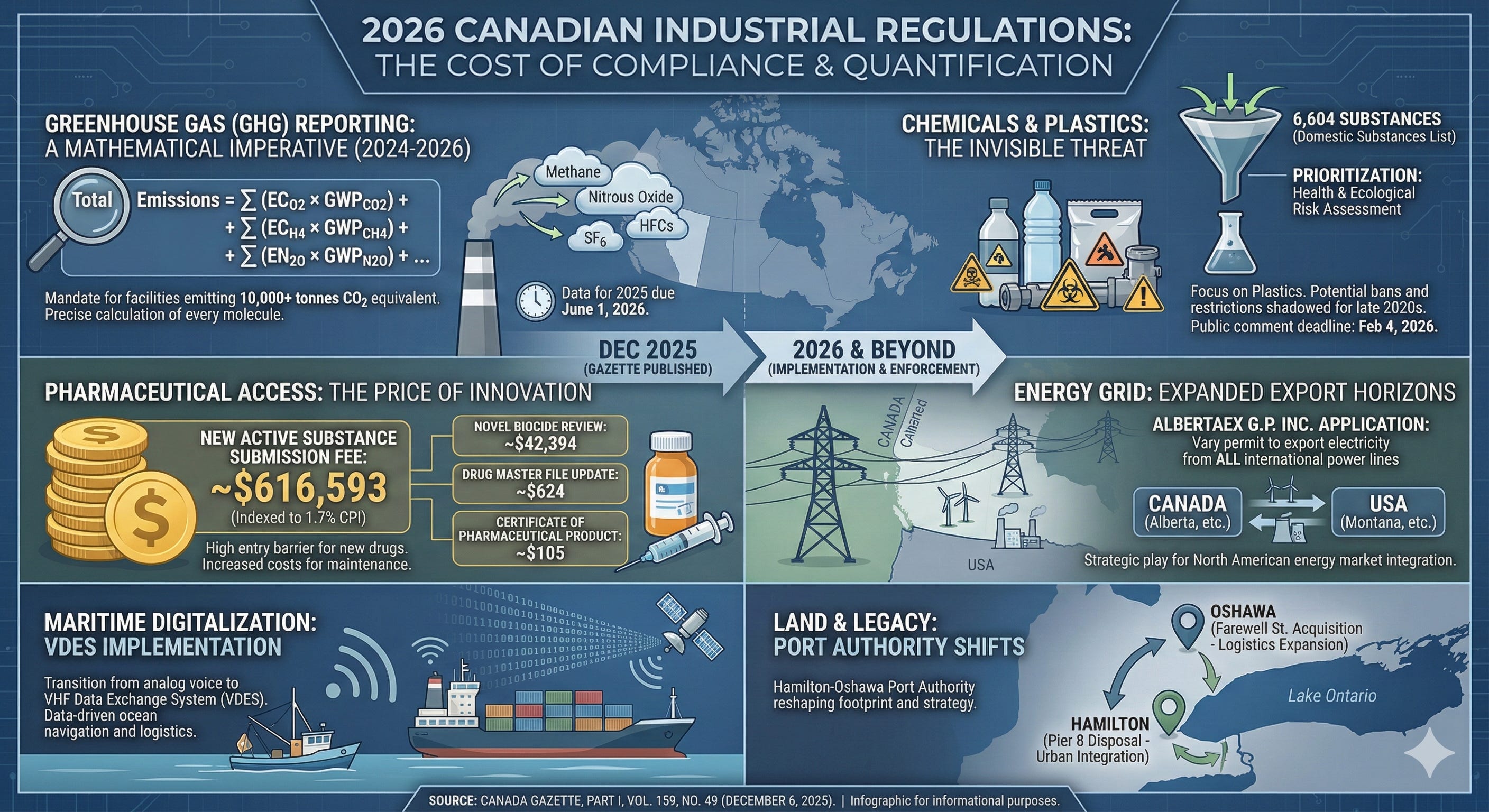
On a Saturday in early December 2025, while the machinery of the Canadian state appeared to be winding down for the winter holidays, the presses at the King’s Printer in Ottawa were busy formalizing the new operating system for the nation’s heavy industries. The publication of the Canada Gazette, Part I, Volume 159, Number 49, offers a stark, granular look at the regulatory tightening that will define the coming year. At the center of this bureaucratic sprawling is a renewed and rigorous focus on greenhouse gas reporting.
The document is not merely a list of rules but a ledger of modern liability. From the precise mathematical formulas required to calculate carbon output to the six-figure fees demanded for pharmaceutical approvals, the government is signaling that the cost of doing business in Canada is inextricably linked to the cost of compliance. We are witnessing the quantification of everything: every tonne of carbon, every new chemical molecule, and every megawatt of electricity destined for the American grid.
The Calculus of Emissions
The most significant update concerns the Department of the Environment’s mandate on greenhouse gases. The government has issued an amendment to the reporting requirements for the 2024, 2025, and 2026 calendar years. This is not a suggestion; it is a mathematical imperative for any facility emitting 10,000 tonnes or more of carbon dioxide equivalent.
The Gazette lays out the specific equation that facility operators must use to determine if they cross the threshold of federal scrutiny. It is a formula that converts the abstract concept of “pollution” into a hard, reportable number:
$$Total Emissions = \sum (E_{CO2} \times GWP_{CO2}) + \sum (E_{CH4} \times GWP_{CH4}) + \sum (E_{N2O} \times GWP_{N2O}) + ...$$
In this equation, $E$ represents the total emissions of a specific gas, and $GWP$ stands for its Global Warming Potential. It is a cumulative calculation that drags every molecule of methane, nitrous oxide, hydrofluorocarbons, and sulphur hexafluoride onto the balance sheet.
The inclusion of the 2026 calendar year in this notice is the critical detail. By extending the reporting window, the government is locking in the surveillance infrastructure for the medium term. Facilities that capture, transport, inject, or store carbon dioxide are also caught in this net. The data for 2025 must be submitted by June 1, 2026, creating a rigid timeline for industrial accountability. This data does not just sit in a vacuum; it feeds into research, objectives, and the “state of the environment” reports that drive future policy. For the operators of Canada’s refineries, power plants, and manufacturing hubs, the message is clear: the government is watching the smokestacks, and it expects you to show your work.
The Invisible Threat of Plastics
While the greenhouse gas equation governs the air, a parallel investigation is underway regarding the solid materials that make up the modern world. The Department of the Environment and the Department of Health have jointly published a notice concerning the “Domestic Substances List.” This is a massive scientific undertaking involving 6,604 specific substances.
The focus here is narrowing on plastics. The government has developed a “science approach document” to prioritize substances that may pose a risk to human health or the ecological balance. This is a prioritization exercise, a way of sifting through thousands of chemical compounds to identify the ones that require immediate intervention under the Canadian Environmental Protection Act.
The language is technical, but the implications are intimate. These substances are the building blocks of packaging, consumer goods, and industrial components. By identifying priorities for assessment now, Ottawa is effectively foreshadowing the bans and restrictions of the late 2020s. The public has until February 4, 2026, to file comments, a sixty-day window that will likely see intense lobbying from the chemical industry. They know that once a substance is flagged for “hazard and potential for exposure,” the regulatory noose begins to tighten.
The Price of Pharmaceutical Access
If the environmental regulations represent a cost of compliance measured in engineering hours, the updates from the Department of Health represent a cost measured in hard currency. The Gazette outlines a comprehensive adjustment of fees for drugs and medical devices, indexed to a Consumer Price Index (CPI) increase of 1.7 percent.
The numbers are staggering for any entity looking to bring a new drug to the Canadian market. Starting April 1, 2026, the fee for the examination of a submission for a “New Active Substance” involving clinical or non-clinical data and chemistry data will rise to $616,593. This is the entry fee for innovation. It is a barrier that ensures only well-capitalized pharmaceutical giants can easily play in the space, potentially stifling smaller biotech firms.
Even the maintenance of existing drugs is becoming more expensive. The fee for a “Drug Master File” update ticks up to $624, while a “Certificate of a Pharmaceutical Product” will cost $105. These may seem like rounding errors compared to the half-million-dollar submission fees, but they represent the frictional costs of a regulated healthcare system.
The government is also formalizing the cost structure for “Biocides,” a category that has gained prominence in a post-pandemic world. A full review for a “novel biocide” will command a fee of $42,394. These are the chemicals used to sanitize water, surfaces, and instruments. By establishing these tiered pricing structures, Health Canada is signaling that the oversight of sterilization and hygiene is a permanent, high-value component of the public health apparatus.
Power Lines and Border Crossings
Beyond the chemistry of the nation, the Gazette also details shifts in the physics of its energy grid. A significant notice from the Canada Energy Regulator highlights an application by AlbertaEx G.P. Inc. This entity is seeking to vary its permit to export electricity to the United States.
The scope of the request is ambitious. AlbertaEx currently holds a permit to export up to 2,000,000 megawatt-hours (MWh) of firm and interruptible energy annually. However, they are asking to expand the geographical scope of this authorization. They want the ability to export not just from Alberta, but “from all international power lines from Canada.”
This is a strategic play. AlbertaEx, or its affiliates, holds interests in critical infrastructure like the Montana-Alberta Tie Line (MATL), a 230-kilovolt transmission line stretching 345 kilometers between Lethbridge and Great Falls, Montana. They also have stakes in the Rattlesnake Ridge Windfarm and the NAT-1 power plant. By seeking a broader export permit, they are positioning themselves to act as a more fluid trader in the North American energy market, moving electrons across the border wherever the transmission capacity exists.
The regulator is soliciting views on how this might affect other provinces and whether domestic consumers have been given a fair shot at buying this power first. It is a reminder that the Canadian energy grid is not a closed loop; it is a porous system integrated deeply with the American market, and the flow of power is dictated as much by regulatory permits as it is by voltage and resistance.
The Digital Sea
Innovation, Science and Economic Development Canada (ISED) contributes its own layer of modernization to this edition of the Gazette, focusing on the invisible infrastructure of the coastline. The department has released a consultation on the “VHF Maritime Frequency Bands.”
This is not merely about radio chatter between fishing boats. The primary intent is to enable the implementation of the VHF Data Exchange System (VDES). The maritime world is transitioning from analog voice communication to digital data exchange. This shift mirrors the broader digitization of the supply chain. VDES allows for more robust data transmission, covering both terrestrial and satellite components.
The consultation proposes a “displacement and licensing moratorium” on analog systems in certain bands to make room for this digital future. It is a technical adjustment with profound consequences for navigation safety and logistics. As ships become smarter and more autonomous, the spectrum they rely on must evolve. The government is effectively evicting old technologies to pave the way for a data-driven ocean.
Land and Legacy
On the ground in Ontario, the Hamilton-Oshawa Port Authority is reshaping its physical footprint. Supplementary letters patent have been issued to reflect both the disposal and acquisition of real property. In Hamilton, the Authority is shedding a parcel of the “Bed of Hamilton Harbour” at Pier 8. Meanwhile, in Oshawa, it is acquiring land on Farewell Street.
These transactions are the microscopic movements of a massive organism. Port Authorities are quasi-federal entities that manage the gateways of trade. When they buy or sell land, it signals a shift in industrial strategy. The acquisition in Oshawa suggests expansion or reconfiguration of logistics capacity, while the disposal in Hamilton hints at the changing use of the waterfront, perhaps moving away from industrial exclusivity toward other urban integrations.
In the financial sector, a similar shuffling of assets is visible. Comerica Bank has published a notice of its intent to transfer “all or substantially all” of its liabilities in respect of its Canadian business to Fifth Third Bank. This merger and transfer is a quiet consolidation, a handing over of the ledger from one foreign bank to another. It underscores the fluidity of capital and the fact that the institutions holding Canadian debt are often parts of much larger, global machinations.
The Democratic audit
Amidst these high-level regulatory shifts, the Gazette also records the minutiae of democratic life. The Chief Electoral Officer has issued a notice deregistering the “Hamilton Centre Green Association.” It is a small administrative death, a footnote in the political history of a specific riding, yet it represents the constant churning of the political ecosystem.
Conversely, the Public Service Commission has granted permission to several federal employees to run for municipal office. Angela Hicks from Correctional Service Canada is running for Councillor in Fredericton. Renata Magalhaes from the Canada Revenue Agency is seeking a seat in Stukely-Sud, Quebec. Jean-Louis Provencher from Parks Canada is running in Lac-Delage.
These notices are reminders that the “government” is not a monolith. It is composed of individuals who, despite their federal employment, remain deeply embedded in their local communities. The bureaucracy has a mechanism to permit this dual life, ensuring that public service at the national level does not preclude civic engagement at the local level.
Conclusion
The Canada Gazette of December 6, 2025, presents a portrait of a nation in a state of calibrated adjustment. The government is not rewriting the social contract, but it is aggressively updating the terms of service.
For the industrialist, the new carbon reporting equations represent a tighter leash. For the pharmaceutical executive, the higher fees are a steeper barrier. For the energy trader, the expanded permits offer a wider horizon. And for the mariner, the spectrum changes promise a digital future.
These disparate notices share a common DNA: they are all mechanisms of control and measurement. The state is asserting its right to know exactly how much carbon is in the air, exactly how safe the chemicals in our plastics are, and exactly who is moving electricity across the border. As 2026 approaches, the invisible architecture of regulation is being reinforced, beam by beam, in the quiet pages of the government record.
Source Documents
AlbertaEx G.P. Inc. (2025, December 6). Application to Vary Permit to Export Electricity to the United States. Canada Gazette, Part I, Vol. 159, No. 49.
Canada Energy Regulator. (2025, December 6). Application to Vary Permit to Export Electricity to the United States. Canada Gazette, Part I, Vol. 159, No. 49.
Chief Electoral Officer. (2025, December 6). Deregistration of a Registered Electoral District Association. Canada Gazette, Part I, Vol. 159, No. 49.
Comerica Bank. (2025, December 6). Transfer of Liabilities. Canada Gazette, Part I, Vol. 159, No. 49.
Department of the Environment. (2025, December 6). Notice Amending the Notice with Respect to Reporting of Greenhouse Gases (GHGs) for 2024 and 2025. Canada Gazette, Part I, Vol. 159, No. 49.
Department of the Environment & Department of Health. (2025, December 6). Publication of the Approach and Results of Investigations for 6 604 Substances Specified on the Domestic Substances List. Canada Gazette, Part I, Vol. 159, No. 49.
Department of Health. (2025, December 6). Notice of Annual Adjustment of the Fees in Respect of Drugs and Medical Devices Order. Canada Gazette, Part I, Vol. 159, No. 49.
Department of Health. (2025, December 6). Notice of Annual Increase of Health Canada’s Drug Master Files and Certificate of Pharmaceutical Product Fees. Canada Gazette, Part I, Vol. 159, No. 49.
Department of Transport. (2025, December 6). Hamilton-Oshawa Port Authority Letters Patent. Canada Gazette, Part I, Vol. 159, No. 49.
Innovation, Science and Economic Development Canada. (2025, December 6). Notice No. SMSE-010-25 - Consultation on the Policy, Technical and Licensing Framework for the VHF Maritime Frequency Bands. Canada Gazette, Part I, Vol. 159, No. 49.
Public Service Commission. (2025, December 6). Permission Granted (Hicks, Angela; Magalhaes, Renata; Provencher, Jean-Louis). Canada Gazette, Part I, Vol. 159, No. 49.