


Just before midnight on November 10, 1979, Mrs. John Riddel was lying awake in her bedroom at 1437 Freeport Drive in Mississauga when she heard a sharp metallic crack from the Canadian Pacific tracks behind her house, followed moments later by a violent explosion. Looking out her window toward the Mavis Road crossing, she saw an enormous wall of flame rising into the night sky, and resting directly in her backyard garden, glowing dull red in the grass, sat a sheared-off railway axle and two steel wheels. In December 1980, Justice Samuel G.M. Grange of the Supreme Court of Ontario tabled the Report of the Mississauga Railway Accident Inquiry, finding that the Canadian Transport Commission had spent nearly a decade tolerating obsolete friction bearings and unmonitored dangerous goods shipments because federal regulators were philosophically reluctant to impose safety costs on the railways.
The Mississauga derailment was the largest peacetime emergency in North American history, forcing the evacuation of up to 240,000 people from their homes for up to six days. But as Grange documented across 212 pages of findings, the disaster was not an unpredictable act of God. It was the direct product of a federal regulatory philosophy that allowed private railway corporations to write their own safety rules, police their own equipment, and resist lifesaving technology to protect their corporate balance sheets.
The Fire on the Galt Subdivision
The train that shattered Mississauga was Canadian Pacific Train 54, a freight run that had been marshalled in London, Ontario, and was rolling eastward toward the Agincourt yards in Toronto. It stretched over 6,000 feet, consisting of three diesel locomotives, 102 freight cars, and a caboose.
Among its 106 cars were twenty-one tankers carrying hazardous industrial chemicals: liquid petroleum gas, caustic soda, toluene, and ninety tons of liquid chlorine.
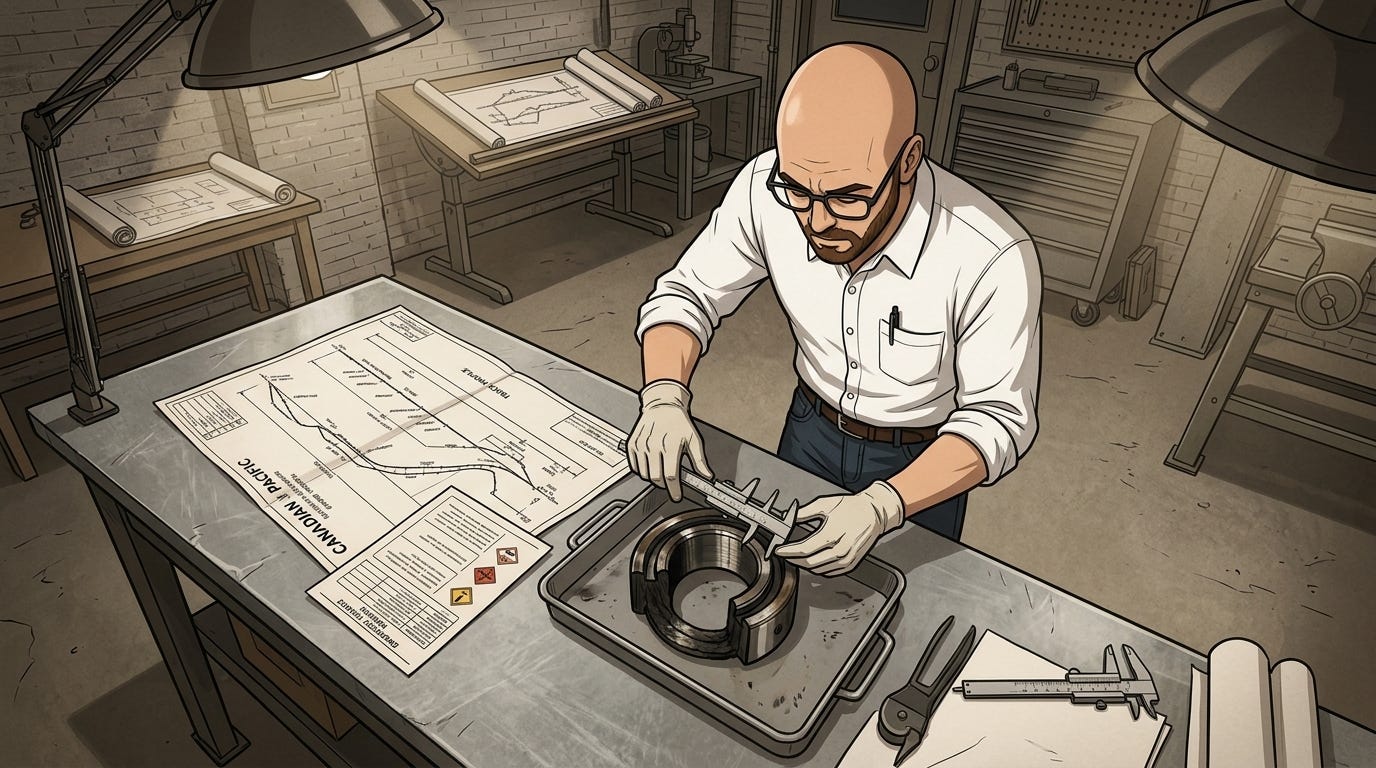
Thirty-third from the front was tank car NATX 11113, loaded with 29,800 gallons of flammable toluene from the Shell Oil plant in Sarnia. Built decades earlier, the tanker did not ride on modern sealed roller bearings. Instead, it was carried by nineteenth-century friction plain bearings: a lead-babbitt brass wedge sitting directly atop a rotating steel axle journal, lubricated solely by an oil-soaked cotton pad nestled in the bottom of a cast-iron journal box. If that pad dried out, shifted, or tore, the oil film vanished. Metal ground against metal.
That breakdown began as Train 54 passed through Halton County. Between Chatham and Toronto, a distance of more than 180 miles, Canadian Pacific scheduled no mechanical inspection by certified carmen. The only eyes on the train belonged to its three-man operating crew: Engineman Keith Pruss and trainman Larry Krupa in the lead locomotive cab, and Conductor William Edward Nichol, who was riding alone in the caboose more than a mile behind them.
As the train rattled past Campbellville at 11:15 p.m., Alfred Houston and his wife were waiting in their car at the County Road 9 crossing. Houston, who knew railway equipment, watched smoke pouring from a journal box under the front third of the train and remarked to his wife that the car was running a hot box.
Over the next twenty-two miles, the journal box turned into an incinerator. At 450 degrees Fahrenheit, the lead babbitt melted away. At 800 degrees, the lubricating oil and cotton packing ignited. By the time Train 54 crossed Derry Road at fifty miles per hour, David McGregor and his wife were stopped at the signals. McGregor saw a steady blowtorch of flame two feet wide roaring out from beneath the undercarriage of the thirty-third car.
Witnesses at Streetsville, Eglinton Avenue, and Burnhamthorpe Road watched in shock as the burning car threw showers of white sparks four to five feet high, its metal tank listing fifteen degrees to one side. Near Wolfedale Road, a Peel Regional Police constable later recovered a discarded chunk of glowing reddish-white steel: the sheared stub of the journal bearing.
Yet inside the cab of Train 54, Pruss and Krupa noticed nothing. CP Rail operating rules instructed crews to glance back around curves, but the railway explicitly discouraged the use of rear-view mirrors. In testimony before the inquiry, CP Rail road foreman George Bathgate stated bluntly that rear-view mirrors were no part of company training and that he would actively forbid their use if an engineer tried to install one. Looking backward along a 6,000-foot train at night, a locomotive crew could not see a flame burning low beneath a tank car unless the train rounded a sharp curve to the right.
In the caboose, Conductor Nichol had to shuttle back and forth between the north and south observation windows of his cupola. Separated from the toluene tanker by seventy-three intervening cars, dust, and darkness, he saw neither flame nor smoke.
Most damning of all, there was not a single automated hot box detector on the Canadian Pacific mainline between London and Toronto. While Canadian National had already installed hundreds of infrared trackside detectors capable of scanning passing journals and instantly alerting dispatchers to overheating axles, CP Rail had refused to adopt the technology on the Galt Subdivision. CP Rail management testified that it was dubious of the devices, arguing that automatic trackside scanners might make train crews too relaxed during manual visual inspections.
Twenty-Four Cars in the Ditch
At 11:53 p.m., the overheated axle on the toluene car finally snapped. The rear axle and its pair of wheels severed completely, bounced off the roadbed, and hurtled into the backyard garden of the Riddel family on Freeport Drive.
For more than a mile, Car 33 dragged its crippled rear truck along the wooden ties and steel rails. At 11:54 p.m., the dragging assembly struck a track switch at the Mavis Road crossing in Mississauga.
The tanker derailed violently, jackknifing across the double tracks and tearing the train apart. Twenty-three cars following behind it piled into the wreckage at fifty miles per hour, accordions of twisted steel, ruptured valves, and severed couplers smashing together in a dense industrial pocket.
Of the twenty-four derailed cars, twenty-one were tank cars, and nineteen carried dangerous goods. The puncture of the toluene car and adjacent liquid petroleum gas tankers sparked an immediate firestorm.
Twenty seconds after the derailment, Engineman Pruss radioed his dispatcher with words captured on the tape: “We’re in the big hole Ted, but still moving... Jésus Christ Ted, one of them tank cars blew up.”
Within thirty minutes, three pressurized propane cars, Cars 8, 12, and 13, succumbed to the intense heat and suffered Boiling Liquid Expanding Vapour Explosions (BLEVEs). The detonations sent towering fireballs thousands of feet into the night sky, rattling windows across western metropolitan Toronto. The force was so immense that the massive steel body of Car 13 was hurled 2,222 feet, nearly half a mile through the air, before slamming into an empty field.
Trapped in the centre of the inferno lay Car 7, tank car CGTX 63597. It was filled with ninety tons of liquid chlorine shipped by Dow Chemical from its Sarnia manufacturing plant. During the pileup, a wandering coupler had punched a jagged hole two and a half feet wide in the tanker’s heavy steel shell.
Chlorine is a choking, corrosive poison gas that hugs the ground and dissolves lung tissue. Had the full contents of Car 7 escaped at ground level into the calm, damp autumn air, tens of thousands of residents across southern Ontario faced grave risk of toxic injury or death.
Confronted with an uncontrolled chemical fire and an open chlorine tanker, Peel Regional Police Chief Douglas Burrows, Mississauga Mayor Hazel McCallion, and Ontario Attorney General Roy McMurtry made the decision to clear the city. Over the next forty-eight hours, emergency services evacuated between 217,000 and 240,000 residents across forty-five square kilometres, stretching from Burnhamthorpe Road south to Lake Ontario. It remains the largest peacetime evacuation in Canadian history.
Miraculously, not a single person died. That outcome was owed to two extraordinary strokes of fortune: the derailment had occurred in a narrow industrial pocket flanked by undeveloped farmland, and the tremendous thermal updraft from the propane fireballs had drafted the initial escaping chlorine miles upward into the upper atmosphere, dispersing the poison before it could settle onto residential streets.
The Philosophy of Regulatory Inaction
When Justice Grange opened his commission of inquiry, he was presented with a mountain of technical evidence: 127 sitting days, 687 exhibits, and 23,594 pages of sworn testimony. What emerged from that record was not a technical mystery, but an administrative indictment.
Mississauga was not a surprise to the Canadian Transport Commission. Nine years earlier, in 1971, following a series of catastrophic rail accidents across Canada, the CTC had convened a national General Safety Inquiry into derailments caused by burnt-off journals.
The 1971 inquiry had identified the exact same hazards: the vulnerability of friction bearings, the need for automated hot box detectors, and the danger of running dangerous goods through urban areas. Yet when Grange examined what the CTC had actually done with its 1971 findings, he found total administrative paralysis.
On hot box detectors, the 1971 inquiry had produced a single formal recommendation: that the Railway Transport Committee of the CTC “intensify their study of derailments on account of burnt-off journals.” Grange did not mince words about that legacy, writing in his report: “It is a well intentioned recommendation but in my respectful view absolutely meaningless.”
In the eight years between the 1971 inquiry and the Mississauga explosion, the CTC had failed to order the installation of hot box detectors on a single mile of Canadian track. When CP Rail expressed philosophical skepticism about electronic detectors, the regulator simply backed away.
The CTC had failed to order the replacement of obsolete friction bearings with modern roller bearings. By 1979, more than half of all rail freight cars operating in Canada still moved on antiquated friction brasses, and the CTC had made no regulatory order to force their retirement.
The commission’s examination of the CTC’s leadership cut straight to the core of the failure. Under questioning, David Jones, the former chairman of the Railway Transport Committee, and John Gray, the sitting chairman, explained the regulator’s governing doctrine.
There was, Grange noted, an “ingrained reluctance to take any action involving expenditure or loss to the railways without a complete investigation of the amount of that expenditure or loss and an assurance that the benefit to be gained will fully compensate for that loss.”
Federal regulators had conceived their role not as guardians of public safety, but as commercial arbiters obligated to protect the profit margins of CP Rail and Canadian National. If a safety measure imposed capital costs that the railways could not recoup through operational savings, the CTC treated the mandate as economically unjustified.
The consequences of this deference were visible across the Canadian rail network:
First, the CTC allowed the railways to write their own operating rules. Under the Railway Association of Canada, the carriers drafted voluntary codes, defined their own inspection schedules, and set their own train speeds.
Second, the CTC’s own safety audits were routinely ignored. The inquiry revealed that the CTC’s monitoring program had discovered safety defects in thirty-four percent of all rail cars leaving railway repair shops. More than one-third of the freight cars certified by railway maintenance shops were mechanically defective when they returned to active service. Yet the CTC had taken no systemic enforcement action.
Third, the federal regulations governing dangerous commodities, known as the Red Book, were so dense, convoluted, and obsolete that railway crews and local firefighters could not comprehend them. Grange observed that the Red Book was “exceedingly difficult to comprehend” and failed to provide operating personnel with clear instructions on handling hazardous cars.
Even after Mississauga blew up, the CTC’s instinct was retreat. In the immediate aftermath of the disaster, the regulator issued a show-cause summons proposing an emergency order: dangerous goods trains would be limited to twenty-five miles per hour through built-up areas and required to carry six buffer cars equipped with roller bearings between the engines and the chemical tanks.
When CP Rail, Canadian National, and the Railway Association of Canada protested that the rule would cause operational headaches and increase transit times, the CTC surrendered and abandoned the proposed order.
Shifting the Burden of Risk
Justice Grange rejected the regulatory philosophy that had governed Ottawa for half a century.
“The railways are answerable to their shareholders; the CTC is answerable to the public,” Grange wrote. “It is not a philosophy that I fully share. I cannot understand how the CTC could accept the railways’ own programmes for conversion to roller bearings and for installation of hot box detectors when both are universally accepted as desirable improvements... I cannot understand how the Commission could leave to the railways the determination of maximum speeds for dangerous goods trains in urban areas.”
Grange demolished the industry’s economic defense with a single foundational legal principle:
“Where the safety of the citizen is concerned, the onus shifts. In such case the burden of proof may (perhaps should) fall upon him who creates the risk.”
To give that principle statutory teeth, Grange delivered fifteen binding recommendations designed to end railway self-policing in Canada.
He recommended that all freight cars carrying dangerous goods, and all cars travelling in dangerous goods trains, be equipped with roller bearings, double-shelf couplers to prevent uncoupling in derailments, head shields to resist punctures, and thermal insulation to stop boiling-liquid explosions.
He recommended that every rail corridor running through a populated area be protected by automated trackside hot box detectors spaced no more than twenty miles apart.
To ensure the railways could not delay compliance, Grange attached an unyielding mechanical penalty: any dangerous goods train that failed to meet the equipment standards was barred from exceeding 4,000 feet in length. Any dangerous goods train running through a built-up area without hot box detector protection was slapped with an immediate, mandatory speed cap of twenty-five miles per hour.
Crucially, Grange refused to grant the rail industry any transition grace period. “Lest there be any doubt about it, I am not recommending any lead time for the technical improvements or the installation of hot box detectors,” he declared. “That time has already run and the recommendations should be implemented immediately.”
Beyond the tracks, Grange demanded that chemical manufacturers be stripped of the automatic right to ship toxic compounds. Under Recommendation Four, no shipper would be permitted to load dangerous goods onto a Canadian railway without first submitting an emergency response plan approved directly by the Minister of Transport. If a private producer could not demonstrate the technical capacity to contain and clean up an accidental release, its right to ship was to be revoked.
The Foundation of Modern Rail Safety
When Justice Grange submitted his report to Transport Minister Jean-Luc Pepin in December 1980, the federal government had already taken the first step toward reform by passing the Transportation of Dangerous Goods Act earlier that autumn. But Grange’s findings provided the technical blueprints and regulatory backbone that transformed the new statute into an operative enforcement regime.
The Grange Inquiry forced the Canadian Transport Commission to abandon its posture of voluntary compliance. In the years that followed, federal regulators mandated trackside hot box detectors across national rail corridors, forced the retirement of friction bearings on dangerous goods routes, required double-shelf couplers on pressurized tank cars, and created the modern CANUTEC emergency response network.
The central lesson of Mississauga remains recorded in Grange’s prose. A quarter of a million people had been driven from their homes not because Canadian engineers lacked the technology to detect burning axles or protect tank cars, but because federal regulators had decided that saving railway corporations money was more important than protecting Canadian communities from industrial disaster.
In ruling that those who create the risk must bear the cost of safety, Justice Grange established an enduring boundary for Canadian governance: the public safety of citizens is not a negotiable corporate expense.
Every investigation in Hansard Files remains completely free to read. Voluntary supporting memberships at $5 a month or $50 a year fund the reading capacity needed to pull evidence directly from primary government records.
Source Documents
Commission of Inquiry on the Mississauga Railway Accident. (1980, December). Report of the Mississauga Railway Accident Inquiry (Cat. No. T22-50/1981E-PDF). Commissioner: The Honourable Mr. Justice Samuel G.M. Grange. Ottawa: Supply and Services Canada.