


On September 15, 2025, two of Canada’s most important independent officers of Parliament appeared before the Standing Committee on Access to Information, Privacy and Ethics. These sessions, one with the Ethics Commissioner and the other with the Information Commissioner, are designed to provide routine updates. What they revealed, however, was anything but routine. The testimony provided a clear and troubling diagnosis of the operating system that runs our government.
Your frustration with a political system that often seems opaque and unaccountable is not misplaced. It is a logical reaction to interacting with a system whose foundational code is decades old. The proceedings of that Monday morning demonstrate that two of the most critical functions of a healthy democracy, ethical integrity and public transparency, are running on software that is no longer fit for its purpose. Understanding this systemic issue is the first step toward demanding a necessary upgrade.
The Screen Is a Sieve
The first hour of the committee meeting focused on the work of the Conflict of Interest and Ethics Commissioner, Konrad von Finckenstein. Much of the discussion centered on the mechanisms used to prevent conflicts of interest for senior public officials, particularly the use of a “conflict of interest screen.” This tool is used when an official places their assets in a blind trust but still knows which assets they were, creating a risk they might make decisions that benefit those holdings. The screen is meant to prevent this by having senior aides intercept any decisions that could affect those specific assets.
The problem, as members of the committee quickly identified, is who holds the screen. In the case of the Prime Minister, the screen is administered by his chief of staff and the Clerk of the Privy Council. When pressed on how Canadians could have confidence in a process managed by the Prime Minister’s own appointees, the Commissioner’s answer was telling. He argued for their integrity and shared interest.
“I rely on the integrity of the senior people in government acting in accordance with the law, because it’s in their interest and in the interest of the Prime Minister they serve.”
Here is the detail I find most revealing. The system’s integrity does not rest on an independent, verifiable mechanism, but on the presumed good intentions of political staff. It is a solution that fails to address the core issue that makes such oversight necessary in the first place: the potential for private interests to influence public duty.
This points to a critical question. If the purpose of an ethics regime is to build public confidence, can a system that relies on internal, unverified processes ever succeed? The Commissioner himself seemed to acknowledge the system’s shortcomings when he advocated for adding the concept of an “apparent” conflict of interest into the law, a change recommended years ago by the Oliphant commission. This proposal admits the current rules are insufficient, as they fail to account for situations that, while not breaking a specific rule, create a reasonable perception of a conflict. The screen is not a firewall, it is a sieve, designed to catch only the most obvious infractions while letting perceptions of conflict pass right through.
The Right to Know Is a Right to Wait
The second hour of the committee featured Information Commissioner Caroline Maynard, and her testimony painted an even bleaker picture of the government’s operating system. She described Canada’s Access to Information Act, the law that gives citizens the right to know what their government is doing, as fundamentally broken.
The act was written in 1983. As the Commissioner noted, the system it created is completely unequipped for the digital age. This is not a minor technical issue. It has led to a systemic failure where the government is routinely breaking its own transparency laws.
“In plain terms, does missing the deadline on almost one-third of requests mean that the government, writ large, is failing to adhere to the law?”
Caroline Maynard: “It is.”
The problem is so severe that the Commissioner has been forced to take the government to court to compel compliance with her own legally binding orders. Think about that for a moment. An officer of Parliament, tasked with enforcing a law, has to sue the very institutions subject to that law to get them to obey it. This is not a sign of a healthy, functioning system.
Commissioner Maynard identified a “culture of secrecy” where the act is used not to facilitate access, but to prevent it. She argued for a complete legislative overhaul, including expanding the act to cover ministers’ offices and addressing the massive delays caused by a broken information management culture. The right to know has become a right to wait, and often, a right to be denied.
Introducing Government’s Ghostware
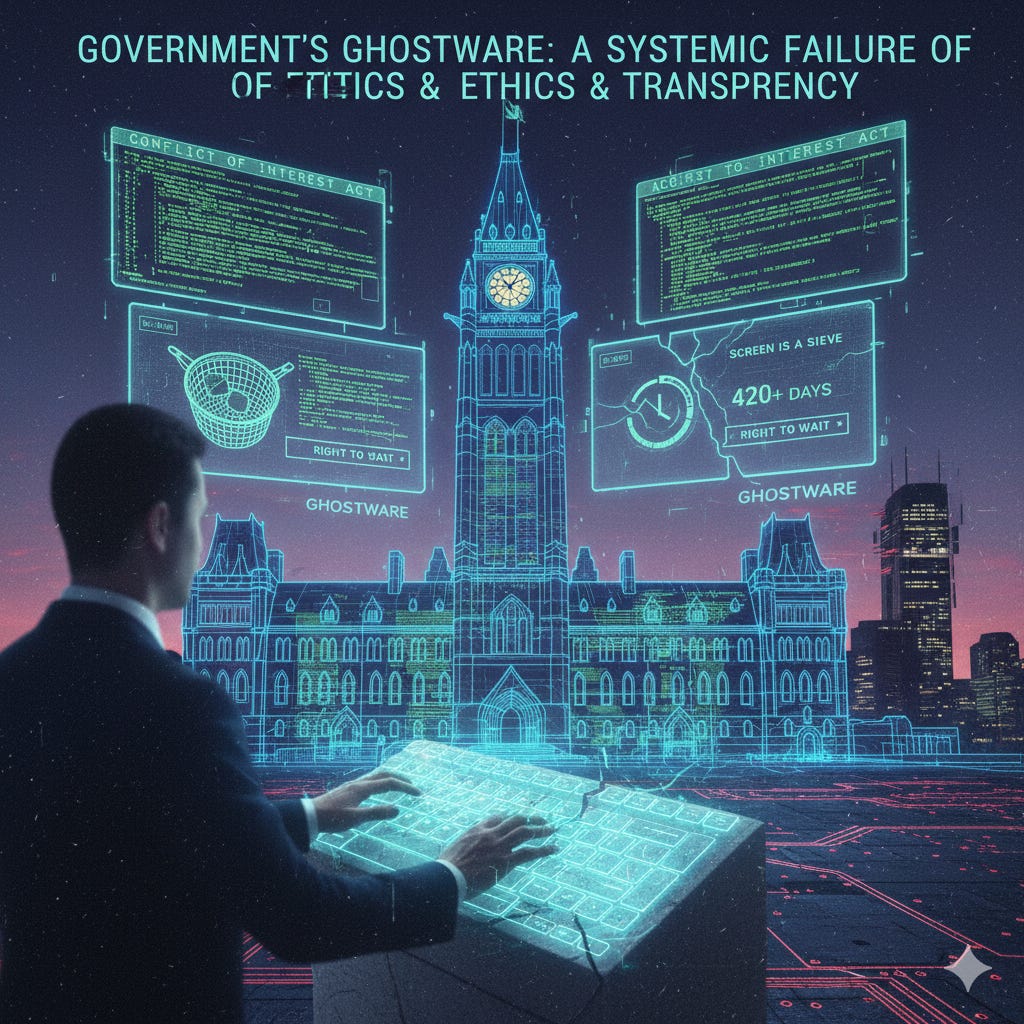
To make sense of these two seemingly separate failures, I propose an analogy: Government’s Ghostware. Think of the rules that govern ethics and transparency as the invisible operating system of our democracy. Ghostware is software that is so old it is no longer supported or updated. It is full of bugs, runs incredibly slowly, and lacks modern security features, leaving the entire system vulnerable.
Our government runs on Ghostware. The Conflict of Interest Act is Ghostware. It lacks a key feature, the “apparent conflict of interest” patch, and its security protocols, like the ethics screen, have obvious backdoors that rely on personal trust instead of independent verification. The Access to Information Act is even older Ghostware, a 1983 program trying to process the data of 2025. It crashes constantly, producing massive delays and system failures that career officials then exploit to foster a culture of secrecy.
This Ghostware creates a trust deficit by design. Your frustration is a rational response to an operating system that is fundamentally unreliable. It forces citizens into a state of perpetual suspicion, because the rules designed to create clarity are themselves opaque and dysfunctional.
Rewriting the Code of Public Trust
The September 15th committee meeting was a diagnostic session for our democracy. It revealed that the systems intended to ensure integrity are failing because their foundational code is obsolete. The problem is not necessarily individual bad actors, but a bad operating system that makes accountability difficult and erodes public trust. We do not need to police the ghosts in the machine, we need to rewrite the code that lets them haunt it.
In Other News...
Beyond this deep dive, you can find more analysis and commentary on the On Hansard site.


Source:
Standing Committee on Access to Information, Privacy and Ethics. (2025, September 15). Evidence (No. 002, 45th Parliament, 1st Session). House of Commons.