


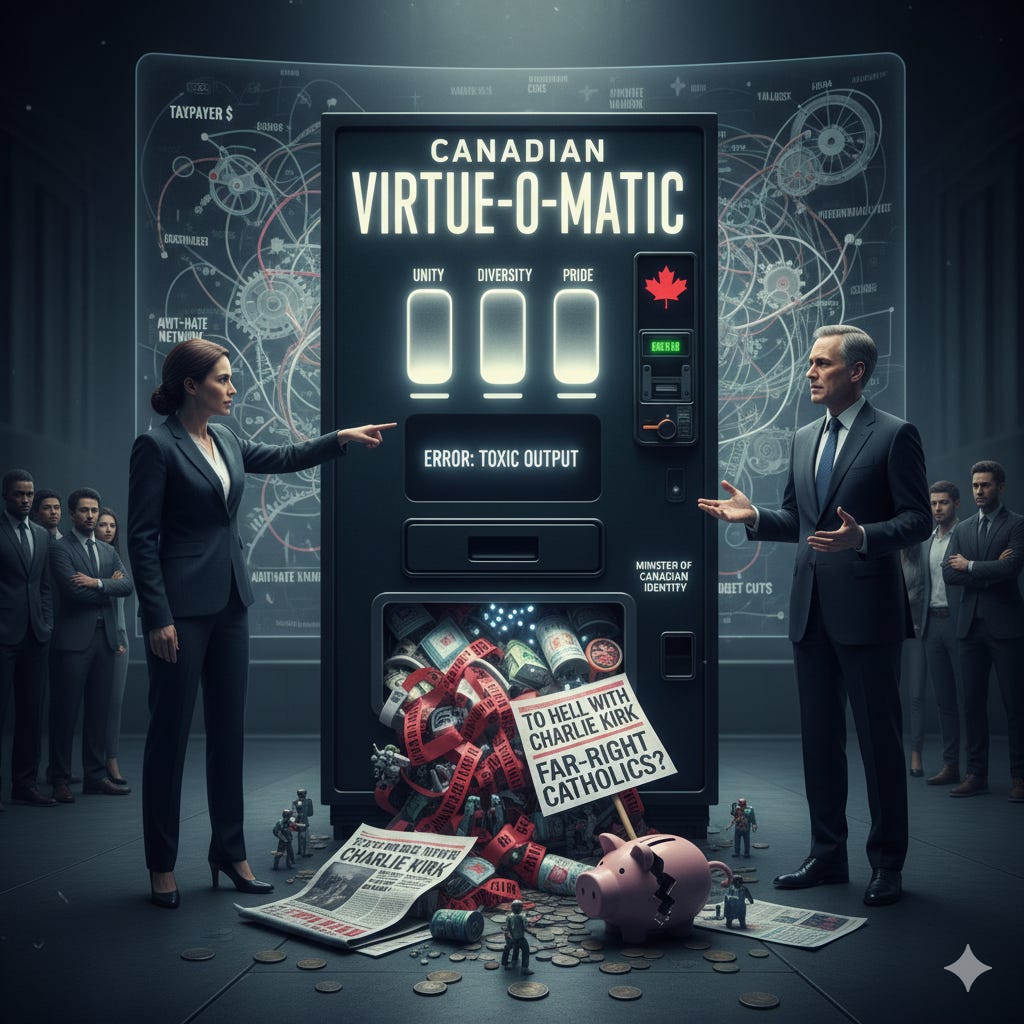
During a parliamentary committee meeting on September 24, 2025, a Member of Parliament posed a direct question to the Minister of Canadian Identity and Culture. She asked why his department gave a grant to an online tabloid that, the day after a political figure’s assassination, published an article titled “To Hell With Charlie Kirk,” which ended with the words, “You reap what you sow.” This moment gets to the heart of a frustration many Canadians feel. You see your tax dollars allocated to the Department of Canadian Heritage with the stated goal of promoting our shared identity, culture, and unity. Yet, the results often seem confusing, contradictory, and unaccountable.
This points to a critical question: what is the mechanism that connects your money to these outcomes? Think of the department’s funding model as a Vending Machine of Virtue. You, the taxpayer, put your money in. The machine is labelled with desirable outputs like “Unity,” “Diversity,” and “National Pride.” But the internal wiring is opaque. Sometimes you get what you expect. Other times, the machine dispenses “Polarization” or “Toxicity.” When you question the results, the operators say they are not responsible for the specific product that comes out, only for stocking the machine. This leaves you wondering if the machine is broken or if it was designed to work this way all along. The committee transcript provides a rare look inside this machine, revealing three critical design flaws.
The Arm’s-Length Accountability Gap
The most prominent issue discussed was the Canadian Broadcasting Corporation (CBC). Conservative MPs repeatedly challenged the Minister on a toxic work environment at the public broadcaster, citing a high-profile human rights complaint from a former journalist. The core of the exchange revealed a massive accountability gap. As the minister is ultimately responsible to Parliament for the CBC, he was asked if he had confronted the CEO about the workplace culture.
Here is the detail I find most revealing. The Minister condemned what happened to the employee but immediately distanced the government from any direct responsibility.
Hon. Steven Guilbeault: “It obviously isn’t the government’s role to interfere in the organization’s day-to-day affairs and management. Those are the responsibility of the public broadcaster, which also has a board of directors. Our role is to ensure that the public broadcaster plays its role and properly represents Canadian values and culture as a whole...”
This is the classic “arm’s-length” principle. It was designed to prevent politicians from turning the CBC into a state broadcaster that parrots the government’s talking points. In theory, this is a cornerstone of a healthy democracy. In practice, it has become a shield. The government provides nearly $1.4 billion in annual funding but claims it cannot act on systemic issues like a toxic culture because those are “day-to-day affairs.” This creates a paradox: the government is responsible for the funding but absolves itself of responsibility for the results of that funding. When pressed again on whether he raised the issue with the new CEO, the minister refused to generalize from what he called “a few isolated cases” and would not give a direct answer. The arm’s-length principle, meant to ensure independence, now functions as a tool to deflect accountability.
Funding by Values, Not Just Merit
The second flaw in the machine became clear when the discussion turned to grants for smaller organizations. MP Rachael Thomas provided another example beyond the “Cult MTL” article. She described how the Anti-Hate Network, an organization co-founded by Canada’s special representative on combatting Islamophobia, received almost $1 million from the department. Part of this funding was reportedly used to investigate groups and individuals it defines as “far-right,” a definition that allegedly includes Catholics and pro-life people. The concern is that public funds are being used to target specific belief systems and increase social polarization.
The Minister’s response was telling. He stated he was unaware of the specifics but made a clear promise.
Hon. Steven Guilbeault: “In the past, we’ve withdrawn funding from organizations that weren’t acting in accordance with the federal government’s values. We’ll look into this specific case, and if it turns out that the organization doesn’t deserve to continue receiving funding from the federal government, the funding will be withdrawn.”
This statement reveals that the ultimate test for receiving taxpayer money is not just the quality of the work, but its alignment with a set of “federal government’s values.” This is a reactive, not proactive, process. The department does not appear to have a robust system for vetting organizations to prevent these situations. Instead, it waits for a public controversy to erupt and then promises to investigate. This approach ensures that your tax dollars will continue to fund divisive content, with corrections only happening after the damage is done. It makes the funding process a matter of ideological alignment, adjudicated behind closed doors after the fact.
The Predictability Problem
The final design flaw is the profound instability built into the system. For cultural organizations, from small local festivals to major film funds, predictable and sustained funding is essential for long-term planning. MP Martin Champoux from the Bloc Québécois pressed the minister on making funding permanent for programs that support arts and heritage. He argued that organizations are tired of constantly lobbying for budget renewals and want to focus on their actual work of creating cultural events.
The Minister’s reply offered little comfort and highlighted the uncertainty that defines the sector.
Hon. Steven Guilbeault: “No minister will ever tell you what’s going to be in the budget before the budget is tabled. We don’t know.”
While he pointed to a doubling of arts and culture funding over the past decade, he could not guarantee its stability. This forces the entire Canadian cultural sector into a cycle of anxiety and lobbying ahead of every budget and fiscal update. This instability is compounded by a government-wide spending review aiming to cut departmental budgets by 15% over three years. Department officials confirmed that program spending is not excluded from these cuts. The Vending Machine of Virtue is not a reliable utility. It is an unpredictable system whose outputs are subject to the opaque priorities of the next budget.
The Price of Blurred Lines
The core issue connecting these flaws is the blurred line between independence and accountability. The “arm’s-length” principle is essential for protecting cultural institutions from political interference. But when it is used to avoid responsibility for billion-dollar expenditures and toxic workplace cultures, it fails the test of public accountability. When funding decisions are policed reactively based on alignment with vague “government values,” the system invites controversy and division. When the funding itself is perpetually uncertain, our cultural sector is forced to prioritize lobbying over creation. We get the culture we fund, and when the funding process itself lacks clarity, we should not be surprised when the outcome is confusion.
Sources:
House of Commons. (2025, September 24). Standing Committee on Canadian Heritage: Evidence (Meeting No. 3, 45th Parliament, 1st Session). Our Commons.