


A final report landed on a government server on May 22, 2025. It was not a piece of legislation or a new policy, but something more fundamental to the operation of modern governance. Titled “Continuous Qualitative Data Collection of Canadians’ Views,” the document details the findings from a series of focus groups commissioned by the Privy Council Office, the nerve centre of the federal public service. The contract, awarded to The Strategic Counsel, cost taxpayers $1,629,482.60.
This research program is designed, in the report’s own words, to inform the development of government communications so they are “aligned with the perspectives and information needs of Canadians.” It offers you a rare and unfiltered look at the machinery of government communication. It reveals how, in moments of national anxiety, the government works to understand not just your opinions, but your feelings, and then field-tests the precise language required to shape a national narrative.
A Nation on Edge
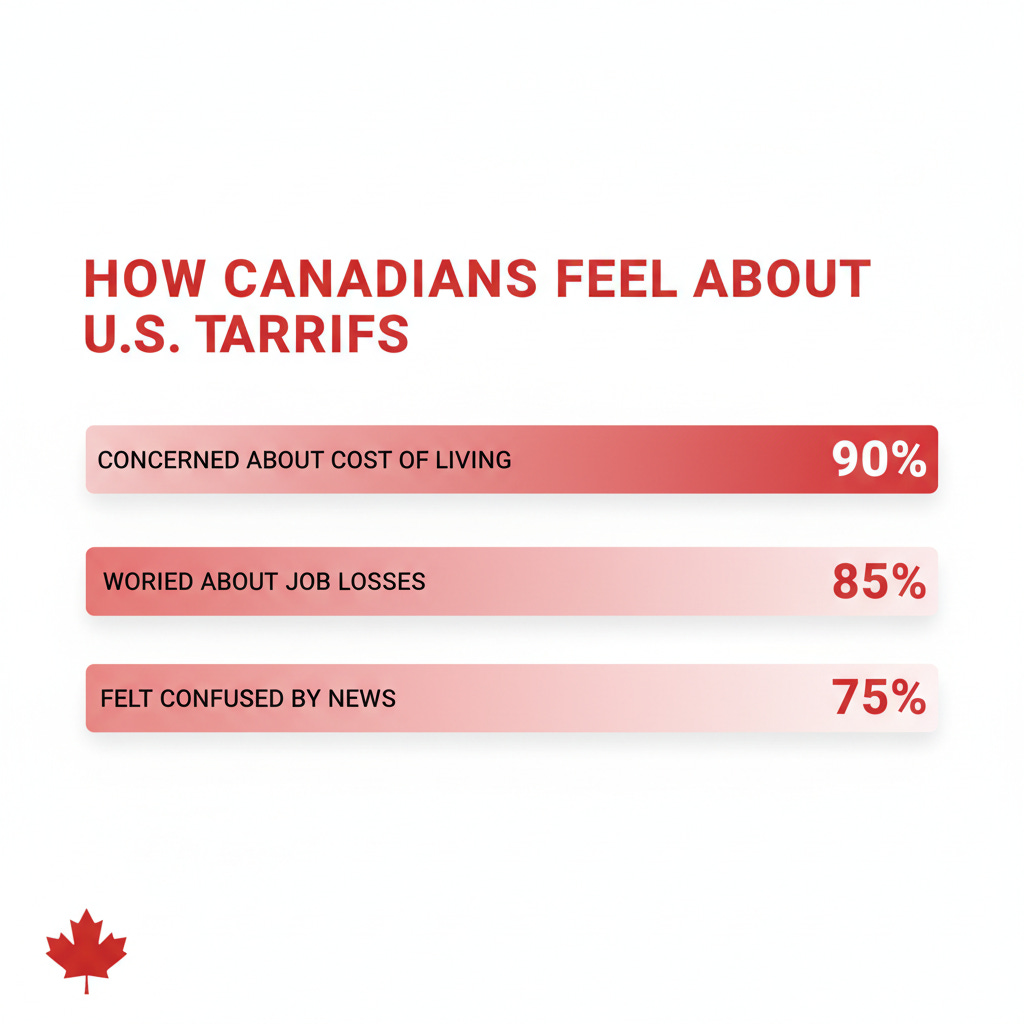
The focus groups, conducted online in March 2025 with 62 participants across the country, took place during a period of intense economic uncertainty. The central topic was the relationship between Canada and the United States, specifically the recent imposition of U.S. tariffs on Canadian goods. The report paints a clear picture of a public struggling with the situation.
Participants described feeling frustrated, nervous, and worried about how the tariffs would impact their financial wellbeing. The conversations were dominated by concerns over a higher cost of living, the scarcity of essential goods, large-scale job losses, and the potential for an economic recession. This points to a critical question: when citizens are anxious, how do they perceive the information they receive? According to the report, not clearly. Many felt it was difficult to keep track of the issue.
“...many feeling that the situation seemed to change on an almost daily basis.”
This confusion creates a vacuum. People are looking for clarity and reassurance, a stable story to make sense of the economic turbulence. The government, armed with this qualitative data, understands the emotional state of the country. The next step is not simply to create policy, but to craft a message that meets the moment.
The Policy Echo Chamber
Here is the detail I find most revealing. Faced with widespread economic anxiety, one of the government’s responses was to develop and test a video advertisement for its “Choose Canada” campaign. This is where the process moves from listening to shaping. I call this the Policy Echo Chamber. The government hears the public’s emotional state (the echo) and then designs a message optimized to resonate within that specific emotional chamber, reinforcing a desired feeling.
Participants in four of the eight focus groups were read a script for the ad. The language was carefully constructed to evoke patriotism and collective resilience.
NARRATOR SPEAKING:
Canada, it’s time for more... us.
Because we’re more than just a place on a map.
We’re an attitude.
One with more empathy than ego.
More unity than conformity.
More grit, go, and we got this.
The reaction was largely positive. Participants reported feeling strong “feelings of national pride and a deep sense of dignity in being Canadian.” The script worked. It successfully tapped into the desired emotions. But the research went deeper, testing specific phrases to see which performed better. In three groups, participants were asked to choose between two lines. “Almost all expressed a preference for ‘more empathy than ego’,” the report notes, because they felt empathy was a “stronger, more all-encompassing term compared to kindness.”
This is not a consultation on policy. It is a focus group for an advertising campaign. The government is using a small sample of Canadians to fine-tune marketing language designed to be broadcast back to the entire population. You are both the subject of the research and the target of the communications it helps produce.
Consulting on a Foregone Conclusion
The same pattern appears in other areas of the report. On the topic of internal trade, participants were not asked for open-ended solutions. Instead, they were presented with a list of four pre-defined potential actions, such as “Allowing businesses to sell their products anywhere in Canada,” and asked which should be the top priority. This method frames the conversation and limits the scope of feedback to a multiple-choice response on government-approved options.
The discussion on consumer carbon pricing is even more direct. Participants were first informed of a government decision and then asked for their reaction. The report states:
“Provided with information about the Government of Canada’s decision to remove the consumer portion of the federal price on carbon, participants were asked whether they supported or opposed this action.”
The decision was already made. The research was conducted to gauge the public’s reaction to a conclusion, not to solicit input that might shape it. The purpose, once again, appears to be about understanding the communications landscape after a policy has been decided, not about using public opinion to form the policy itself.
From Consultation to Communication
The stated purpose of this $1.6 million research project is to support the Privy Council Office’s Communications and Consultation Secretariat. Its mandate is to help “coordinate government communications.” The findings from these 62 Canadians are not primarily for deputy ministers drafting trade policy or for ministers setting carbon policy. They are for the communications professionals tasked with building a national narrative.
This process transforms public opinion from a democratic input into a strategic resource. It gives the government a data-driven advantage in the art of public persuasion. By understanding your anxiety about tariffs, your preference for the word “empathy” over “kindness,” and your reaction to a finished policy on carbon pricing, it can craft messages that are more likely to be accepted, to reassure, and to unify sentiment around a chosen course of action.
The Citizen as Critic
Understanding this machinery is essential. The government’s use of focus groups is not a conspiracy, it is a sophisticated and logical practice of modern communications. But it is a practice you should know about. This process is not the same as a town hall meeting or an electoral mandate. It is a closed loop of message testing and refinement. The clarity this report provides offers you a new form of agency. When you see a government advertisement or hear a new talking point, you can now analyze it as a finished product that was tested and optimized for a specific emotional effect.
When you understand the machinery of persuasion, you are no longer just its target.
Sources:
The Strategic Counsel. (2025, May 22). Continuous Qualitative Data Collection of Canadians’ Views: March 2025 Final Report. Privy Council Office.
That feels totally accurate based on the many conversations I have with business owners and leaders. The uncertainty and perpetual changes make any sort of planning a challenge.