


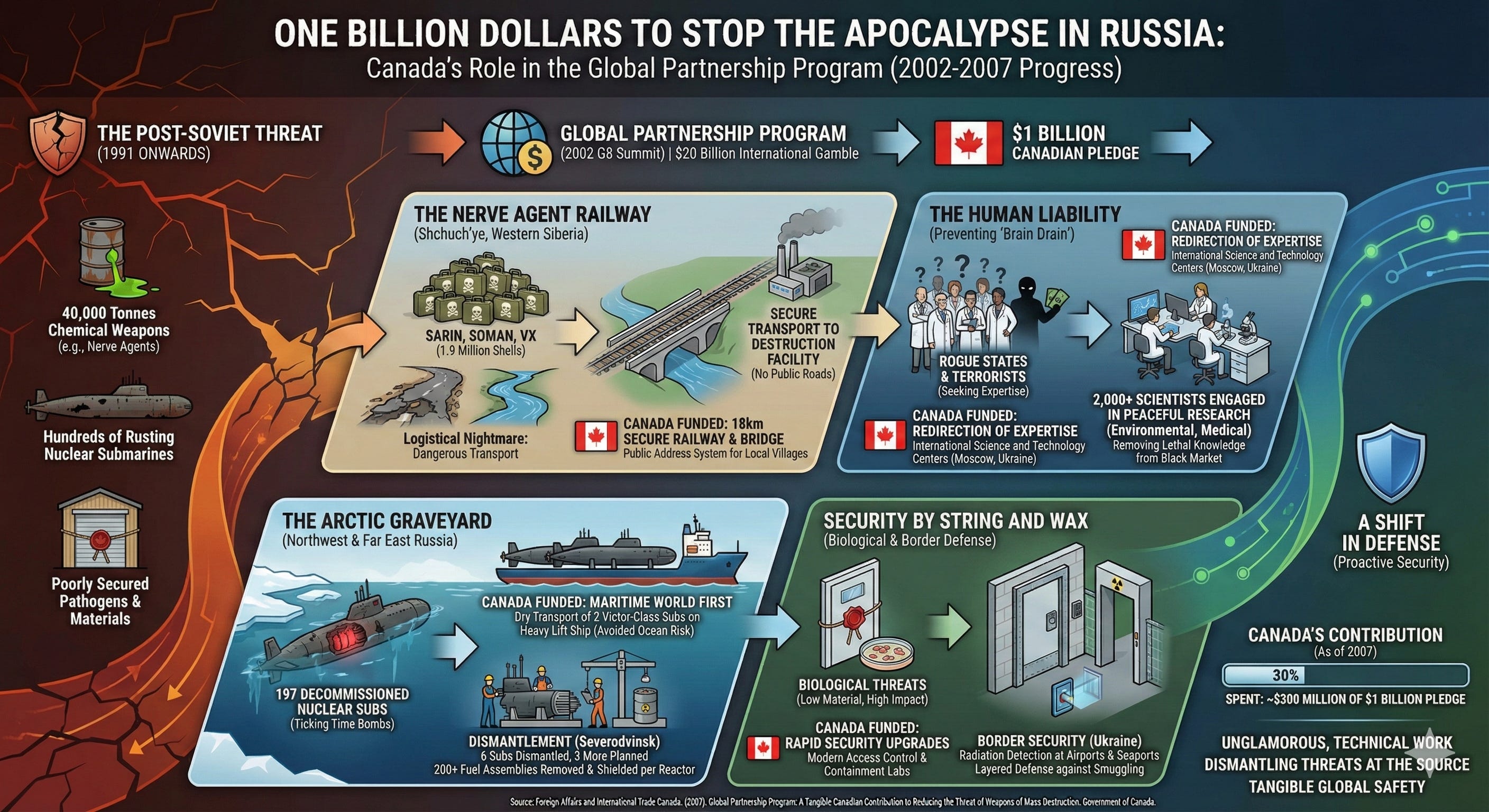
The dissolution of the Soviet Union in 1991 did not just end a geopolitical era. It cracked open a Pandora’s box of lethal materials that had been stockpiled for decades. As the Iron Curtain fell, it revealed a terrifying landscape of unguarded threats: forty thousand tonnes of chemical weapons, hundreds of rusting nuclear submarines, and warehouses full of pathogens secured by little more than wax seals. This was the chaotic reality that birthed the Global Partnership Program. Launched at the G8 Kananaskis Summit in 2002, this initiative represented a twenty billion dollar international gamble to secure these materials before they could be sold to the highest bidder or seized by terrorist groups. Canada stepped into this volatile vacuum with a pledge of one billion dollars, initiating a race against time to dismantle the physical legacy of the Cold War before it could be weaponized against the West.
The Nerve Agent Railway
Deep in the Kurgan Oblast of Western Siberia lies Shchuch’ye, a name that represents one of the most concentrated nightmares on Earth. Here, the Soviet Union had amassed nearly two million artillery shells filled with deadly nerve agents. These were not large, cumbersome missiles that required specialized launch systems. These were small-calibre munitions, rugged and portable enough to fit inside a standard briefcase. For security experts, Shchuch’ye was a catastrophe waiting to happen. The sheer volume of Sarin, Soman, and VX gas stored there constituted a significant portion of the world’s declared chemical weapons stockpile, sitting in aging warehouses that were never designed to hold them forever.
The logistical challenge of destroying these weapons was nearly as dangerous as the weapons themselves. The chemical weapons destruction facility was separated from the storage depot by miles of rough terrain and the Miass River, creating a vulnerability during transport where an accident or an ambush could lead to a mass casualty event. Canada directed thirty-three million dollars toward a concrete solution: an eighteen-kilometre railway.
By March 2006, construction crews broke ground on a dedicated rail line designed to act as a secure conveyor belt for the apocalypse. This infrastructure project included a bridge over the Miass River and high-security communications lines to link the storage depot with the destruction facility. The objective was simple but critical: move the 1.9 million shells from their static decay into the furnaces of the destruction plant without them ever touching public roads. Beyond the steel and concrete, Canada funded a public address system for the local villages, a grim acknowledgment that even with the best engineering, the people living in the shadow of Shchuch’ye needed a way to be warned if the wind suddenly carried something deadlier than dust.
The Arctic Graveyard
While the chemical threat lay hidden in Siberian warehouses, the nuclear threat was rotting openly in the frigid waters of the Arctic. Following the Cold War, the Russian Navy decommissioned nearly two hundred nuclear-powered submarines. Lacking the funds to properly dismantle them, the Russian Federation left them to float at their berths in the Northwest and the Far East. These vessels were not dormant. They were ticking environmental and radiological time bombs. Many still carried spent nuclear fuel on board, their reactors cooling in the hulls of ships that were slowly succumbing to corrosion.
The sheer scale of the waste required a level of engineering audacity that had never been attempted. In 2006, Canadian funding facilitated a maritime world first. Two Victor-class nuclear submarines, stripped of their dignity but retaining their danger, were lifted entirely out of the water and transported as dry cargo on the deck of a specialized heavy lift ship. A Dutch maritime company, Dockwise, was contracted to move the vessels from a naval base near Murmansk to the Zvezdochka Shipyard in Severodvinsk, eight hundred and fifty kilometres away. Towing the submarines through the open ocean was deemed too risky. Their hulls were in such poor technical condition that they might have broken apart in rough seas, releasing their radioactive payload into the Arctic ecosystem.
Once at the shipyard, the process of dismantlement began. It was a surgical operation performed on a colossal scale. Workers cut away the pressure hulls and installed containment buildings over the reactor sections. Specialized equipment removed over two hundred fuel assemblies from each reactor, placing the highly radioactive spent fuel into shielding casks for transport to the Urals. By 2007, Canada had funded the dismantlement of six submarines, with agreements in place to destroy three more. This was not merely about environmental cleanup. It was about non-proliferation. Each dismantled sub represented two reactors and a massive quantity of highly enriched uranium removed from the global equation.
The Human Liability
The hardware of the Cold War was terrifying, but the software—the human knowledge required to build it—posed an even more insidious threat. When the Soviet Union collapsed, tens of thousands of scientists who had spent their careers designing plague agents, nerve gases, and nuclear warheads found themselves unemployed. In the closed nuclear cities that did not appear on any public maps, entire populations that had once enjoyed the privileges of the Soviet elite were suddenly faced with economic ruin. The risk was obvious. Rogue states and terrorist organizations were actively recruiting, looking to buy the expertise that could turn raw materials into functioning weapons of mass destruction.
To counter this “brain drain,” Canada funneled millions into the International Science and Technology Center in Moscow and its counterpart in Ukraine. The goal was redirection. The program paid former weapons scientists to turn their lethal skills toward peaceful research. By 2007, over two thousand scientists were engaged in Canadian-funded projects. These were not abstract grants. They were targeted payments designed to keep nuclear physicists and biological warfare experts employed in legitimate work, such as environmental monitoring or medical research, rather than selling their services to the highest bidder on the black market.
The program acknowledged a dark reality: a scientist who cannot feed their family is a security risk. By integrating these experts into the international scientific community and helping them commercialize peaceful technologies, the initiative sought to permanently remove them from the marketplace of terror. It was a soft-power strategy with hard-security implications, ensuring that the knowledge of how to weaponize anthrax or enrich uranium remained locked in the past.
Security by String and Wax
Perhaps the most chilling discovery of the post-Soviet assessment was the state of biological security. While nuclear facilities often had fences and guards, many biological institutes housing some of the world’s deadliest pathogens had almost no physical protection. Canadian inspectors visiting priority institutes in 2006 found facilities where the only thing standing between a thief and a vial of weaponized disease was a simple door secured by string and a wax seal.
The biological threat is unique because it requires so little material to cause catastrophic damage. A nuclear bomb requires significant infrastructure; a biological attack requires a petri dish and a delivery system. The Canadian response involved a rapid upgrade of physical security. At facilities across the former Soviet Union, the string and wax were replaced with modern access control systems, reinforced perimeters, and proper containment laboratories.
This effort extended to the frontiers of the former Soviet bloc. In 2006, Canada invested in securing the borders of Ukraine, installing radiation detection equipment at airports and seaports to prevent nuclear smuggling. The strategy was to build a layered defense, securing the materials at their source while simultaneously hardening the transit points where smugglers might try to move them. It was a recognition that in a globalized world, a biological leak or a stolen radioactive source in Eastern Europe could become a national security crisis for North America in a matter of days.
The Global Partnership Program represents a shift in how nations view defense. It operates on the principle that the most effective way to protect citizens is not to build higher walls at home, but to go to the source of the danger and dismantle it piece by piece. As of 2007, Canada had spent nearly three hundred million dollars of its billion-dollar pledge. The work is unglamorous, technical, and often invisible to the public, yet it remains one of the most tangible contributions to global safety in the modern era. Every dismantled submarine and every destroyed nerve shell is one less nightmare waiting to happen.
Source Documents
Foreign Affairs and International Trade Canada. (2007). Global Partnership Program: A Tangible Canadian Contribution to Reducing the Threat of Weapons of Mass Destruction. Government of Canada.