


Every summer, a familiar ritual unfolds across Canada. Hundreds of organizations, from national industry associations to local community groups, invest countless hours preparing detailed submissions for the House of Commons Standing Committee on Finance. They analyze data, survey their members, and craft recommendations on how the federal government should spend taxpayer money. This effort is based on a foundational promise of our democratic system: that through the open, all-party process of pre-budget consultations, their voices will be heard and their ideas will help shape the fiscal direction of the country.
This year, that promise has been broken. A procedural battle in the Finance Committee on September 17, 2025, revealed a fundamental disruption to this core democratic function. The government has scheduled a surprise budget for November 4, effectively sidelining the committee’s ability to conduct meaningful public consultations. This points to a critical question for anyone who believes in parliamentary oversight: Is the budget process still a democratic dialogue, or has it become a top-down corporate-style announcement?
The Ritual of Consultation
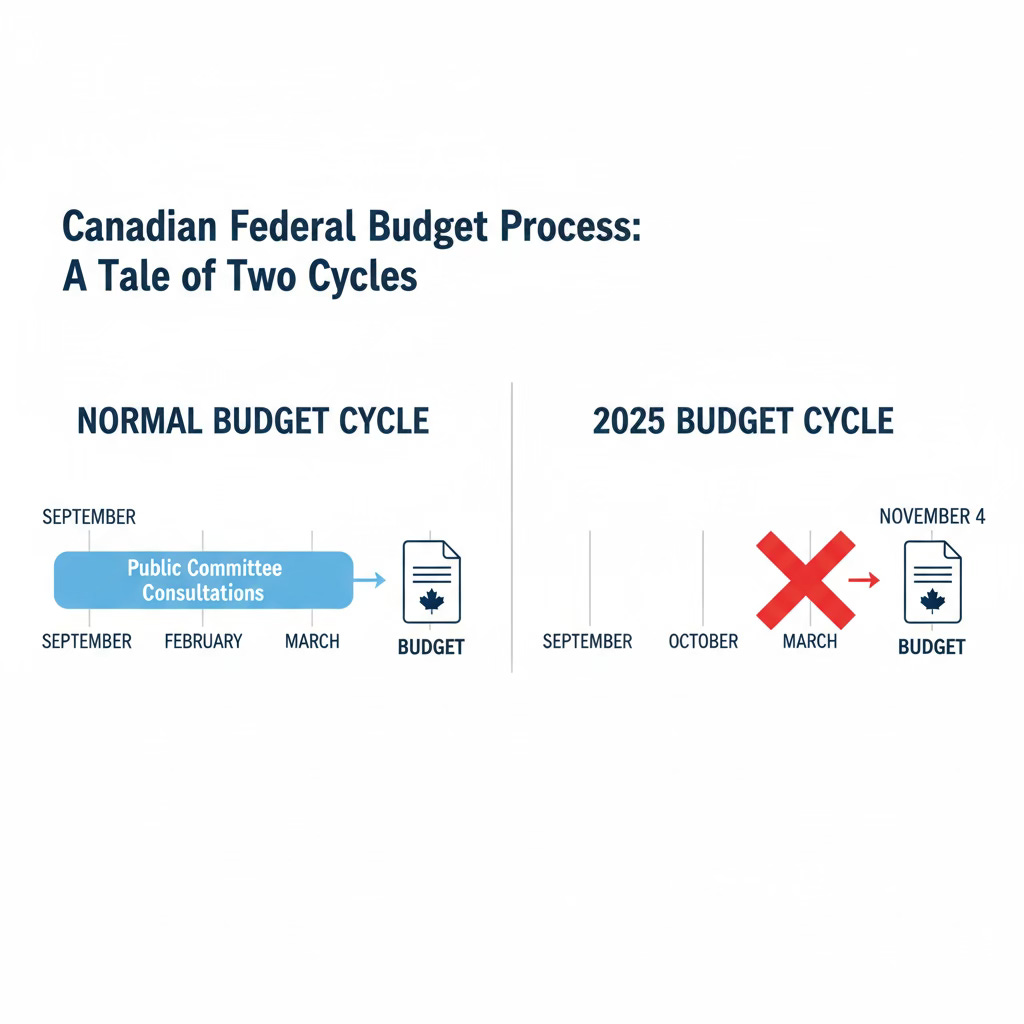
To understand what’s gone wrong, you first need to understand how the process is supposed to work. In a recent committee meeting, Bloc Québécois MP Jean-Denis Garon described the “long-standing tradition” that dictates the committee’s agenda. Normally, the committee spends the fall travelling the country and holding hearings, giving groups the chance to present their recommendations. As Garon noted, these are people “whose time and resources are scarce and precious, so Parliament, parliamentarians and the committee must respect that time”. This work culminates in a comprehensive report, usually tabled in February, which presents Parliament’s collective advice to the Minister of Finance before the budget is finalized for its typical spring release. This cycle is the primary mechanism through which citizens directly influence the government’s budgetary policy. It is slow, deliberative, and public by design.
A Cycle Interrupted
The normal cycle was thrown into disarray by a spring 2025 federal election. Because of the election, the government did not table a budget in March or April, a situation Garon points out “generally occurs during major crises such as COVID-19 or in wartime”. Following the election, the new government announced it would not present a budget until November 4. This sudden announcement, just weeks before the budget’s release, effectively vaporized the timeline for the Finance Committee’s traditional consultation process. There is simply no time to hear from the hundreds of groups that made submissions, analyze their testimony, and write a substantive report that could possibly influence a budget set to go to print in a matter of weeks.
The Ghost Kitchen Budget
The best way to understand this new approach is to think of it as a Ghost Kitchen Budget. A ghost kitchen is a restaurant that only exists for delivery apps. There is no storefront, no dining room, and no direct interaction with customers. Food is prepared behind closed doors and delivered directly to your doorstep.
This is precisely what is happening with the 2025 federal budget. The Department of Finance has become a ghost kitchen, preparing a fiscal plan in private. The government argues it has conducted its own consultations, with Liberal MP Ryan Turnbull pointing to “over 50 different consultations across every province and territory”. But these are not the same as the public, all-party hearings of a parliamentary committee. They are private meetings held by the government, for the government. The final product, the budget, will be delivered to the House of Commons on November 4, fully formed. The parliamentary committee, which should be the public dining room where ideas are debated and scrutinized, has been bypassed.
The Impossibility of Meaningful Work
Opposition MPs argue that this compressed timeline makes a mockery of the consultation process. They believe the government is simply going through the motions to create the appearance of listening. Jean-Denis Garon was blunt in his assessment:
We can’t rush it and make people come to us out of expediency just to make them think the committee heard them and the minister will consider their recommendations in a timely member when that won’t be the case.
He added that with the budget so close to being finalized, the government is essentially inviting people to a hearing where “nobody’s going to listen to them or hear them, that they’ll have wasted their time and be laughed at”. The core of the opposition’s motion was a demand for clarity. They asked the Minister of Finance to appear and explain whether the November budget is for the 2025 fiscal year only, or if it extends into 2026. Without this basic information, the committee cannot even begin to plan its work. As Garon stated, “We simply can’t work unless we have that information”.
The Government’s Defense
The government’s representatives on the committee see the situation differently. They frame the issue as a consequence of the election and accuse the opposition of obstruction. Liberal MP Ryan Turnbull argued, “the budgetary cycle was interrupted by an election”. His position is that the committee should use what little time it has to hear from as many witnesses as possible, rather than debating procedure. He sees the opposition’s motion as “throwing a wrench into the works of this committee to slow us down so that we can’t hear from witnesses”. Fellow Liberal Carlos Leitão added that waiting to table a budget was the “responsible” choice given the economic uncertainty caused by the United States government. From their perspective, they are making the best of a difficult situation, and any consultation, even a rushed one, is better than none.
The Real Stakes: Parliament vs. The Executive
Here is the detail I find most revealing. This debate is not just about a single budget’s timeline. It is a conflict over the fundamental roles of Parliament and the government. The government, or the executive branch, believes its duty is to consult on its own terms and deliver a budget. The opposition, representing the legislative branch, argues that Parliament’s role is to provide a public forum for accountability and to ensure the voices of Canadians are formally integrated into the process.
When the executive branch truncates or bypasses the established parliamentary process, it concentrates power within the Prime Minister’s Office and the Department of Finance. It transforms a democratic dialogue into a corporate-style announcement. The work of hundreds of citizen groups is relegated to background noise rather than essential input, and the role of MPs on the committee is reduced from legislators to spectators.
A Process is a Promise
This is not a simple story of partisan bickering. It is a case study in procedural decay. The integrity of our democratic institutions rests not just on outcomes, but on predictable, transparent processes. When those processes are treated as inconvenient obstacles to be circumvented for political expediency, the promise of participation is broken. The budget cycle was not designed to be efficient for the government of the day, it was designed to be effective for the people of Canada.
In Other News...
Beyond this deep dive, you can find more analysis and commentary on the On Hansard site.


Sources:
Standing Committee on Finance. (2025, September 17). Evidence (No. 002, 45th Parliament, 1st Session). House of Commons of Canada.