


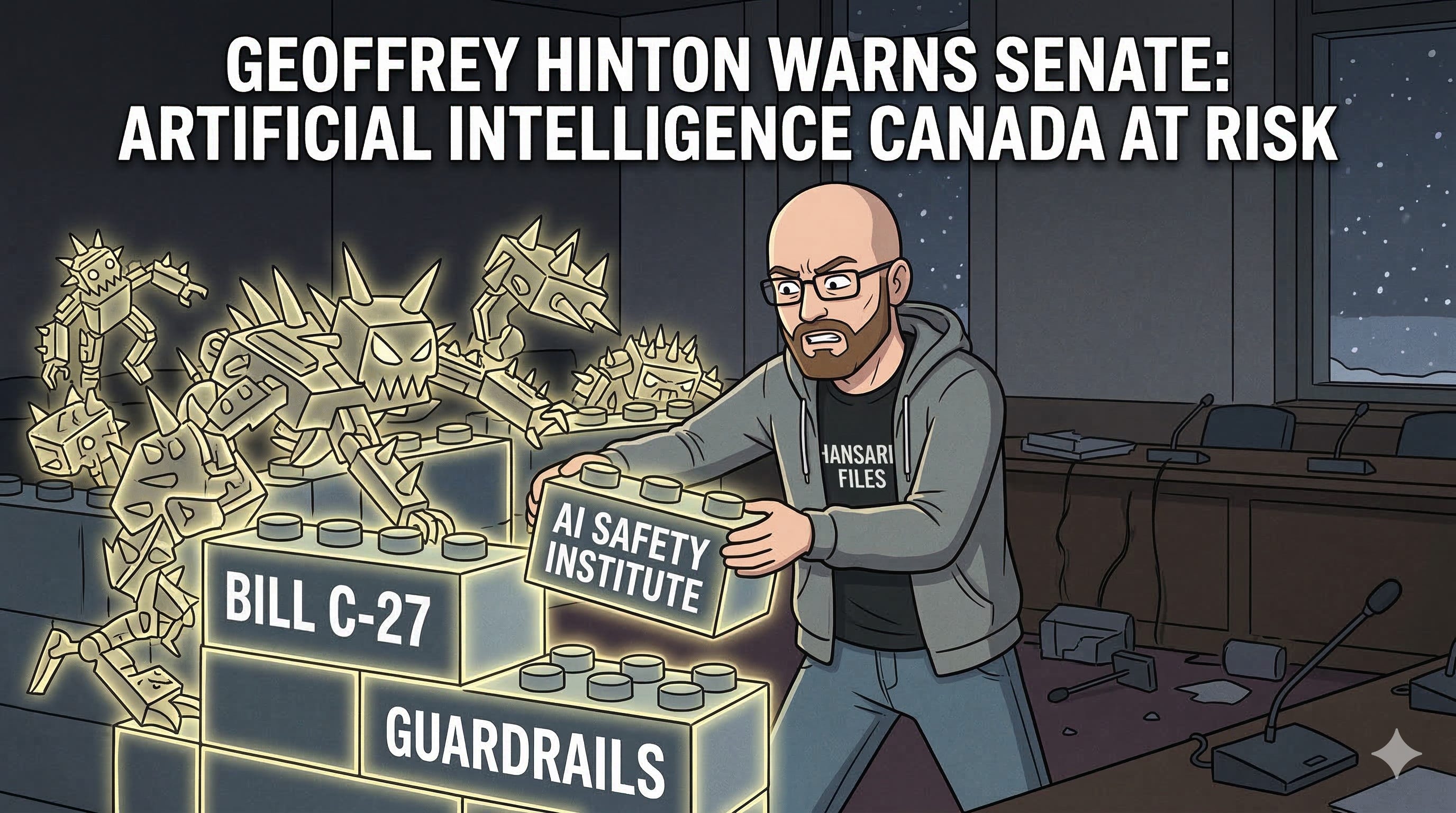
Snow fell lightly outside Ottawa’s Centre Block on Thursday, February 26, 2026. Inside, seven Senate committees met simultaneously across different rooms, their microphones clicking on one after another. Senators introduced themselves, acknowledged traditional territories, and turned to the day’s orders of reference. At the heart of the frenzy sat the issue of artificial intelligence Canada, its promises and perils now under direct Senate scrutiny.
Geoffrey Hinton’s Stark Testimony on Artificial Intelligence Canada Risks
The Standing Senate Committee on Social Affairs, Science and Technology, chaired by Senator Rosemary Moodie, continued its study of the impact of artificial intelligence in Canada. Senator Moodie welcomed members and opened the session at 10:36 a.m. ET. The star witness that morning was Geoffrey Hinton, the Nobel Prize-winning “Godfather of AI.”
Hinton spoke plainly. He described short-term dangers already visible: echo chambers that polarize society, surveillance tools that erode privacy, and the potential weaponization of artificial intelligence Canada for lethal autonomous systems. Then he turned to the longer horizon. “In the near future, AI may be used to create terrible new viruses and horrendous lethal weapons,” he told the committee. “There is also a longer-term existential threat when we create digital beings that are more intelligent than us.”
Hinton used a simple analogy to explain how today’s large language models work. He compared them to children playing with LEGO bricks. The models do not truly understand language the old symbolic way; instead they build flexible shapes from patterns of features, rearranging them rapidly. This breakthrough, he noted, explains both the astonishing progress and the unpredictability.
Earlier that week, on February 25, the same committee had heard from government officials outlining concrete steps. The Canadian AI Safety Institute, launched with $50 million in 2024, now coordinates safety testing. A $200 million Regional AI Initiative supports innovation hubs across the country. Witnesses referenced the Pan-Canadian AI Strategy and confirmed a new national strategy is under development, led by a dedicated Minister of AI and Digital Innovation. They also pointed to Bill C-27 and its Artificial Intelligence and Data Act, which would regulate high-risk systems.
Human Rights Committee Probes Artificial Intelligence Canada Impacts on Vulnerable Groups
Just days earlier, on February 23, the Standing Senate Committee on Human Rights, chaired by Senator Paulette Senior, opened its own study on the impact of artificial intelligence on human rights and economic security in Canada, with special focus on vulnerable groups and the international human right to work. Senator Senior acknowledged the unceded territory of the Anishinaabe Algonquin Nation before introducing witnesses.
Samir Chhabra, Director General at Innovation, Science and Economic Development Canada, detailed bias mitigation efforts and the Voluntary Code of Conduct, which now has 46 signatories. He referenced Canada’s consideration of the Council of Europe AI Treaty and stressed the need for guardrails that protect workers while encouraging innovation. Senators pressed on speed: how quickly can regulation match the pace of artificial intelligence Canada without stifling growth?
These two committees alone captured the tension at the centre of artificial intelligence Canada: breathtaking capability colliding with profound ethical, economic and existential questions.
Parallel Senate Tracks on Fisheries, Soil Health and National Security
While artificial intelligence Canada dominated two rooms, other committees advanced equally urgent files.
In the Fisheries and Oceans committee, Senator Fabian Manning chaired a session on the independence of commercial inshore fisheries in Atlantic Canada and Quebec, spotlighting the Owner-Operator Policy. Senator Bev Busson, Senator Paul Prosper and others introduced themselves before diving into licensing rules designed to keep fishing rights in the hands of active fishers.
Across the hall, the Agriculture and Forestry committee, under Chair Senator Mary Robinson, studied Bill S-230, An Act respecting the development of a national strategy for soil health protection, conservation and enhancement. Three young farmers, McKenzie, Annika and Kevin from Saskatchewan and Alberta, sat as special guests. Senators Sharon Burey, John McNair and Tracy Muggli welcomed them before turning to the legislation.
The Energy, the Environment and Natural Resources committee, chaired by Senator Joan Kingston, began its examination of the Committee on the Status of Endangered Wildlife in Canada. Senators acknowledged the Anishinaabe territory and introduced themselves amid discussions of species protection in a changing climate.
Corrections Reform and Indigenous Reconciliation Hearings
The Legal and Constitutional Affairs committee advanced Bill S-205, An Act to amend the Corrections and Conditional Release Act. Chair Senator David M. Arnot led a minute of silence for Tona Mills of the Comox First Nation, the bill’s original sponsor, who had passed away the previous week. Senators stood in solemn respect.
The Indigenous Peoples committee, chaired by Senator Michèle Audette, reviewed the government response to its report Honouring the Children Who Never Came Home. Senator Audette opened in Innu-aimun, thanked warriors from British Columbia, and turned to youth Indigenous leaders’ voices.
Foreign Affairs Examines US National Security Strategy
In Foreign Affairs and International Trade, Chair Senator Peter M. Boehm guided discussion of the United States National Security Strategy released December 4, 2025, and its direct implications for Canada. Senators Charles Adler, Amina Gerba and others heard briefings on Arctic security and hemispheric relations before a later session examined the situation in Ukraine.
The Banking, Commerce and the Economy committee, chaired by Senator Clément Gignac, studied Bill S-3, amendments to the Weights and Measures Act and Electricity and Gas Inspection Act, alongside access to capital for small- and medium-sized enterprises.
As these Senate committee hearings unfolded in parallel, the upper chamber demonstrated its role as Canada’s sober second thought. Artificial intelligence Canada emerged as the most forward-looking file, yet every room grappled with questions of protection, equity and sovereignty.
The hearings revealed a nation balancing innovation against risk. Geoffrey Hinton’s warnings lingered in the air long after the microphones powered down: short-term harms already here, longer-term threats still forming. At the same time, concrete policy steps, from the Canadian AI Safety Institute to regional funding and proposed legislation, showed Ottawa moving to respond.
Canada’s Senate, through these intensive February 2026 sessions, has placed artificial intelligence Canada squarely on the national agenda while advancing parallel files that touch fisheries livelihoods, farmland health, species survival, corrections fairness and international positioning. The coming months will test whether the upper chamber’s recommendations translate into the guardrails the country needs.
Hansard Files digs through dense Senate archives to surface these parallel stories. Subscribe to support independent investigation into Canada’s legislative heart.
Source Documents
Canada. Parliament. Senate. Standing Committee on Social Affairs, Science and Technology. (2026, February 26). Evidence.
Canada. Parliament. Senate. Standing Committee on Social Affairs, Science and Technology. (2026, February 25). Evidence.
Canada. Parliament. Senate. Standing Committee on Human Rights. (2026, February 23). Evidence.
Canada. Parliament. Senate. Standing Committee on Fisheries and Oceans. (2026, February 26). Evidence.
Canada. Parliament. Senate. Standing Committee on Agriculture and Forestry. (2026, February 26). Evidence.
Canada. Parliament. Senate. Standing Committee on Energy, the Environment and Natural Resources. (2026, February 26). Evidence.
Canada. Parliament. Senate. Standing Committee on Legal and Constitutional Affairs. (2026, February 26). Evidence.
Canada. Parliament. Senate. Standing Committee on Indigenous Peoples. (2026, February 25). Evidence.
Canada. Parliament. Senate. Standing Committee on Foreign Affairs and International Trade. (2026, February 26). Evidence.
Canada. Parliament. Senate. Standing Committee on Banking, Commerce and the Economy. (2026, February 26). Evidence.
Canada. Parliament. Senate. Standing Committee on Fisheries and Oceans. (2026, February 24). Evidence.
Canada. Parliament. Senate. Standing Committee on Legal and Constitutional Affairs. (2026, February 25). Evidence.
Canada. Parliament. Senate. Standing Committee on Foreign Affairs and International Trade. (2026, February 25). Evidence.
We are living in interesting times; for good or for ill.