


Walk through the argument in polite Ottawa circles and you hear a familiar refrain: grow the economy and social outcomes follow. The discussion paper prepared for the 2003 Yale symposium on “Globalization and Health: The Gender Challenge” offers a colder reading. It shows how the current rulebook for global economic integration pushes governments toward fiscal restraint and privatization, then treats the fallout as an afterthought. The effects land differently on women and girls, especially in health.
The authors outline an upstream-to-downstream view of how macro rules flow through ministries, communities, and households before showing up as sickness, unpaid care, or lost access to services. The thesis is not ideological. It rests on how incentives work and who absorbs risk.
When policy treats gender as invisible, health loses
The paper states the central analytical fault line with clarity:
“Macroeconomic policies related to economic globalization are not ‘gender blind’… [they] contain biases… that [have] a more profoundly negative impact on women and girls relative to men.”
Those biases have names. The text lists three that recur across reforms:
“Marketization bias” replaces public benefits with individual entitlements, “male breadwinner bias” ties social goals to full-time male employment, and “deflationary bias” prioritizes high interest rates and tight money even when recession drives people into precarious work.
The downstream reality follows a predictable path. Services shift to markets. Public systems thin out. Care work moves into the household. Women pick it up.
The paper underscores the “invisibility and under-valuing” of women’s paid and unpaid work, the lack of voice in decision-making, and the “double-work burden” or time-poverty that results.
Here’s what stands out most: this is not a story about attitudes. It is a story about design. The rulebook rewards one set of outcomes and sidelines the rest.
How the rulebook moves illness and cost onto women
1) The macro signals.
The text catalogs the trends tied to the current wave of globalization: faster capital flows, more privatization, falling official development assistance, and a bigger role for multinationals. These signals shape what finance ministries do. Fiscal restraint plus deregulation plus privatization is the standard package.
2) The institutional pathway.
Using a framework attributed to Labonté and Torgerson, the paper traces how global agreements and macroeconomic choices narrow “policy space,” weaken public capacity, and then show up as service access problems at the community level and time burdens inside households. Though the figure itself is visual, the logic appears across the chapter summary and structure.
3) Labour market reality.
Once you watch the labour side, the gendered pattern snaps into focus.
In agriculture, shifts from subsistence to cash crops move income control away from women and restrict access to land and credit. The result is more hours and less earnings power.
In the public sector, downsizing pushes women into the informal economy with lower wages and fewer benefits while increasing unpaid care work at home.
In manufacturing, higher-skill jobs grow, yet occupational segregation and discrimination block access for many women, especially poorer women without training.
4) Health risks compound.
When public systems thin out and user fees spread, surveillance and prevention falter. The paper’s infectious-disease section links reduced public outlays and heavy debt to weaker systems and user charges, with the burden falling on the poor, most of whom are women. The disease examples are concrete. Tuberculosis remains a leading killer in developing countries, with women accounting for an estimated 40 percent of TB deaths, and malaria threatens pregnant women and contributes to maternal mortality and anemia.
5) Measurement hides the harm.
The authors stress a methodological trap: widely used poverty and consumption measures assume a unitary household that pools resources and allocates them efficiently. That assumption hides intra-household power and masks unpaid reproductive work. The result is false comfort about “growth reduces poverty” findings when the lived distribution inside families points in another direction.
6) Governance drifts toward narrow fixes.
The section on global public-private partnerships (GPPPs) adds a governance layer. Partnerships promise speed and focus, yet often narrow agendas to specific products or campaigns while leaving health system capacity underbuilt. The paper flags the risk that private priorities overshadow public health objectives and that women’s health receives little space when decision tables lack women, especially from low-income countries.
The authors call out the absence of standards for GPPP governance, evaluation, accountability, and transparency, and note that committees are “currently dominated by northern scientists and the commercial sector.”
Iceberg Economics
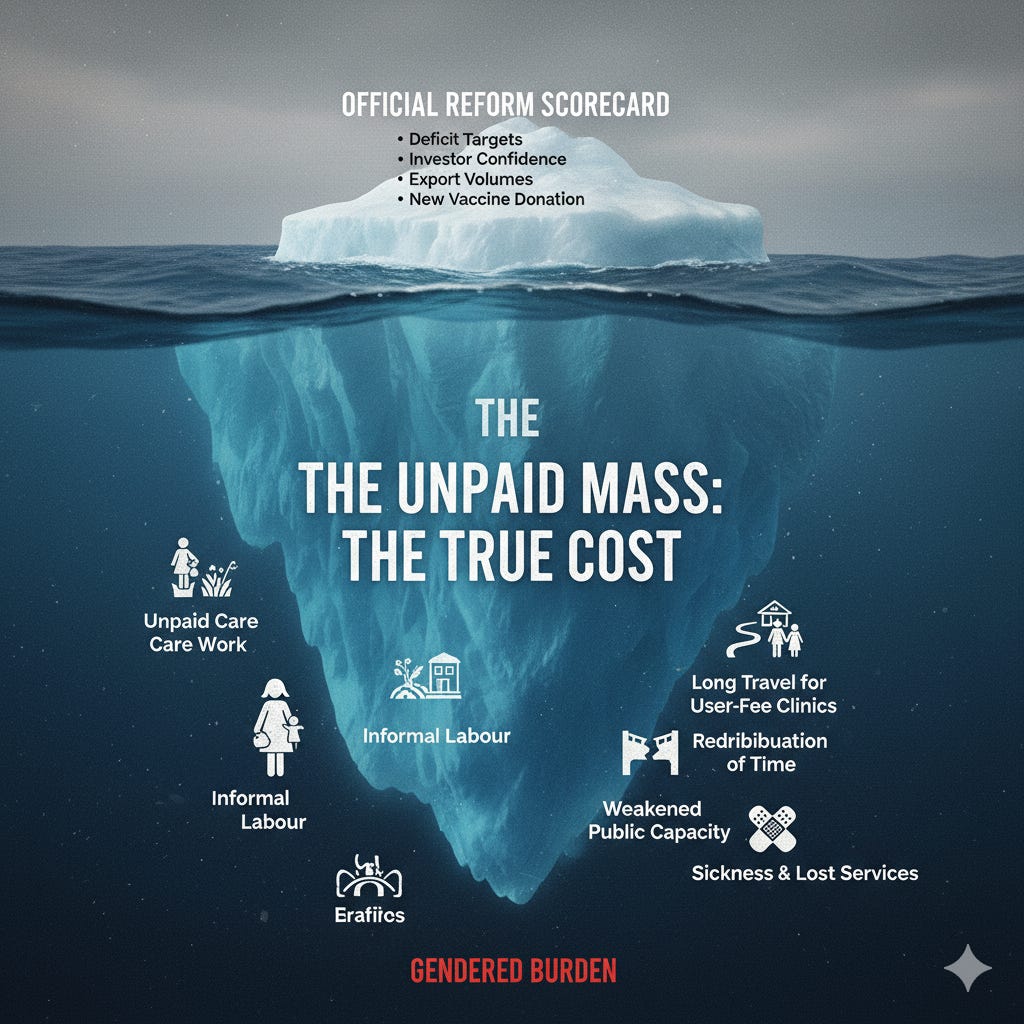
Think of the official reform scorecard as an iceberg. Above the waterline sit the metrics that receive applause: deficit targets, investor confidence, export volumes, a new vaccine donation. Below the waterline sits the mass that keeps the system afloat: unpaid care, informal work, long travel for user-fee clinics, the household redistribution of time when services shift to markets. The Yale discussion paper tells us the underwater mass is gendered. Policy that stares at the tip will miss the collision.
As the authors put it, mainstream responses “treat social policies as an ‘afterthought to macroeconomic policies’,” which leaves the iceberg’s weight uncounted.
Judge macro reforms by whether they expand social rights in practice
The paper points readers toward a different test. Elson and Cagatay’s “transformatory approach” would judge “soundness” not by market criteria alone but by whether reforms meet a social-justice standard. That means building gender into finance, trade, investment, and budget analysis from the start.
Recommended tools include “gender mainstreaming in finance,” “gender assessments of trade and investment agreements,” and “gender-aware policy appraisals,” supported by gender-disaggregated beneficiary assessments and gender-responsive budgets.
This is not moralizing. It is good systems thinking. If macro rules shrink public capacity and push costs into households, a fair test brings those costs back onto the balance sheet where they belong.
What this means for readers seeking agency
Resist the tidy narrative that growth solves distribution by itself. The paper’s findings suggest a different practical sequence for citizens and policymakers:
Scrutinize any reform or partnership for the three biases. Marketization moves services to prices. Breadwinner logic ties security to one job form. Deflationary stance trades employment for finance. If you see those choices, expect unpaid care to rise and access to fall. Quote and framework provided above.
Demand gendered evidence up front. If a program evaluation assumes pooled, efficient households, treat the results as partial. The authors warn that such assumptions erase power and time.
Press for governance standards that secure women’s voice, especially from low-income countries, inside GPPPs. Otherwise, agendas will narrow to what funders like, not what systems need. The paper flags this risk directly.
This points to a key tension. Efficiency framed in narrow market terms often displaces the very capacities that protect health. A credible alternative is not anti-trade or anti-growth. It asks for a fuller accounting that includes the underwater mass.
A better bottom line counts the unpaid
The Takeaway: If the reform story ignores who absorbs risk and who supplies unpaid labour, the numbers lie. The Yale paper’s most durable contribution is a test you can apply to any big promise: if a policy shrinks public space and treats care as infinite, the health balance sheet will tilt against women. Put the full iceberg on the ledger and the incentives start to change.
Sources
Maclean, H., Labonté, R., Glynn, K., & Sicchia, S. R. (2003). Globalization, Gender and Health: Research-to-Policy Interface. Discussion paper prepared for Globalization and Health: The Gender Challenge, Yale University Symposium, June 20–22, 2003.