


Every Canadian who has ever wielded a shovel knows the feeling. You spend an hour clearing your driveway after a heavy snowfall, only to hear the familiar rumble of the city plow. In a single pass, the plow operator undoes your hard work, leaving a dense, icy wall of snow blocking your path to the street. This windrow of municipal waste feels like an annual, unavoidable frustration. It’s a small injustice, but one that aggregates into a deep-seated cynicism about public services.
Here is the detail I find most revealing. The Government of Canada solved this problem. Not recently, with some new smart city technology, but in 1963, with an elegant piece of mechanical engineering developed by its own National Research Council (NRC). The story of this invention, and its subsequent failure to become standard equipment on every plow in the country, is a perfect case study in why common-sense innovation often dies on the vine. The answer, buried in two decades-old technical reports, has nothing to do with the quality of the idea and everything to do with the friction of implementation.
The Problem: A Wall of Icy Annoyance
The challenge, as the NRC defined it in their February 1963 report, was simple. Conventional snowplows work by gathering snow and casting it to the side. This process creates a “continuous bank along the side of the road across private driveways and cross streets, as well as blocking fire hydrants”. This disturbed snow then “tends to harden into a tough rigid mass with time”, creating a significant burden for residents. The problem was clear, universal, and ripe for a straightforward engineering solution.
The Solution: A Deceptively Simple Gate
The NRC’s Engine Laboratory, led by M.S. Kuhring, developed an “hydraulically operated gate” designed to be fitted to the discharge end of a standard snowplow. The concept was brilliant in its simplicity. As the plow approached a driveway, the operator could close the gate, temporarily trapping the snow in front of the blade. Once the plow cleared the driveway, the operator would raise the gate, depositing the accumulated snow on the bank on the other side.
The NRC’s mandate was not to build a commercial product, but to prove the concept was sound. They built a robust prototype and tested it extensively. The results were excellent. The gate worked “satisfactorily in heavy snow” and could open or close in about one second, which was more than fast enough to handle driveways on city lots at typical plowing speeds. After proving the device worked, the NRC published its findings and made the information freely available to any municipality or manufacturer who wanted it. The solution was invented, tested, and delivered.
The Mystery: Why Isn’t This on Every Plow?
This is where the story should have ended, with cities across the country eagerly adopting the technology to solve a persistent public complaint. But that is not what happened. In September 1964, the NRC published a follow-up report summarizing the feedback from a national questionnaire. Of 106 respondents, only 22 had built, purchased, or were in the process of acquiring a gate. The vast majority had decided not to proceed.
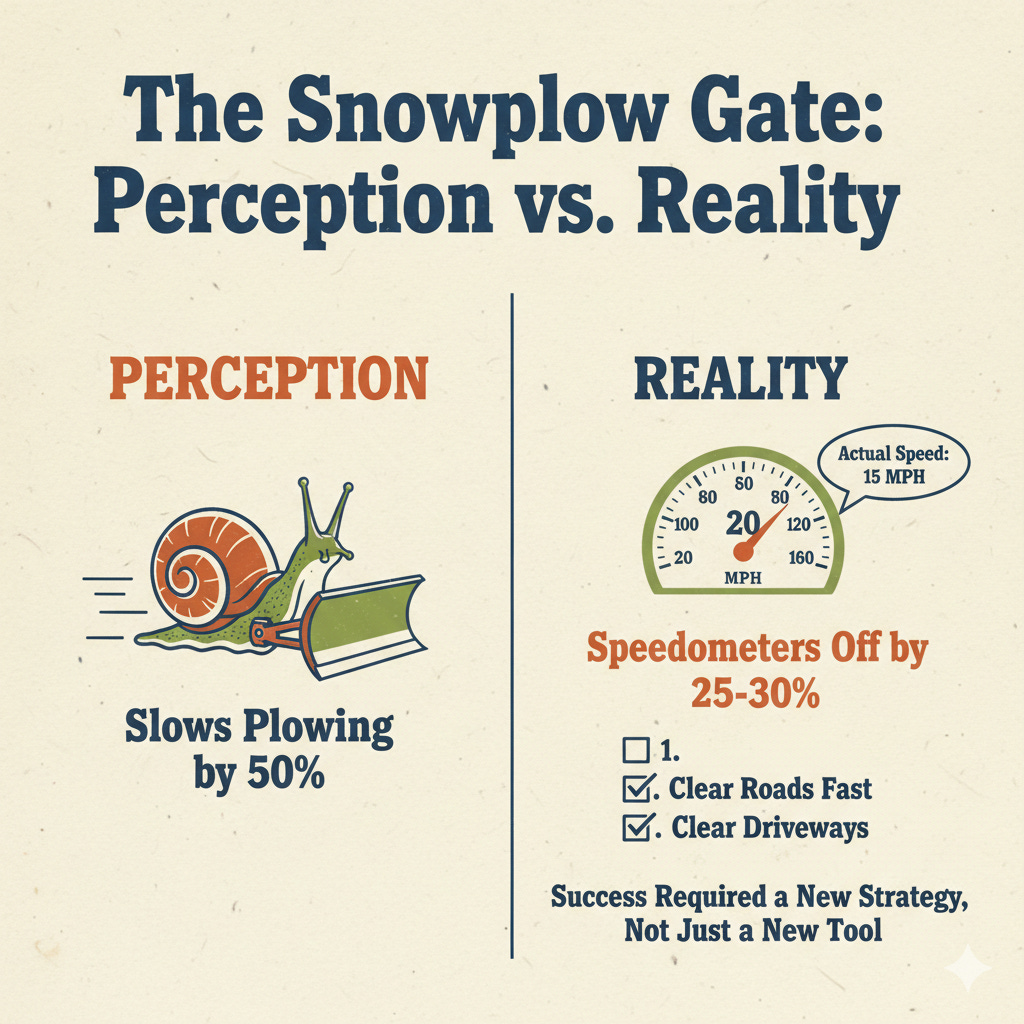
The reason, cited over and over again, was a single, powerful objection. As one municipality noted after checking with others who had tried it, “They advised that it slowed plowing operations considerably”. Another decided against it because they felt “it might slow down snow plowing operations”. This narrative, that the gate made plowing inefficient, became the accepted wisdom that effectively killed the project. But it was a conclusion based on a critical flaw in the data.
The Last-Mile Problem of Public Innovation
This points to a critical question. How could the NRC’s tests show the gate was efficient while the real-world experience suggested the opposite? The answer lies in what we can call the “Last-Mile Problem of Public Innovation.”
Inventing a device is often the easy part. The difficult part, the “last mile,” is translating that invention into a practical, real-world operational system. It requires not just a tool, but also accurate data, a clear strategy, and a feedback loop for refinement. The snowplow gate successfully ran the first 99 yards of the field, but it fumbled the ball in the last yard, right before the goal line.
The Data Glitch: A Kilometer Isn’t Always a Kilometer
The NRC researchers were just as puzzled by the reports of slow operation. Their prototype was quick and had no trouble keeping up. So, they ran more tests, and in doing so, they “brought out a very interesting error”.
They discovered that on the test truck, the speedometer was driven by the transmission. For plowing, an additional reduction gear was used in the rear axle, which slowed the truck down without affecting the speedometer reading. The result was a massive data discrepancy:
When the speedometer read 15 mph, the truck’s actual speed was 10.8 mph.
When the speedometer read 20 mph, the actual speed was 15.5 mph.
The widespread belief that the gate was too slow was, in large part, based on operators looking at faulty speedometer readings. They thought they were driving at 20 mph when they were actually going much slower. This single data glitch created a powerful, but false, narrative that gave municipalities the perfect excuse to reject the innovation. A good idea was dismissed based on bad data.
The Strategy Deficit: A Tool Without a Tactic
The second failure in the “last mile” was the lack of an operational strategy. Most cities seemed to view the gate as an all-or-nothing tool that had to be used on every single pass. This is where the thoughtful experience of the City of Pointe Claire, Quebec, is so valuable.
In a letter to the NRC, their maintenance engineer explained that using the gate on the initial pass did, in fact, increase plowing time by about 35 percent. Their solution was tactical. They used the plows without the gate for the first pass to quickly open all roads for emergency vehicles. Then, they used the gates on the second pass for cleaning up and widening the cleared path.
This two-pass strategy was the missing piece of the puzzle. It balanced the need for speed with the public-relations benefit of clear driveways. The innovation wasn’t just the device itself, but the strategy for deploying it. Unfortunately, this crucial insight was not part of the original package, leaving most municipalities to conclude it was simply inefficient.
The Unfinished Prototype: Hazard of the Swinging Gate
Finally, the NRC’s prototype had a few minor but significant design flaws. Most notably, the gate was designed in a way that caused it to swing outward as it was raised. Multiple municipalities, including Calgary and Pointe Claire, correctly identified this as a hazard that could cause the gate to strike “the curb, a hydrant, a power pole or any object which might be along-side the sidewalk”.
These were solvable problems. Pointe Claire, for instance, simply “corrected [it] by placing a hinge where the blade is attached directly to the lifting arms”. But for organizations without the time or engineering staff to make such modifications, it was another barrier to adoption. The gap between a research council’s proof-of-concept and a commercially road-ready product was just wide enough for many to decide it was not worth the effort.
The Real Barrier to Innovation
The story of the snowplow gate is a frustrating lesson in how progress stalls. The technology was sound, the public need was clear, and the cost was manageable. The project failed because the “last mile” of implementation was neglected. A faulty speedometer created a false narrative, a lack of strategy made the tool seem inefficient, and minor design flaws made it appear impractical. The system for turning a good idea into a standard practice was incomplete.
We are often left with yesterday’s problems not because we lack solutions, but because we fail to see that an invention is only as good as the instructions that come with it.
In Other News...
Beyond this deep dive, you can find more analysis and commentary on the On Hansard site.


Sources:
Kuhring, M. S. (1963). An hydraulically operated gate for snowplows (Mechanical Engineering Report ME-213). National Research Council of Canada.
Kuhring, M. S. (1964). Consolidated replies to questionnaire on the hydraulically operated snowplow gate (Mechanical Engineering Report ME-216). National Research Council of Canada.
It goes to show that the potential inaccuracy of all data inputs (like speedo readings) can skew the end results of testing. I live in a rural area and appreciate road plows slow down before possibly removing my roadside mailbox!