


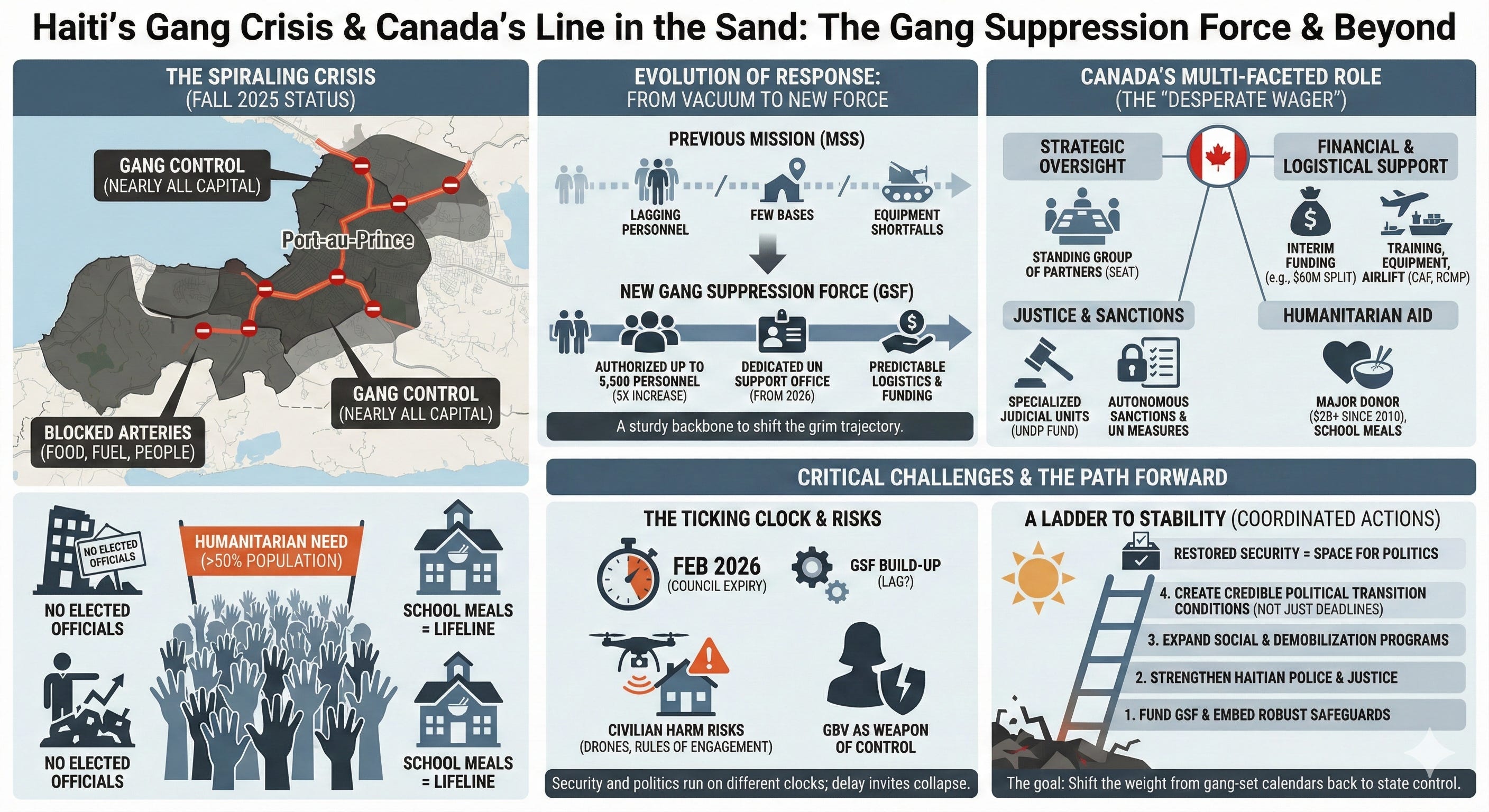
The Gang Suppression Force sits at the center of a desperate wager, one that runs through the neighborhoods of Port au Prince and the committee rooms of Ottawa. As the mission gathers strength, Canada must decide how far to push, and how fast, in a crisis where delay invites collapse and haste risks harm.
By the fall of 2025, armed groups commanded nearly all of the Haitian capital and choked the arteries that move food, fuel, and people. The state had no elected officials in office, humanitarian need had swollen to more than half the population, and even school meals were becoming a lifeline. Parliament’s foreign affairs committee opened its study with one question that shaped all the others, could an empowered force stabilize the streets long enough for politics to catch up, or would the clock run out first.
The Vacuum After the Assassination
The sequence began with a vacuum. In January 2020, the mandates of the lower house and most of the upper house expired without new elections. Rule by decree deepened mistrust. The assassination of President Jovenel Moïse in July 2021 was a pivot, not a beginning, but the shock accelerated a slide that Haitian and foreign investigators are still unwinding. In September 2023, a powerful gang coalition consolidated control and began coordinated strikes on critical infrastructure. The state’s collapse was not abstract. Markets shuttered. Roads turned into checkpoints. Violence multiplied in neighborhoods where public services had already thinned to a thread.
Faced with escalating chaos, Haiti’s acting leadership requested outside security support, and the United Nations Security Council authorized a Multinational Security Support mission. That mission never reached intended scale. Its personnel lagged far below plan, its bases were few, and equipment fell short of what on-the-ground operations required. In parallel, the Caribbean Community brokered a Transitional Presidential Council, a nine member body meant to steer toward an interim government and elections. Over time, allegations of corruption, infighting, and stalled delivery drained much of the council’s public legitimacy. The mandate now has a firm end date. The mission to restore security arrives on one timeline. The transitional authority expires on another.
The Promise of the Gang Suppression Force
The Gang Suppression Force was designed to fix what failed before. The new mission carries authorization up to 5,500 personnel, a fivefold increase over the struggling predecessor, and a dedicated United Nations support office with assessed budget backing starting in 2026. Predictable logistics and funding are not abstractions. Fuel for vehicles translates into reachable neighborhoods. Radios that work mean a joint operation can be coordinated. When a force is stuck waiting for voluntary contributions, every missed shipment becomes a new opening for an ambush.
For Canada’s envoy in Port au Prince, resolution 2793 marked a hinge, a point where a stronger mandate and a sturdier backbone could shift a grim trajectory. The Standing Group of Partners, where Canada has a seat, is meant to provide strategic oversight and spur troop generation and financial support. The job is both immediate and practical. Keep current contingents operating as the transition proceeds. Bridge voluntary funding until assessed money arrives. Avoid a dangerous gap that would signal retreat. At full deployment, the mission will still depend on tens of millions in voluntary contributions each year to meet objectives, a reminder that architecture alone cannot guarantee execution.
Rules, Drones, and Civilians
The difference between an offensive mandate and an indiscriminate campaign is written in rules of engagement, independent oversight, and complaint mechanisms that people trust. Those details were under review as the committee heard testimony, which is why Ottawa’s diplomats, police, and military were already analyzing and pressing for clarity. The committee heard a stark pattern. Sexual and gender based violence has become a weapon of control. Women and girls suffer in areas where gangs punish communities and recruit minors. Health care is patchy. Many facilities are closed. Survivors struggle to obtain emergency contraception, forensic services, or psychosocial support within the critical window for care.
Technology compounds risks. Attack drones began appearing in the skies over the capital in 2025, a tactic that can change the ground in seconds but also misread a neighborhood as a target. If rules are not precise, if operations are not guided by strict safeguards and civilian harm mitigation, an offensive posture can tilt into something that leaves people more exposed. Demobilization capacity is thin. The estimated number of gang members includes a large share of minors. Arrests and kinetic strikes make headlines. Transitional justice, safe exits for children, and community stabilization do not. Yet without them, violence will recycle faster than any unit can clear.
A Clock Ticking on Politics
Security and politics run on different clocks. The Transitional Presidential Council’s term ends in early February 2026, before the new mission is expected to hit full stride. Elections are unlikely before that date given who controls the roads and the turf where more than half of the electorate lives. Logistics alone block a ballot. Distributing materials across gang held highways is a plan without a route. Even if the state could move trucks and personnel, a credible result requires enough consensus to accept the outcome.
Witnesses urged a shift from fixed deadlines to conditions. Tie an electoral calendar to measurable security thresholds, to observable logistics, to milestones people can see. Start local where possible, build upward as safe zones expand, and create safeguards against gang capture of the process itself. Then there is representation. The transitional council includes only one woman and without a vote, despite constitutional requirements. The committee heard how pervasive insecurity, including sexual violence, narrows who can engage in politics, which compounds a legitimacy problem for any transition plan. A viable path requires space for participation, and participation requires basic safety.
Money, Muscle, and Aid
Canada’s footprint is long and visible. In the fifteen years since the earthquake that killed hundreds of thousands, Ottawa has provided more than two billion dollars in assistance, the second largest contribution after the United States. In the 2023 to 2024 year alone, Haiti was Canada’s largest recipient in the Americas. Canada has contributed to every United Nations peace mission in the country for nearly three decades. Since 2022, Canada’s support has included hundreds of millions across security, governance, humanitarian, and development lines. A justice basket fund managed by the United Nations Development Program was created with Canadian leadership to chip away at impunity.
When the new mission replaced the old, Canada announced another sixty million dollars, splitting funds between the mission and a regional maritime initiative aimed at slowing the illicit flow of firearms and ammunition into Haiti and the surrounding Caribbean. On the ground, the Canadian Armed Forces and the Royal Canadian Mounted Police have delivered training, equipment, and logistics, including through operation specific airlift. Aid is not only uniforms and radios. The committee heard that Canadian funding helped deliver daily hot meals to more than one hundred thousand schoolchildren over the last year. Those meals stabilize households and keep children off the street in neighborhoods where gangs recruit aggressively.
Justice, Sanctions, and the Long Game
In April 2025, Haitian authorities set up specialized judicial units to pursue complex financial crimes and mass crimes. International partners, including United Nations bodies, helped recruit prosecutors and magistrates and begin to operationalize a system designed to insulate cases from broader dysfunction. Analysts described the effort as an entire chain that runs parallel to a strained justice system, a structure that could, for the first time, make convictions possible for orchestrators of massacres and high level corruption. Canada used its Group of Seven presidency to rally support for these units and created a monitoring committee to track their setup and operating rules.
Sanctions are the other lever. Ottawa has targeted dozens of Haitian individuals under its autonomous regime while implementing United Nations measures, and officials reported practical impacts on travel, finance, and political operations. The committee also heard warnings about growing links between Haitian gangs and criminal networks in Canada, a reminder that the border is not a firewall. Sanctions are not a panacea, but they change incentives and constrain logistics. Combined with maritime interdiction and customs support, they can narrow the pipeline of weapons and money that keeps gangs supplied.
Canada’s Hard Choices
Canada has been cautious about deploying uniformed personnel to lead international missions in Haiti. The caution reflects complexity on the ground and the legacy of past operations that failed to protect civilians, particularly women and girls, and that left lasting harm, including the cholera outbreak after the 2010 disaster. That history does not argue for inertia. It argues for precision. Ottawa’s role inside the Standing Group of Partners places it close to the decisions that will decide whether the new mission’s rules of engagement are tight enough, its oversight independent enough, and its complaint mechanisms trusted enough to prevent abuse.
The committee’s witnesses coalesced around a set of priorities that amount to a map. Keep the Gang Suppression Force funded and growing toward its authorized size without a gap in deployments. Embed robust safeguards against sexual exploitation and abuse. Strengthen the Haitian National Police so there is a national institution to hold reclaimed ground. Expand survivor centered services. Scale programs that help children leave armed groups. Press for a political transition that is inclusive, credible, and realistic about conditions on the ground. Reinforce efforts to stop the flow of guns. Invest in the specialized judicial units and the broader rule of law so arrests and trials have meaning beyond the next headline.
The Billion Dollar Oversight
The stakes are not contained. A paralyzed state in the Caribbean amplifies irregular migration, enables trafficking, and destabilizes neighbors. The costs feed back into Canada’s domestic politics, from border pressures to law enforcement. The committee’s recommendations are not a wish list. They are a ladder. Each rung connects to the next, from the way a patrol moves down a street to the way a court hears a case. The ladder must hold a country’s weight.
Time is the enemy. If the mission’s build out lags and the transitional authority expires without a credible replacement, the crisis will move into a more dangerous phase. If, instead, Canada and its partners align resources and conditions, the Gang Suppression Force can open a window long enough to restore basic security in key zones, the police can begin to rebuild trust, and civilians can breathe long enough to participate in designing a transition. In that window, the justice units can signal that impunity is no longer automatic. After years in which gangs set the calendar, the objective is simple, take it back.
The Street and the State
Every statistic hides a family. Humanitarian need rises when a market cannot open because a road is controlled by a checkpoint, when a clinic is closed and a survivor cannot reach care in time, when a child’s only hot meal is the one served at school, if the school is open at all. Stabilization is not an abstraction for those families. It is a patrol that arrives when called. It is a judge who hears a case without fear. It is an election that people believe counts.
Canada’s decision is whether to lead with the tools it has and accept the risks that come with leadership, or to remain at a distance and accept the risks that come with absence. The committee’s work reads like a ledger. On one side, the record of what has failed, of what has harmed, and of what did not arrive in time. On the other, a portfolio of actions that, coordinated and sequenced, can shift the weight. The Gang Suppression Force is the keystone in that portfolio. If Ottawa pushes to make it lawful, disciplined, and accountable, if it matches that push with support to Haitian police, justice, and civil society, there is a path through.
Source Documents
House of Commons Standing Committee on Foreign Affairs and International Development. (2025, December). Haiti’s multi faceted crisis and Canada’s response. Ottawa, Canada: 45th Parliament, 1st Session.