


When you hear news of a shooting in a Laval Starbucks or the tragic murder of a woman named Gabie Renaud by a partner with a long history of violent crime, you feel a mix of sorrow and anger. A natural response is to look to our leaders for action and accountability. You turn to the proceedings of Parliament, hoping to see these urgent matters addressed with the seriousness they deserve.
Instead, you often find a frustrating spectacle. You see pointed questions met with defensive non-answers. You see grief used as a setup for a political attack and a tragedy used as an opportunity to defend a system. This disconnect between real-world problems and the political debate about them is a core source of civic frustration. The institution designed to provide answers, the daily Question Period, often seems engineered to do the opposite. It leaves you feeling that the entire process is a performance, one where your concerns are merely props on a stage.
The Performance of Scrutiny
The central problem you face as an engaged citizen is that our primary mechanism for government oversight has been transformed into Accountability Theatre. It has the appearance of scrutiny. It uses the language of accountability. But its objective is not to produce clarity for the public. Its objective is to produce political advantage for the participants.
This is not a conspiracy. It is the logical result of a system where every exchange is recorded, clipped, and shared to reinforce a partisan narrative. The goal is no longer to get an answer on the record. The goal is to get a sound bite on the internet. Understanding the structure of this performance is the first step toward seeing through it and regaining your sense of agency. Accountability Theatre unfolds in two predictable acts.
Act One: The Indignant Question
The performance begins with a question from the opposition that is not designed to elicit information. It is designed to frame the government as incompetent or malicious. The questions are often loaded with accusatory language and state conclusions as if they are foregone facts.
Consider the exchange on October 2, 2025, regarding the tragic murder in Saint-Jérôme. Senator Carignan did not simply ask what the government was doing to reform bail for violent offenders. He framed the question as a direct accusation:
Do you acknowledge that your government’s laxity and naivety over the past ten years have turned Canada’s correctional system into a massive revolving door?
This is not a question seeking a policy update. It is a political indictment presented as a query. The language of “laxity and naivety” and “massive revolving door” is chosen for its emotional impact, not its precision.
Similarly, on the topic of the firearms buyback program, Senator Housakos did not ask for a progress report. He demanded the Prime Minister “fire his incompetent public safety minister and finally scrap this failed gun buyback scheme”. This approach bypasses debate and goes straight to a verdict. Its purpose is to signal to supporters that the opposition is fighting, not to engage in a substantive discussion about the complex issue of gun crime. This is the opening act of Accountability Theatre: a question that provides its own answer.
Act Two: The Defensive Reply
The second act is the government’s response, which is equally performative. Because the question is an attack, the answer becomes a defense, not an explanation. The goal is to neutralize the political charge of the question, often by refusing to engage with its premise.
The Government Representative in the Senate, Senator Moreau, provides a masterclass in this technique throughout the October 2nd session. When faced with Senator Carignan’s question about the justice system, his first move was not to address the specific case but to defend the institution and question the motive of the person asking:
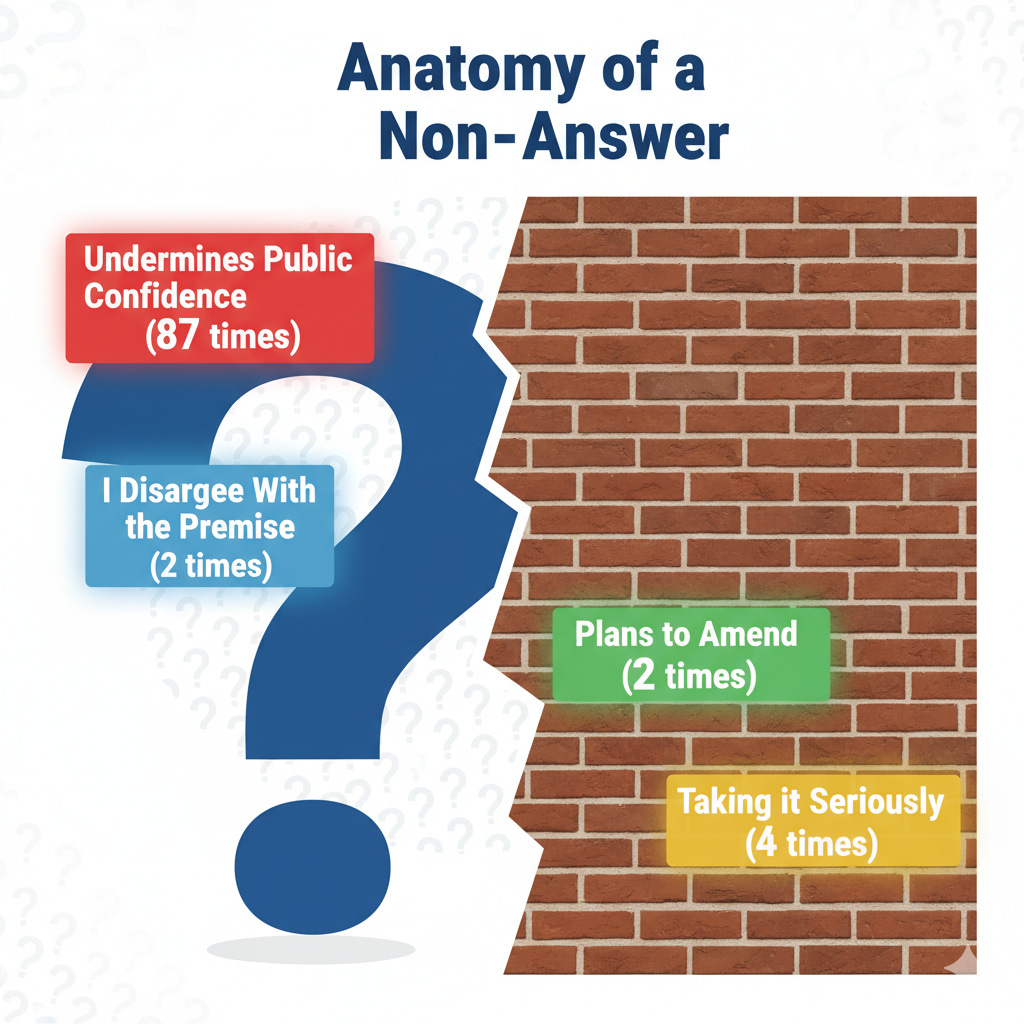
Senator Carignan, as I’ve already said, when the justice system is described in negative terms, it undermines public confidence in that system and in the courts. I believe that our role... is to support the justice system across Canada.
This tactic reframes a call for accountability as an attack on the integrity of Canada’s institutions. It deflects the specific issue (a repeat offender committing murder) and puts the questioner on the defensive.
An even more direct example is the response to questions about the Prime Minister’s own department, the Privy Council Office, being the subject of 87 compliance orders from the Information Commissioner. This is a factual claim from an independent officer of Parliament. The government’s response was a simple, repeated refusal to engage:
I disagree with the premise of your question, Senator Housakos.
When pressed, the answer remained the same: “Once again, Senator Housakos, I disagree with the premise of your question.” This is not an answer. It is a stonewall. It is a verbal tactic to run out the clock until the next question, leaving the issue of government transparency completely unaddressed. This is the predictable second act of Accountability Theatre: a reply that avoids the substance of the question entirely.
The Cost of the Performance
When political debate becomes Accountability Theatre, the consequences are significant. First, it destroys public trust. Citizens see a system that is unresponsive to urgent problems and conclude that their leaders are not serious about solving them. This breeds cynicism and disengagement.
Second, it allows complex problems to fester. While the parties perform their daily drama, the underlying issues with the bail system, firearms trafficking, and government transparency remain unresolved. The performance becomes a substitute for the hard work of governance. The promise of future action, like the Minister of Justice’s vague “plan to amend the Criminal Code,” becomes a recurring line in the script, offered without a timeline or details.
Finally, it robs you of your agency. You are left as a frustrated spectator to a drama you cannot influence. The performance is not for you. It is for the benefit of the actors, who use the stage of Parliament to build their brands and rally their bases.
Beyond the Stage
The foundational principle of Question Period is not for the opposition to look tough or for the government to appear unflappable. It is to ensure that the executive branch must answer for its decisions in a public forum. It is the primary mechanism through which Parliament holds the government to account on behalf of the people it serves. When this mechanism is used for performance rather than scrutiny, a pillar of our democratic architecture weakens. Recognizing the script of Accountability Theatre is the first step to demanding a better show, one where clarity replaces conflict and answers take precedence over applause. The purpose of the stage is not just to be seen, but to make things clear.
In Other News...
Beyond this deep dive, you can find more analysis and commentary on the On Hansard site.


Sources:
Parliament of Canada. (2025, October 2). Debates of the Senate (Hansard), 45th Parliament, 1st Session, Volume 154, Issue 21.