


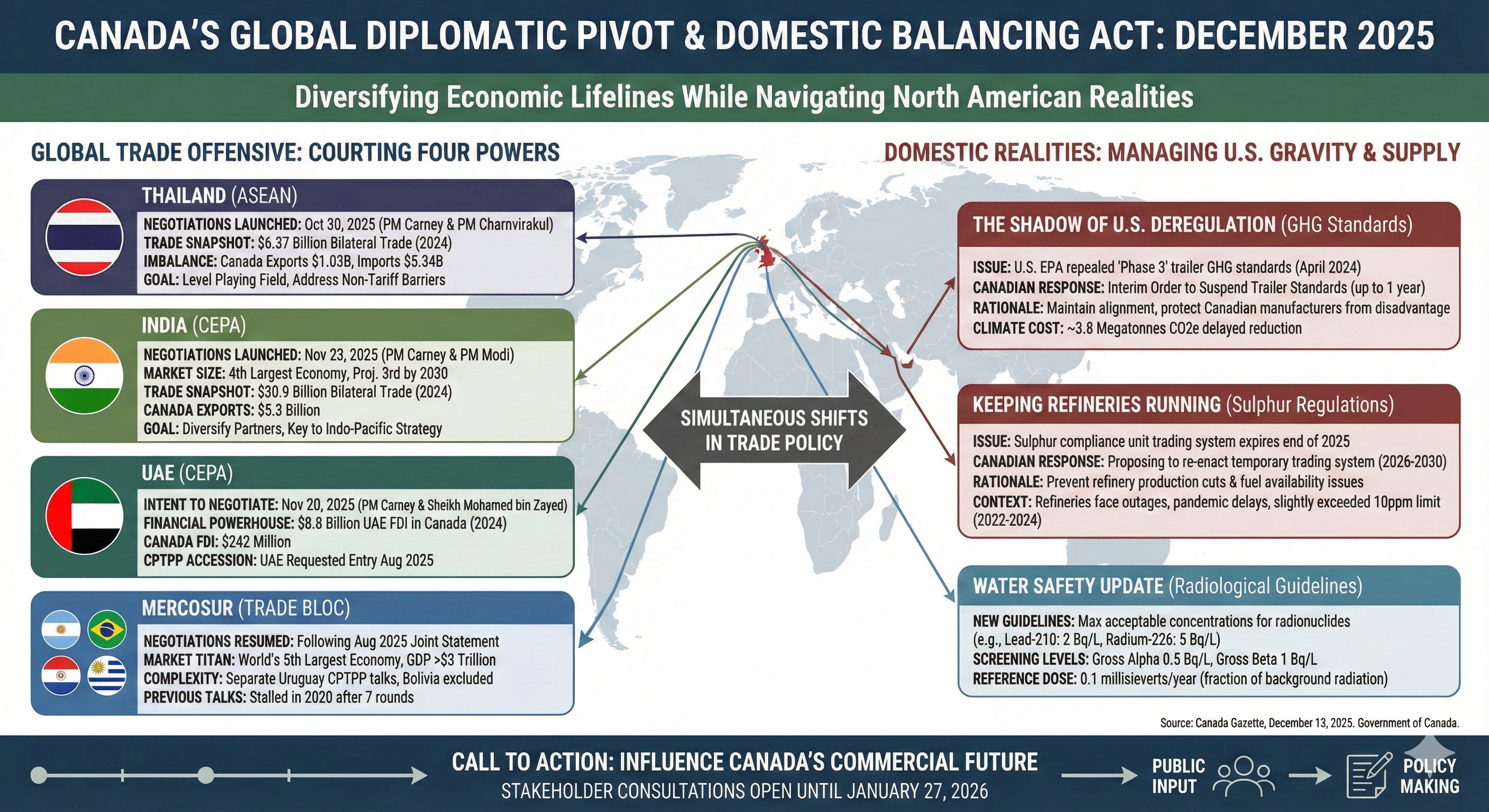
It is December 2025, and inside the quiet corridors of Global Affairs Canada, a massive geopolitical pivot is underway. On a single Saturday, the federal government signaled its intent to aggressively expand its economic footprint into the Indo-Pacific, the Middle East, and South America. This coordinated launch of public consultations for free trade agreement negotiations represents one of the most significant simultaneous shifts in Canadian trade policy in recent memory, targeting nations that represent billions in potential commerce.
While the machinery of state looks outward to new horizons, domestic regulators are wrestling with the heavy gravity of the American market. From suspending greenhouse gas standards on trailers to keep pace with United States policy rollbacks, to adjusting sulphur regulations to keep Canadian refineries operational, the narrative emerging from Ottawa is one of ambitious expansion abroad tempered by pragmatic alignment at home.
The Indo-Pacific and The Indian Giant
The government’s eyes are firmly fixed on the East. In a move to deepen ties with the Association of Southeast Asian Nations (ASEAN), Canada is soliciting views on a potential free trade agreement with Thailand. This is not a cold start; the diplomatic machinery was engaged on October 30, 2025, when Prime Minister Mark Carney and Thailand’s Prime Minister Anutin Charnvirakul agreed to launch negotiations.
Thailand currently stands as Canada’s second-largest trading partner within the ASEAN region. The numbers paint a picture of a relationship that is already robust but heavily tilted: bilateral merchandise trade hit $6.37 billion in 2024, yet Canadian exports accounted for only $1.03 billion of that total. The government is now seeking input from Canadian exporters on everything from non-tariff barriers to sanitary measures, hoping to level a playing field that has long favored imports.
Simultaneously, a much larger prize is being pursued. On November 23, 2025, Prime Minister Carney and Indian Prime Minister Narendra Modi announced the launch of negotiations toward a Comprehensive Economic Partnership Agreement (CEPA). India, currently the world’s fourth-largest economy and projected to be the third-largest by 2030, represents a massive market for Canadian goods. Two-way trade already reached $30.9 billion in 2024, with Canadian exports climbing to $5.3 billion. The government is explicitly looking to diversify its partners to drive economic growth, acknowledging that India is a key partner in strengthening links to the broader Indo-Pacific region.
The Desert and The Southern Bloc
The diplomatic offensive extends beyond Asia. On November 20, 2025, Prime Minister Carney and His Highness Sheikh Mohamed bin Zayed Al Nahyan, President of the United Arab Emirates (UAE), announced the intent to negotiate a Comprehensive Economic Partnership Agreement. The UAE is a financial powerhouse and a critical node in Middle Eastern trade. In 2024, Emirati foreign direct investment in Canada reached a staggering $8.8 billion, dwarfing the $242 million Canada invested in the UAE.
The stakes here involve more than just bilateral flows. In August 2025, the UAE formally requested accession to the Comprehensive and Progressive Agreement for Trans-Pacific Partnership (CPTPP), a massive trade bloc of which Canada is a key member. These consultations will inform how Canada approaches the UAE’s potential entry into this exclusive Pacific rim club.
Further south, Canada is attempting to revive a dormant ambition. Negotiations with Mercosur, the trading bloc comprising Argentina, Brazil, Paraguay, and Uruguay, had stalled in 2020 after seven rounds of talks. Now, following a joint statement with Brazil in August 2025, officials have been directed to resume discussions. Mercosur is a titan, representing the world’s fifth-largest economy with a GDP of over US$3 trillion.
The complexity of these negotiations is highlighted by the internal dynamics of the South American bloc. While Canada engages the group, it is also negotiating separately with Uruguay regarding its request to join the CPTPP. Meanwhile, Bolivia, which is in the process of implementing Mercosur’s internal rules, remains outside these specific negotiations.
The Shadow of American Deregulation
While diplomats draft treaties in foreign capitals, regulators at the Department of the Environment are dealing with the reality of an integrated North American manufacturing sector. The government has issued an Interim Order to suspend greenhouse gas (GHG) emission standards for trailers, a decision driven directly by regulatory reversals in the United States.
The issue traces back to a legal challenge in the US that prevented the implementation of “Phase 2” GHG standards for trailers. In April 2024, the US Environmental Protection Agency (EPA) finalized “Phase 3” rules that effectively repealed the trailer standards entirely. This left Canada in a precarious position. The Canadian trailer manufacturing industry is small compared to its American counterpart, and without the US market enforcing similar standards, Canadian companies faced a severe competitive disadvantage if forced to comply with stricter domestic rules.
The Interim Order suspends these standards for up to one year to maintain alignment. The Department of the Environment acknowledges that this suspension comes at a climate cost: delaying the trailer standards by another model year will decrease estimated GHG reductions by approximately 3.8 megatonnes of carbon dioxide equivalent over the lifetime of the affected vehicles. However, the analysis concluded that the economic risk to Canadian manufacturers, who could not spread compliance costs across the massive volumes seen in the US, necessitated the pause.
Keeping the Refineries Running
A second regulatory adjustment reveals the fragility of Canada’s fuel supply chain. The government is proposing to re-enact a temporary trading system for sulphur compliance units for the years 2026 to 2030. The previous system, designed to help refineries transition to lower sulphur gasoline, is set to expire at the end of 2025.
The rationale for this extension is stark. Without the ability to trade compliance units, some of Canada’s primary gasoline suppliers would likely fall out of compliance with the Sulphur in Gasoline Regulations in 2026. To avoid breaking the law, these firms would be forced to reduce production, leading to a decrease in refining capacity and potential fuel availability issues in several regions.
The industry has faced operational headwinds, including unplanned outages of desulphurization equipment and delays in upgrades caused by the lingering effects of the pandemic. While sulphur levels in Canadian gasoline have dropped, the pool average slightly exceeded the 10 parts per million (ppm) limit between 2022 and 2024. The revived trading system acts as a safety valve, allowing refineries to purchase credits to offset temporary exceedances and ensure that the fuel supply remains uninterrupted while they complete necessary capital projects.
The Safety of the Water
Amidst high-level trade strategy and industrial policy, the Department of Health has finalized new technical guidelines for radiological parameters in Canadian drinking water. These guidelines establish maximum acceptable concentrations (MACs) for radionuclides, which are naturally present in the environment but can accumulate in water sources.
The new standards set the limit for lead-210 at 2 Becquerels per litre (Bq/L), radium-226 at 5 Bq/L, and radium-228 at 2 Bq/L. The guidelines recommend that water systems initially screen for gross alpha and beta radiation levels; individual radionuclide analysis is only triggered if screening levels of 0.5 Bq/L for alpha or 1 Bq/L for beta are exceeded.
These guidelines are based on a reference level corresponding to a radiation dose of 0.1 millisieverts per year, a fraction of the background radiation Canadians are exposed to daily. While drinking water is a minor source of radiation exposure compared to other natural sources, the guidelines emphasize that water utilities should manage their distribution systems to minimize the accumulation of radiological elements in pipes and sinks.
Conclusion
The federal notices from mid-December 2025 paint a portrait of a nation in motion. On the global stage, Canada is aggressively courting the economies of the future, launching four simultaneous trade negotiations to secure its place in the Indo-Pacific and South American markets. Yet, at home, the government is engaged in a delicate balancing act, tweaking environmental regulations to protect domestic industries from American policy shifts and ensuring the stability of the national fuel supply.
As consultations open for trade deals that could reshape Canada’s economy for decades, the immediate next step for stakeholders is clear. Interested parties have until January 27, 2026, to submit their views on the Thailand, India, UAE, and Mercosur negotiations, a brief window to influence the trajectory of Canada’s commercial future.
Source Documents
Canada Gazette. (2025, December 13). Canada Gazette Part I, Vol. 159, No. 50. Government of Canada.