

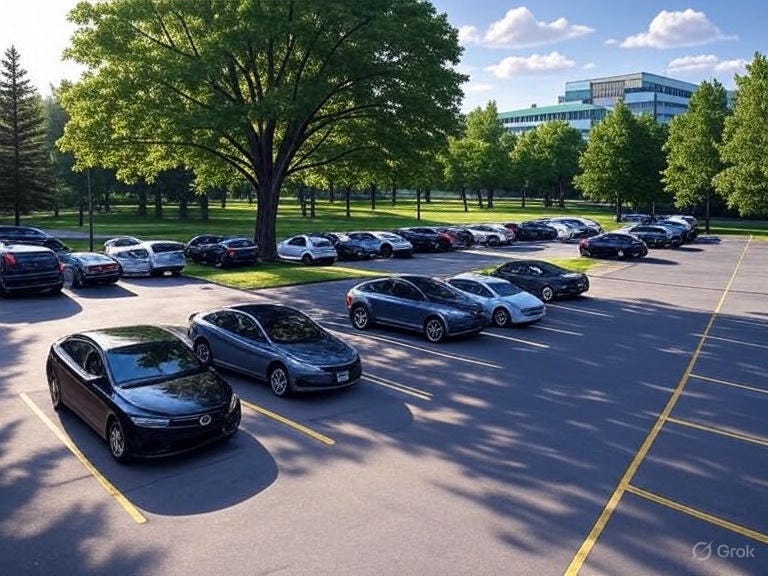
You know the feeling. It’s the peak of a summer heatwave, and the air is thick and still. You walk across a sun-beaten parking lot and the heat radiates upwards from the black asphalt, feeling like a physical force. Then, you step onto the grass of a nearby park, under the shade of a large oak tree. The relief is immediate, a drop of ten degrees or more. We’ve all felt this.
We intuitively understand that cities are hotter than the surrounding countryside, a phenomenon scientists call the "urban heat island" effect. We accept it as a general fact of modern life.
But what if this general understanding is wrong? Or rather, what if it's not specific enough to see the real danger—or the most powerful solution? A recent study suggests the most important climate battle isn't between the city and the country, but between the parking lot and the park. A group of researchers in Ottawa, Canada, ran a beautifully simple experiment to tell this exact story, and their findings are a critical lesson for all of us.
This article unpacks that experiment. By the end, you'll understand the story of what they did, what they discovered about the hidden climates within our own neighborhoods, and the single most important takeaway it offers for keeping our communities safe in a warming world.
The Question on a Quiet Campus
Our story begins not in a supercomputing lab, but on a quiet office campus in Ottawa, Canada. Researchers were tired of the limitations of purely digital models, which can be complex and computationally expensive. They wanted to anchor their predictions in the real world. They wanted to know, in simple terms: Exactly how does the ground beneath our feet change the air around us?
To find out, they chose four distinct "characters" for their experiment, all within the same campus and experiencing the same daily weather:
The 'Parking' Plot: An open parking lot, covered in asphalt, with no trees or greenery in sight. The classic urban skillet.
The 'Lawn' Site: A wide-open field of grass, with no buildings or trees within a 50-meter radius. Your typical suburban yard.
The 'Tree' Site: A greener area with sparsely distributed trees offering some shade and vegetation.
The 'Forest' Site: A plot with 100% tree coverage, representing a small, dense, urban wood.
The question was simple: On the same hot summer day, how differently would these four environments behave?
Listening to the Land
For three months, from June to September 2024, the scientists set up weather stations at each of the four locations. They listened. They recorded the "microclimate"—the specific, on-the-ground weather conditions—at each site, every day.
Think of it like putting a thermometer on the asphalt, another on the lawn, and two more among the trees, and then comparing the readings at the end of the day. The goal was to capture the real-world impact of our immediate surroundings, moving beyond city-wide averages to neighborhood-level truths.
What the Data Whispered—And Then Shouted
The first results were no surprise. The data confirmed what our senses tell us: the 'Parking' plot was consistently the hottest spot on campus. But the real revelation came when the researchers used this data to look into the future.
They didn't have a time machine, but they had the next best thing: machine learning.
Here's how it worked, explained simply:
They found a pattern. They took all the data they collected from their four sites and fed it to a powerful AI model. The AI's job was to learn the relationship between the official weather data (recorded at the nearby airport) and the actual microclimate in the parking lot, the lawn, the sparse woods, and the dense forest.
It learned the rule. For example, the AI learned that if the airport reported 30°C, the parking lot was actually experiencing conditions equivalent to a much higher "feels like" temperature, while the forest was significantly cooler.
They asked it to predict the future. Once the AI mastered these rules, the scientists gave it publicly available future climate projections for the years 2050 and 2090 and asked, "Okay, if global temperatures rise by 3.5°C, what will the heat stress feel like in our parking lot?"
The results were staggering. The study projects that while all sites will face an increased number of days with "low health risk," only one site could reliably protect against the worst-case scenarios. The dense 'Forest' site was shown to effectively prevent "extremely high-risk" heat conditions (defined as a Universal Thermal Climate Index above 38.9°C) even under severe future warming.
The asphalt parking lot, however, becomes a serious health hazard. The difference between survival and heatstroke, the study shows, is the ground you’re standing on.
The Takeaway: Nature Is Our Best Technology
And so, a simple experiment on four small plots of land tells a profound story about the future of every city. The battle to protect our communities from overheating won't be won by some far-off, futuristic technology alone. It will be won in our neighborhoods, by making conscious choices about our environment.
The key lessons from the Ottawa experiment are clear:
Asphalt is a risk multiplier. Unshaded, non-green surfaces absorb and radiate heat, dramatically increasing thermal stress on the human body.
Trees are a safety buffer. The cooling effect of shade and evapotranspiration from plants is a powerful, life-saving force.
Density is destiny. The study showed that while some trees are good, a dense canopy is transformative. The 100% tree coverage of the 'Forest' site provided a level of protection the sparsely-treed site could not.
In the grand, often overwhelming conversation about climate change, this research provides a dose of clarity and agency. It shows that the choices we make about our immediate surroundings—what we pave and what we plant—have a direct, measurable, and life-altering impact. The most advanced piece of climate adaptation technology might just be a maple tree.
The question is no longer what to do, but where we can start planting.