


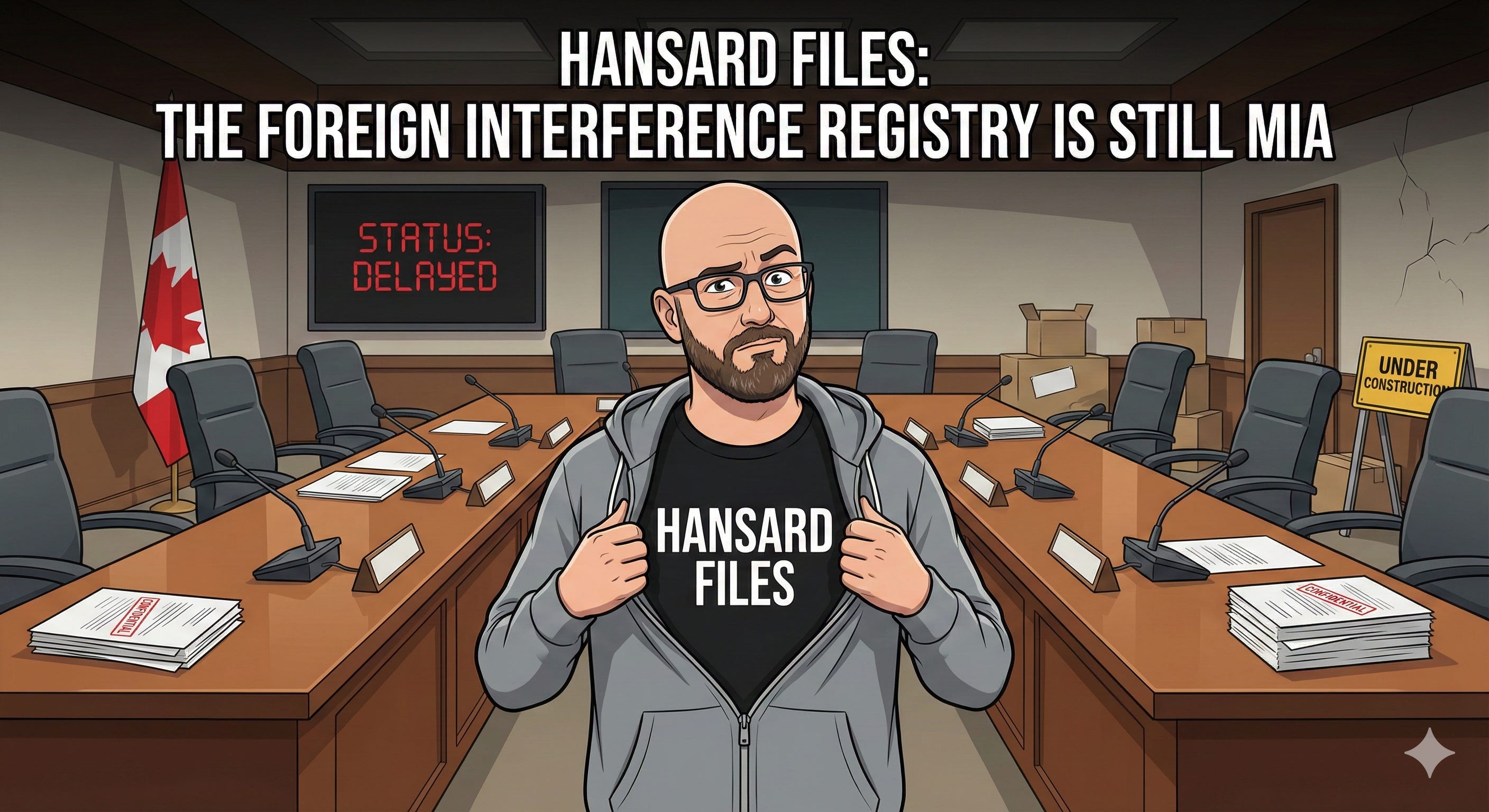
The threat of foreign interference is no longer a shadow game played in the backrooms of embassies; it is a live wire running through the heart of Canadian democracy, and right now, the government’s hands are shaking as they try to cut it. In a tense committee room this December, federal officials were forced to admit that six months after the law passed, Canada still has no foreign influence commissioner, no registry, and no clear timeline for when the “finish line” will actually be crossed. While intelligence reports warn of teenagers being radicalized by terror groups and diplomats potentially meddling in elections, the bureaucratic machinery in Ottawa seems stuck in neutral, offering vague promises of progress while the window of vulnerability remains wide open.
The Finish Line That Keeps Moving
The atmosphere inside the Standing Committee on Procedure and House Affairs was thick with frustration. It has been over a year since the legislation received royal assent, a law designed to bring transparency to the murky world of foreign influence. Yet, when pressed for a date—any date—on when the registry would be operational, the national counter-foreign interference coordinator could only offer a metaphor that seemed to stretch endlessly into the horizon.
“We are very close to the finish line,” Sébastien Aubertin-Giguère repeated, a phrase that did little to quell the impatience of MPs. The reality on the ground is stark: there is no office, no staff, and crucially, no commissioner. The Minister of Public Safety has identified a “preferred candidate,” a “high-quality” individual requiring top-secret clearance, but the consultation with opposition leaders hasn’t even begun.
This delay is not merely administrative; it is a gap in the national shield. As CSIS officials testified, the threats are evolving. We are seeing “transnational repression” where diaspora communities are targeted, and foreign actors use “inauthentic and coordinated amplification” online to sow discord. While the government insists it is moving “as soon as possible,” the machinery of state security appears dangerously out of sync with the speed of the adversaries it is meant to counter.
The Billion-Dollar “Misunderstanding”
If the delay in the foreign registry suggests a government struggling with speed, the saga of the Stellantis contract suggests a government struggling with the truth. Across the hall, in the Committee on Government Operations, a different kind of drama unfolded—one that strikes at the core of parliamentary supremacy and the stewardship of public funds.
Philip Jennings, the Deputy Minister of Industry, sat before a firing squad of questions regarding the massive subsidies granted to Stellantis for an electric vehicle battery plant. In previous testimony, Jennings had assured the committee that the heavy redactions in the contract—blacking out key details of the billion-dollar deal—were requested by Stellantis to protect commercial secrets. But that narrative collapsed under scrutiny.
“Who told you to lie to this committee?” MP Kelly Block asked, her voice cutting through the bureaucratic air.
Jennings, caught in a bind, walked back his earlier statements. He admitted that his previous testimony reflected his “honest understanding at that time” but acknowledged it was “ultimately incorrect.” The reality was that government officials had proactively redacted the documents before even showing them to the automaker, operating on a presumption of secrecy rather than a mandate of transparency. It was a stunning admission: the government had obscured the details of a massive expenditure of tax dollars not because the company demanded it, but because the bureaucracy assumed the public didn’t need to know.
A Hole in the Sky
While parliamentarians fight for basic transparency on contracts and registries, a far more existential threat is gathering on the horizon, one that makes bureaucratic delays look like quaint relics of a simpler time. The Committee on Ethics heard testimony that sounded less like policy analysis and more like the opening scene of a disaster film.
Connor Leahy, an AI safety expert, invoked the 1985 discovery of the ozone layer hole—a planetary crisis that galvanized global action. He warned that humanity is now facing a similar “hole in the sky,” but this time, the threat is superintelligent AI. “Mitigating the risk of extinction from AI should be a global priority,” Leahy told the committee, describing a technology that is being “grown” rather than coded, with even its creators understanding less than 3% of how it works.
The disconnect is jarring. In one room, officials are debating the paperwork for a registry that doesn’t exist yet; in another, experts are warning that by 2030, we may face artificial intelligences capable of outsmarting national security apparatuses, hacking critical infrastructure, and posing an “extinction risk” comparable to nuclear war. The legislative tools being sharpened in Ottawa today—slow, reactive, and bogged down in process—seem woefully inadequate for a technology that is evolving recursively, improving itself faster than any law can be written.
The Algorithm of Harm
The human cost of this regulatory lag is already being paid by Canada’s youth. In the Committee on Canadian Heritage, the discussion moved from existential future threats to immediate, visceral present-day harms. Katie Paul of the Tech Transparency Project delivered a devastating indictment of how social media platforms are monetizing danger.
Her testimony painted a picture of a digital wild west where algorithms actively push children toward drug dealers and self-harm content. “It takes only two clicks for a teen to find and connect with a drug dealer on Instagram,” Paul revealed, “but it takes five clicks to log out of the platform.”
This is not a passive failure of technology; it is a business model. The committee heard how platforms profit from ads selling deadly drugs like fentanyl and illegal ghost guns, laundering their liability through “paid allies” and delaying safety features until faced with lawsuits. The “parasocial relationships” formed between influencers and young teens create a bypass around critical thinking, allowing commercial and ideological content to flow unchecked into the minds of the vulnerable.
The Age of Unaccountability
Taken together, these proceedings paint a portrait of a federal apparatus that is dangerously overwhelmed. Whether it is the inability to appoint a commissioner to track foreign interference, the proactive secrecy shrouding billion-dollar industrial subsidies, or the sluggish response to the existential risks of AI and social media, the thread connecting them is a loss of control.
The “finish line” that Mr. Aubertin-Giguère spoke of is a mirage. In the modern era of high-speed threats—be they digital spies, superintelligent code, or billion-dollar corporate negotiations—there is no finish line. There is only the race. And right now, Canada is falling behind.
Source Documents
House of Commons Standing Committee on Government Operations and Estimates. (2025, December 9). Evidence (No. 021).
House of Commons Standing Committee on Procedure and House Affairs. (2025, December 2). Evidence (No. 016).
House of Commons Standing Committee on Access to Information, Privacy and Ethics. (2025, December 1). Evidence (No. 020).
House of Commons Standing Committee on Public Accounts. (2025, December 2). Evidence (No. 018).
House of Commons Standing Committee on Natural Resources. (2025, December 11). Evidence (No. 019).
House of Commons Standing Committee on Canadian Heritage. (2025, December 1). Evidence (No. 017).
House of Commons Standing Committee on Canadian Heritage. (2025, December 3). Evidence (No. 018).
House of Commons Standing Committee on Science and Research. (2025, December 1). Evidence (No. 019).
House of Commons Standing Committee on Health. (2025, October 28). Evidence (No. 008).
House of Commons Standing Committee on Official Languages. (2025, December 4). Evidence (No. 015).
House of Commons Standing Committee on Official Languages. (2025, December 9). Evidence (No. 016).
House of Commons Standing Committee on Veterans Affairs. (2025, December 2). Evidence (No. 016).
House of Commons Standing Committee on Public Accounts. (2025, December 4). Evidence (No. 019).
House of Commons Standing Committee on Environment and Sustainable Development. (2025, December 1). Evidence (No. 018).
House of Commons Standing Committee on Health. (2025, December 2). Evidence (No. 015).
House of Commons Standing Committee on Citizenship and Immigration. (2025, December 2). Evidence (No. 016).
Thank you
While some level financial mismanagement is BAU in governments everywhere (and still unacceptable), it’s hard to comprehend the lack of urgency on the national security front- especially in the areas of foreign interference and AI. These are two of the most pressing issues of the day and Canada seems to be doing what it does best - minimize, deny and defer action. That is our national, cultural virus. I’ve wondered about the Liberal proclivity to hang out with communists and dictators ever since watching Fidel Castro walk into the church in Montreal for Pierre Trudeau’s funeral. Carney’s trip to China will be one to watch very very closely during and after.