


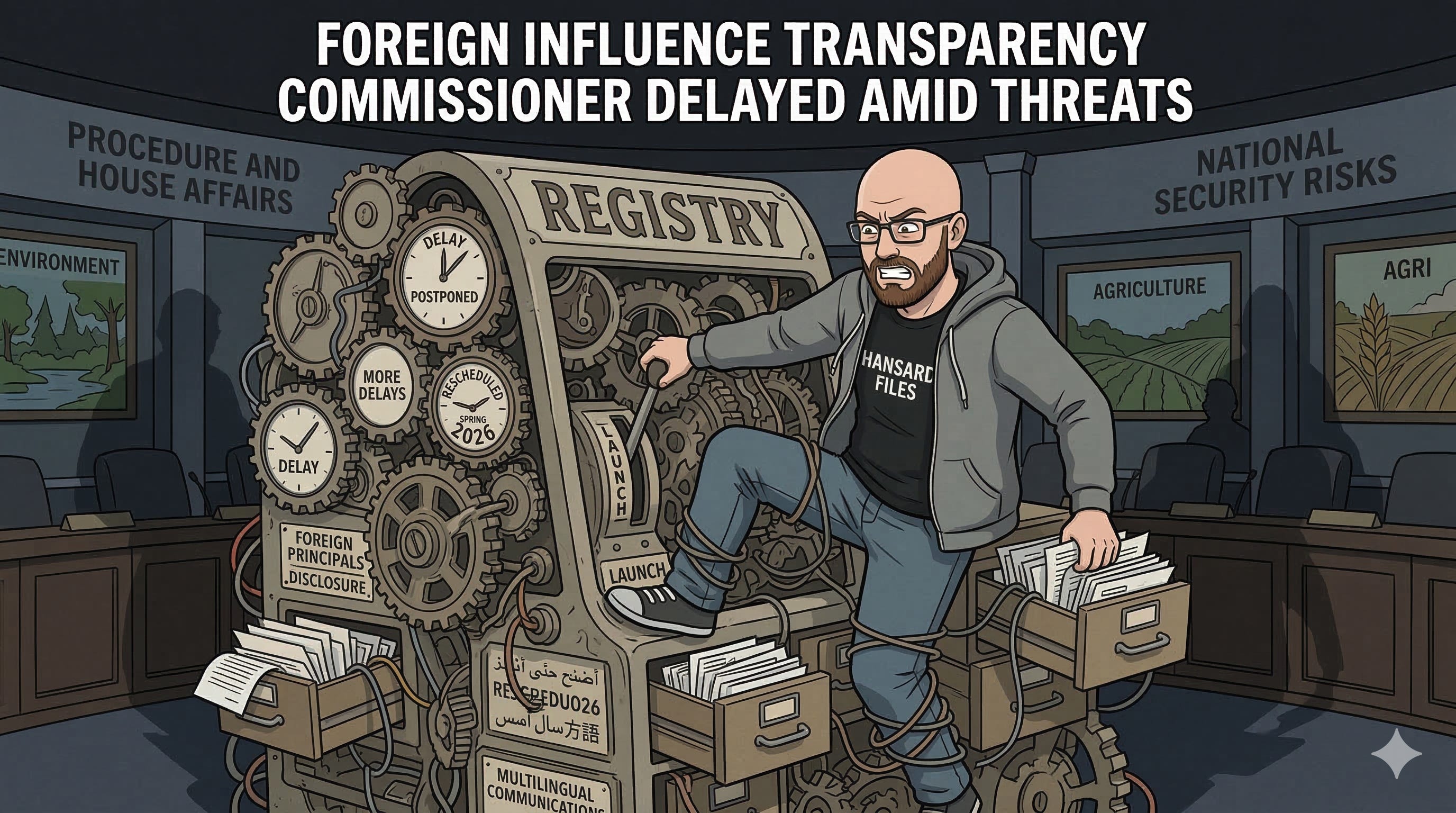
On Thursday, February 26, 2026, Ottawa buzzed with urgency. Six standing committees of the House of Commons sat simultaneously, each grappling with threats to Canada’s future. Yet one hybrid session in the Standing Committee on Procedure and House Affairs carried unmistakable national security weight. Chair Chris Bittle called meeting number 023 to order at 11:00 a.m. The agenda: consider the certificate of nomination of Anton Boegman to the position of foreign influence transparency commissioner.
Boegman, a former naval officer and Chief Electoral Officer of British Columbia, delivered a five-minute opening statement that cut straight to the danger. “Canada’s institutions and interests are increasingly under threat from foreign interference,” he began. “Malign foreign actors seek to exert influence through covert means to shape public policy, to change public opinion or to interfere with our democratic processes.” Canadians, he stressed, need to know who is trying to influence them and why. The new office would enforce disclosure rules, build partnerships with CSIS and the RCMP, and restore trust through transparency.
Drawing on his experience after the Cambridge Analytica scandal, Boegman described creating an election integrity working group in British Columbia, unique at the provincial level, that brought together federal and provincial agencies. He had implemented registers, regulated advertising and finance, and enforced rules non-partisanly. “My values of accessibility, integrity, transparency, accountability and service guide my decision-making,” he said. If appointed, his priorities would be launching the registry, engaging targeted communities, building public awareness and establishing enforcement partnerships.
“Delay After Delay”: MPs Demand Answers on Registry Timeline
Conservative MP Michael Cooper wasted no time pressing the core issue. The government had promised the foreign influence transparency commissioner registry before the last election, then June 2025, then December 2025. Public Safety Minister’s latest timeline: spring 2026. “You’ve been nominated to serve as the commissioner of the registry,” Cooper said. “Do you have any idea when the registry will be up and running?”
Boegman replied candidly. As nominee, he had no involvement in ongoing work. A transition team in Public Safety was preparing the office, but permanent staffing and full technology lay ahead. “It would be a priority of mine to get the registry up and running, whether it’s in an interim format or the complete technological solution,” he pledged. He would immediately develop guidance documents and clarity bulletins.
Cooper continued: draft regulations released in January with consultations ending earlier in February. Boegman confirmed he had read them but played no role in drafting. Final regulations were advancing without his input. Staff hiring remained unclear beyond the transition team. Cooper asked if $25 million allocated over 10 years (roughly $2.5 million annually) was enough for office space, IT and salaries. Boegman admitted he had not yet done a detailed plan but trusted resources would be provided, noting mechanisms to request more, as he had done in British Columbia.
“Would you agree that the independence of your office is key?” Cooper asked. Boegman affirmed it was critical. He noted the appointment process risked perceptions of partisanship. The OECD review of Canada’s Parliamentary Budget Officer, released that week, praised strong parliamentary involvement and recommended the same for interim appointments.
Building Trust, Partnerships and Enforcement
Liberal MP Arielle Kayabaga asked how the registry would contribute to fighting foreign interference and transnational repression, and whether Boegman had seen cases where it would have helped. Boegman pointed to his register experience: 3.5 million electors, political parties and third-party advertisers in British Columbia. The office would provide transparency to deter covert activity and support a whole-of-government approach. In his first months, priorities included operationalizing the registry, issuing interpretation bulletins, outreach to affected communities and academic groups, and public awareness campaigns to rebuild trust.
Bloc Québécois MP Christine Normandin raised independence concerns. Intelligence from CSIS might contradict public statements, as in the Prime Minister’s India comments versus CSIS warnings. How would Boegman stay neutral? Boegman emphasized partnerships with intelligence, police and financial agencies. The commissioner’s office, likely around 30 people, focused solely on transparency. If an agreement existed between an individual and a foreign principal to influence a parliamentarian or distribute funds, registration was required. The system would remain country-agnostic.
Questions turned to AI-generated content, diaspora communities abroad and enforcement against non-compliant actors. Boegman stressed multilingual communications (16 languages in British Columbia), online accessibility and reliance on other agencies for covert cases. Administrative monetary penalties in the regulations would deter violations.
Parliament’s Parallel Battles on February 26, 2026
The foreign influence transparency commissioner hearing unfolded against a backdrop of intense parliamentary activity. In the Standing Committee on Environment and Sustainable Development, the Federation of Canadian Municipalities warned of $9 billion annual infrastructure costs from climate change, potentially rising to $14 billion by 2050, with a $294 billion repair backlog. Louise Wallace Richmond and Leslie Muñoz called for $2 billion immediate adaptation funding plus $1 billion annually for 10 years. “Every dollar invested in preparing for climate risks can save nearly $5,” they said. Mayor Blaine Payne of Parson’s Pond, Newfoundland, described relentless coastal erosion threatening the Northern Peninsula highway, pleading for armour stone protection before resettlement became inevitable.
The Agriculture and Agri-Food committee examined science centre closures, including Lacombe, with the Beef Cattle Research Council highlighting risks to food safety, genomics and industry reputation. Witnesses stressed that every dollar in public agricultural research returns up to $63 and warned that private sector or university gaps could not be filled quickly.
Official Languages members debated Part VII regulations and intersectionality. International Trade reviewed China relations and tariff issues. Government Operations scrutinized supplementary estimates (C) with $4 billion in new spending.
These simultaneous sessions illustrated the 45th Parliament’s interconnected challenges.
Boegman closed by pledging swift operationalization. “If I’m appointed Canada’s first foreign influence transparency commissioner, I will tirelessly commit to ensuring that activities aimed at influencing political and governmental processes in Canada are made public,” he said. The committee adjourned with the nomination process ongoing.
As foreign interference threats evolve, the foreign influence transparency commissioner’s success hinges on timely launch, genuine independence and coordinated enforcement. Parliament’s February 26 deliberations revealed democracy under active defence, even as timelines slip and expectations mount.
Hansard Files digs through dense parliamentary archives to uncover these hidden stories of democracy, spending and national stakes. Subscribe to support independent investigative writing that brings the evidence to light.
Source Documents
House of Commons Canada. (2026, February 26). Evidence. Standing Committee on Procedure and House Affairs, Number 023.
House of Commons Canada. (2026, February 26). Evidence. Standing Committee on Environment and Sustainable Development, Number 027.
House of Commons Canada. (2026, February 26). Evidence. Standing Committee on Agriculture and Agri-Food, Number 025.
House of Commons Canada. (2026, February 26). Evidence. Standing Committee on Official Languages, Number 023.
House of Commons Canada. (2026, February 26). Evidence. Standing Committee on International Trade, Number 025.
House of Commons Canada. (2026, February 26). Evidence. Standing Committee on Government Operations and Estimates, Number 029.
House of Commons Canada. (2026, February 12). Evidence. Standing Committee on Health, Number 022.
I wish I wasn't quite so cynical... but I doubt the ability of the current gubbermint to put any form of accountability into place. It is antithetical to their ethos.
Those committee meetings must be brutal