


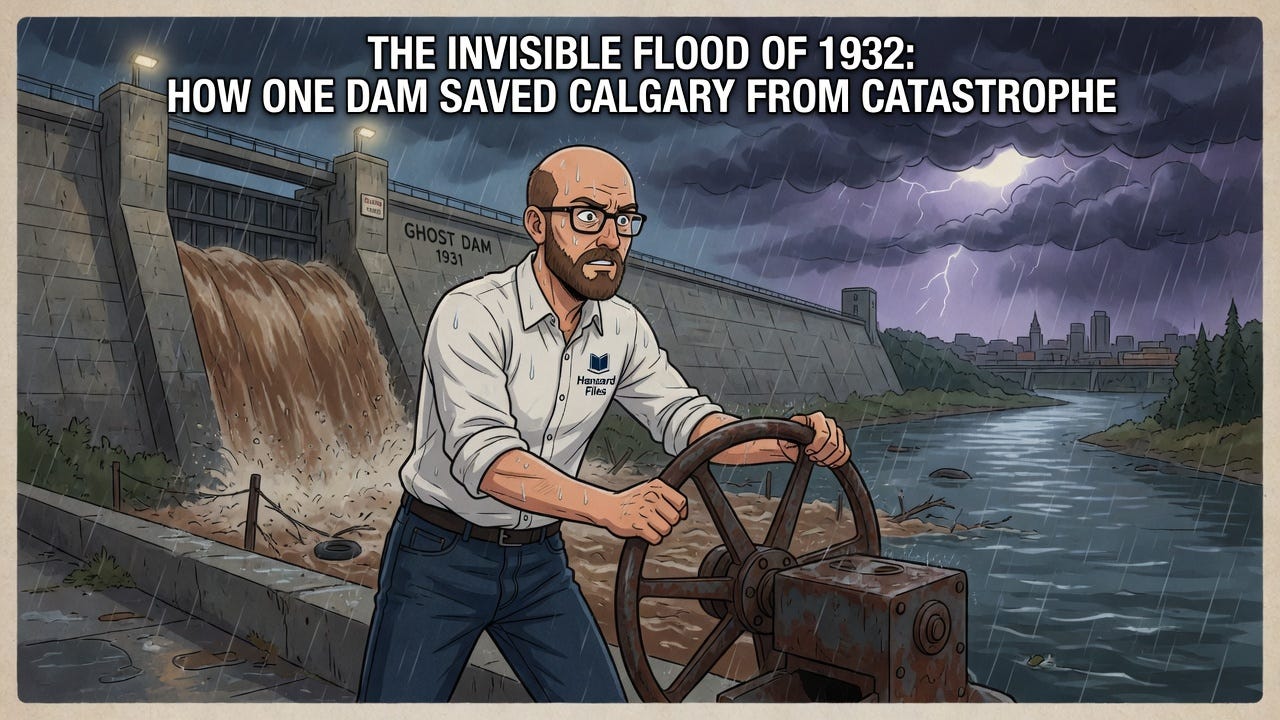
The rain began on May 31, 1932, and it did not stop. For three days, a low-pressure system stalled over the eastern slope of the Rocky Mountains, dumping torrential precipitation onto ground that was already sponge-soaked from a wet April. In ordinary times, this is a weather report. In the topography of Southern Alberta, it is a physics problem with a deadly solution.
By 2:00 a.m. on June 3, the flood mitigation infrastructure of the Bow River basin faced its ultimate test. The river at Calgary peaked at a flow rate of 53,600 cubic feet per second (c.f.s.)—a volume of water sufficient to fill an Olympic swimming pool every 90 seconds. It was the highest water recorded in thirty years, surpassing the floods of 1915, 1923, and 1929.
Yet, as the brown water churned beneath the Langevin Bridge, something was missing. The devastation that had defined the “Great Flood” of 1897—which tore through the valley with a force of over 60,000 c.f.s.—did not materialize. The city engineer, standing in the rain, watched the gauge hold steady. He was witnessing a phenomenon that would define the next century of civil engineering: the invisible flood. The water that didn’t arrive.
The Ghost in the Machine
To understand the miracle of 1932, one must look upstream, away from the city, to the concrete ramparts of the Ghost and Minnewanka reservoirs.
The Department of the Interior’s report on the flood, authored by engineers O.H. Hoover and W.T. McFarlane, presents a stark “what if” scenario. Their data reveals that the storm of 1932 was not merely a heavy rain; it was a hydrological monster. The run-off generated by the storm was, in specific metrics, “much greater than for any flood during the past 30 years.”
If nature had been allowed to take its course, the volume of water barrelling toward Calgary would have likely exceeded the 1897 catastrophe. A graph accompanying the official analysis estimates the “Flood that would have occurred at Calgary without storage” at a staggering figure—potentially doubling the destructive power of the river.
Instead, the reservoirs swallowed the surge. The Ghost Reservoir, a massive artificial lake created just a few years prior, acted as a shock absorber for the millions of tons of water rushing down from the mountains. It captured the peak of the flood, holding it back and releasing it in a controlled, albeit terrifying, torrent. The engineers had effectively decapitated the flood wave.
The 2 A.M. Vigil
The drama of the flood peaked in the darkness of early morning on June 3. At the Langevin Bridge in Calgary, the river gauge was the center of the universe.
According to a memorandum by B. Russell of the Calgary Power Company, the water hit a gauge height of 12.50 feet at exactly 2:00 a.m. At this height, the river was discharging approximately 50,000 to 53,600 c.f.s. The tension in the city was palpable. The Flood Warning Service, relying on telegraphs and telephone calls from Bragg Creek and Banff, had alerted the press and citizens that the water was coming.
Russell’s team had been running levels along the riverbanks, frantically documenting the rise. They tracked the water as it crept up the “north slope dyke” at Prince’s Island and lapped at the “floor shack green door” near the Centre Street Bridge. Every inch of rise represented a threat to the city’s industrial heart—the Eau Claire Sawmills and the power plants that kept the lights on.
The damage was real, but calculated. The City of Calgary suffered $36,662.26 in damages (roughly $750,000 today). The Eau Claire Sawmills lost $12,000. The total regional damage tally was $79,112.26. But compared to the total annihilation of infrastructure that would have occurred without the dams, this was a bargain. The “invisible wall” of the reservoirs had purchased the city’s survival for the price of a few flooded basements and washed-out roads.
The Glenmore Factor
While the Ghost Reservoir held the line on the Bow, a second drama was unfolding on the Elbow River, the Bow’s erratic tributary. The Glenmore Dam, a massive municipal project, was nearing completion.
The report notes that the Elbow River was subjected to “extremely high water run-off conditions.” However, the Glenmore reservoir, though not fully operational, played a critical role. The Department’s analysis includes a diagram showing the “effect of Glenmore Dam during June flood,” illustrating how the dam shaved the peak off the violent Elbow River.
Recommendations filed immediately after the flood called for even tighter surveillance. W.T. McFarlane urged the installation of an additional staff gauge and observer “midway between Calgary and Bragg Creek” to give the city engineers at Glenmore vital extra minutes to adjust their sluice gates. In the high-stakes game of hydraulic roulette, information was as valuable as concrete.
The Margin of Error
The 1932 flood serves as a chilling reminder of the thin line between safety and disaster. The report concludes with a sobering observation: “The conditions were therefore not by any means 100% ideal for the production of the maximum flood that could be easily possible.”
The engineers noted that the “extreme headwaters of the Bow river did not record an abnormal precipitation,” and temperatures remained moderate, preventing a catastrophic simultaneous snowmelt. The system had held, but the beast had not been fully unleashed.
The legacy of 1932 is not in the water that flooded the streets, but in the water that didn’t. It was the first modern proof that humanity could place a hand against the chest of a flooding river and hold it back. The 53,600 c.f.s. that flowed through Calgary was a warning; the 50,000 c.f.s. that stayed behind in the Ghost Reservoir was a salvation.
We sift through thousands of pages of forgotten government reports to find the moments where history held its breath. Subscribe to Hansard Files to support independent archival journalism.
Source Documents
Hoover, O.H. & McFarlane, W.T. (1932, October 17). Floods in Southern Alberta During 1932. Department of the Interior, Dominion Water Power and Hydrometric Bureau.
Russell, B. (1932, June 10). Memorandum: Subject High Water, June 3, 1932, Bow River at Calgary. Calgary Power Company, Ltd.