


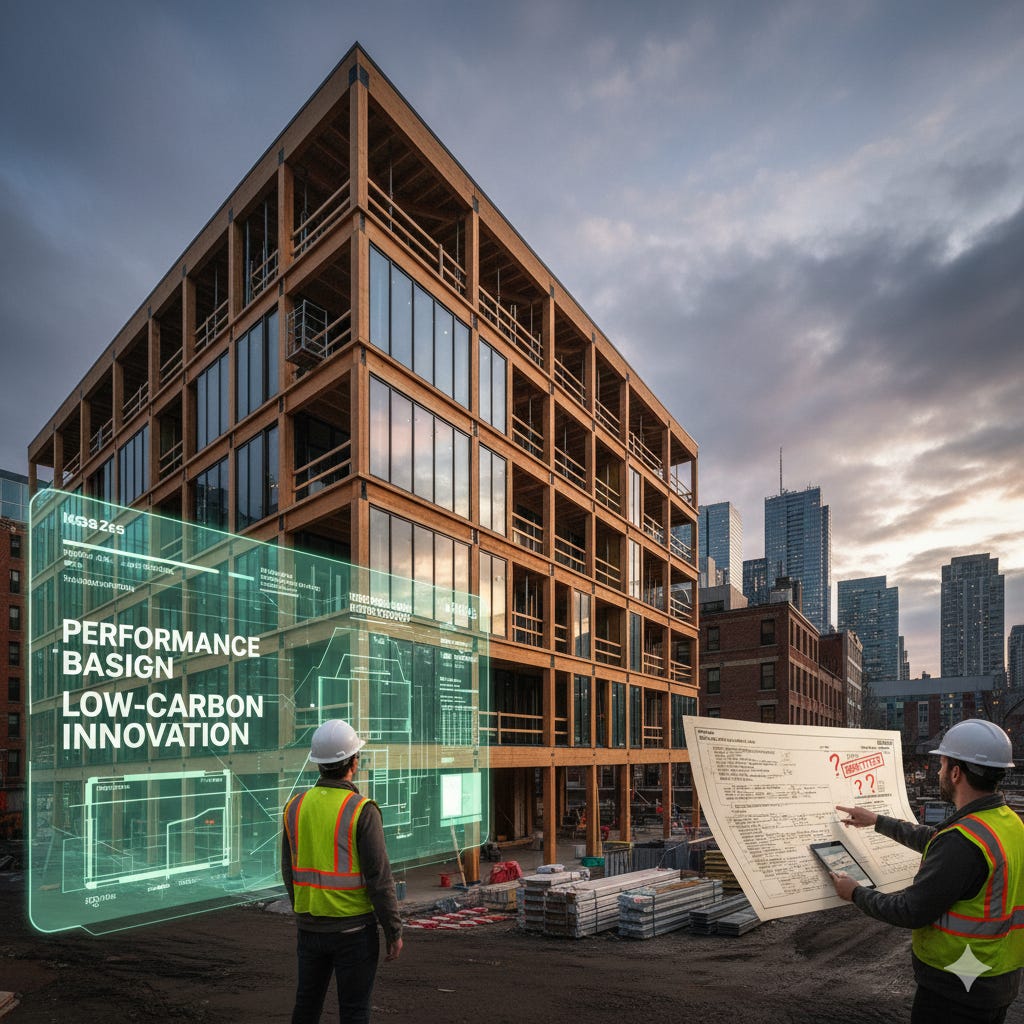
Canada is trying to solve two monumental challenges at once: a housing crisis and ambitious climate targets. To do either, we need to build faster, smarter, and with new, low-carbon materials. A new report, however, highlights a fundamental obstacle: the rulebook we use for building is stuck in the past.
A deep analysis of the 2020 National Building Code of Canada (NBC) reveals a system that is overwhelmingly “prescriptive.” This means the code acts less like a set of goals and more like a specific recipe. It tells designers exactly what materials to use and how to assemble them, based on decades of historical precedent.
This approach has a major flaw. If you invent a new, innovative, or low-carbon solution that isn’t in the “recipe,” you face an uphill battle to prove it’s acceptable. The report, funded by the National Research Council’s (NRC) “Platform to Decarbonize the Construction Sector,” argues this prescriptive model creates a “challenge to the introduction and validation of new innovative solutions.”
The “Parallel Path” Solution
So, what’s the alternative? The report pushes for a shift toward “Performance-Based Solutions” (PBS).
This approach is fundamentally different. Instead of prescribing how to build, a performance-based code defines what a building component must achieve.
Prescriptive (Old): You must use X material at Y thickness.
Performance (New): The wall assembly must prevent moisture buildup and resist X amount of lateral load.
The report, which was written to inform the 2025-2030 code development cycle, does not recommend supplanting the existing prescriptive rules. Doing so would ignore the industry’s deep familiarity with the current code.
Instead, the authors recommend a “parallel means of compliance.” This would give designers and builders a choice. They can either follow the familiar prescriptive recipe or use an alternative solution, as long as they can demonstrate it meets the new, clear performance targets.
Where the Code Is Failing
The provision-by-provision analysis identified critical gaps where the current code makes it difficult to innovate.
Structural and Earthquake Design
When it comes to small buildings (Part 9), the code is full of prescriptive solutions that “have historical precedent.” The problem? The “implicit performance of these prescriptive solutions is not well known.” We know they work, but we don’t know how well they work. This makes it impossible to compare a new, innovative system against the old one to see if it’s “equivalent or better.”
For larger buildings (Part 4), the report calls for clarifying the basic performance objectives. For example, what does “life safety” in an earthquake actually mean in quantitative terms, like maximum system drift or component damage?
Fire Safety, Egress, and Accessibility
The analysis found that the “rationale and assumptions” behind many fire safety rules are simply missing from the code’s supporting documents.
In a glaring example, the current User’s Guide for Part 3 (Fire Protection) was last developed for the 1995 edition of the NBC. This was before the “alternative solution” compliance path was even introduced in 2005.
The report also notes that “risk characterization” information is “scattered throughout Part 3,” making it difficult to get a clear, consolidated picture of a building’s risk profile.
Building Envelope and Energy
This is perhaps the most critical failure identified. Part 5 of the code, which governs environmental separation (heat, air, moisture), was intended to be performance-based. The report finds that it’s “qualitative in nature.”
What does this mean in practice? The code tells designers to prevent deterioration from moisture, but “the method for calculating performance and confirming compliance is not provided.” This leaves designers guessing. The report warns that failure to comply is often only identified after the building is constructed and has already “failed due to premature structural deterioration and/or exposure of occupants to harmful... mold.”
Furthermore, in Part 9, many provisions simply refer to “manufacturer’s installation instructions.” This creates an “undefined performance gap,” as these instructions are not standardized and cannot serve as a consistent target for innovation.
The Data Brief
A new federal report summarizes a “provision-by-provision analysis” of the 2020 National Building Code.
It finds the code’s “prescriptive” nature (telling you how to build) is a barrier to “innovative low-carbon solutions.”
The core recommendation is to create a “parallel means of compliance” by adding “performance-based requirements” (telling you what to achieve).
The analysis found that for Structural, Fire, and Building Envelope rules, the code often lacks clear, quantitative performance targets.
The “rationale and assumptions” behind existing rules are often unstated. The main Part 3 User’s Guide dates to 1995, before alternative solutions were even part of the code.
For Building Envelope (Part 5), the code is only “qualitative,” meaning failure is often only found after deterioration or mold appears.
What This Really Means
This report is more than just a technical review. It’s a map of the regulatory “plumbing” that is currently blocking Canada’s climate and construction goals. The prescriptive code isn’t just an inconvenience; it actively “stifles innovation” by making it costly and difficult to prove new ideas are safe. The report’s call for a “parallel path” is a pragmatic compromise. It keeps the old system intact for those who need it, while creating an express lane for the low-carbon and high-productivity solutions we desperately need.
Source Documents
Calder, K., Girault, M., Beauchemin, C., Adebar, P., Chui, Y. H., Kayll, D., Robbins, A. P., McFadden, J. B. W., & St-Onge, C. (2025). Summary of a code analysis of the National Building Code towards performance-based solutions. National Research Council of Canada.