


In early 2024, nearly eight thousand adults quietly answered a long list of questions about their money lives. The result is a brisk snapshot of how people save, borrow, plan and worry. The headline number is not dramatic, yet it is decisive: three fifths report either struggling to keep up or falling behind on bills during the last year. This sits beside another calm fact. Most people did not seek financial advice at all in the past twelve months. Put those two together and a tension appears. Financial stress is common. Professional guidance is rare.
The 2024 Canadian Financial Capability Survey is built to track skills, confidence and behaviours over time. It is methodical work. A probability sample of 7,963 adults was recruited by phone, invited to complete the survey online, and supplemented with computer-assisted telephone interviews for hard-to-reach groups. Results were weighted by region, gender+, income, education and age to produce national estimates. The instrument’s goal is practical clarity about how Canadians understand their finances and act on them.
A public that budgets and borrows without a plan
Two findings frame the core problem. First, financial pressure is widespread. Sixty percent say they sometimes struggle or are falling behind on obligations. Those with spending that exceeds income report the hardest time keeping up. Second, advice and structured learning are thin. Nearly two thirds used no financial advice in the past year and about half did no financial self-study in the past five years.
The result is a pattern that looks like effort without direction. People are taking actions, often reactive ones, while lacking a reliable map. Consider retirement preparation. Roughly half hold RRSPs or RRIFs and two fifths hold TFSAs, yet about half of RRSP owners and one third of TFSA owners contributed nothing in the last year. Only a third of non-retirees say they have a good idea of how much they need to save to maintain their desired standard of living.
“About half of non-retired Canadians are financially preparing for retirement… Only about one third have a good idea how much they need to save.”
1) The present economy is stress-testing household systems
The survey situates itself after an unusual economic cycle. Inflation peaked in 2022, rates rose, and key necessities stayed expensive. The report notes the persistent impact on food, transportation, shelter and mortgages. In this environment, the link between debt reliance and financial stress shows up with force. Among those who tapped credit cards, overdraft or borrowed for regular expenses, nearly nine in ten report struggling to keep up. The same story appears for those using non-bank “non-traditional” methods like payday lenders or pawnbrokers.
“About nine in ten of those who used non-traditional methods… are also struggling to keep up with their bills.”
Confidence buffers stress. Those who say they “certainly could not” raise an unexpected 2,000 dollars within a month are overwhelmingly in difficulty. This points to an emergency-cash threshold that separates routine strain from acute vulnerability.
2) Preparation gaps are largest where planning matters most
Ownership alone is not preparation. The retirement picture shows why. Almost half hold retirement accounts, yet a large share made no contribution last year. Knowledge correlates with action. Those who have a clear target for retirement are more likely to contribute up to or at the maximum allowable amount.
The expectations side is equally telling. Three in ten non-retirees expect government pensions to be their primary retirement income, and this expectation is higher among women, lower-income households and those with lower education. The confidence in that choice is low. The executive summary flags low confidence among those relying on public pensions for their hoped-for standard of living.
“Government pension benefits rank as the top expected source… yet confidence is weak among those who expect to rely on them.”
The same “ownership without direction” pattern appears in near-term goals. Almost half plan a major purchase of 10,000 dollars or more within three years. Many say they will use savings, a prudent answer, yet the broader data show large shares running short in ordinary months and leaning on credit to cover daily expenses. Ambitions and monthly cash reality pull in opposite directions.
3) Advice deserts and the trust gap
Most Canadians did not use financial advice last year, and the most relied-upon sources are friends, family and banks. Fifteen percent say they cannot find advice from a trusted source at all. That trust gap matters. The survey’s methodology confirms strong subgroup differences by gender, income, education, Indigenous identity and disability status. Those same groups appear repeatedly in the stress and retirement sections. Where the need for tailored guidance is highest, the supply of trusted guidance is patchy.
4) Why budgeting alone is not enough
A slim majority say they have a household budget in place. Yet budgeting is not the signal variable in the stress charts. The decisive patterns are income-expense balance, reliance on debt for routine costs, and the ability to raise 2,000 dollars in an emergency. In other words, the issue is not only whether you keep track of money. The issue is whether your monthly system creates surplus, limits interest costs, and builds small buffers predictably.
This is why the survey’s definition of financial capability still fits. The instrument aims to measure skills and confidence to spot opportunities, find help, choose wisely and act effectively. Those verbs describe navigation, not just knowledge.
Build navigation systems around three household thresholds
Reading across the tables and figures suggests a guiding principle. Households gain agency when they design simple systems to cross and hold three thresholds:
Monthly surplus
Spend less than income, consistently. The survey directly links surplus to lower difficulty keeping up with commitments.Emergency liquidity
Reach and hold the 2,000-dollar buffer. Confidence in raising that amount maps closely to lower reported struggle.Deliberate contributions
Move from owning accounts to funding them on schedule. Contribution behaviour tracks with clarity on retirement needs.
This is less a set of tips and more a design stance. You align your budget, debt choices and savings automations to defend those thresholds first. Then you layer complexity.
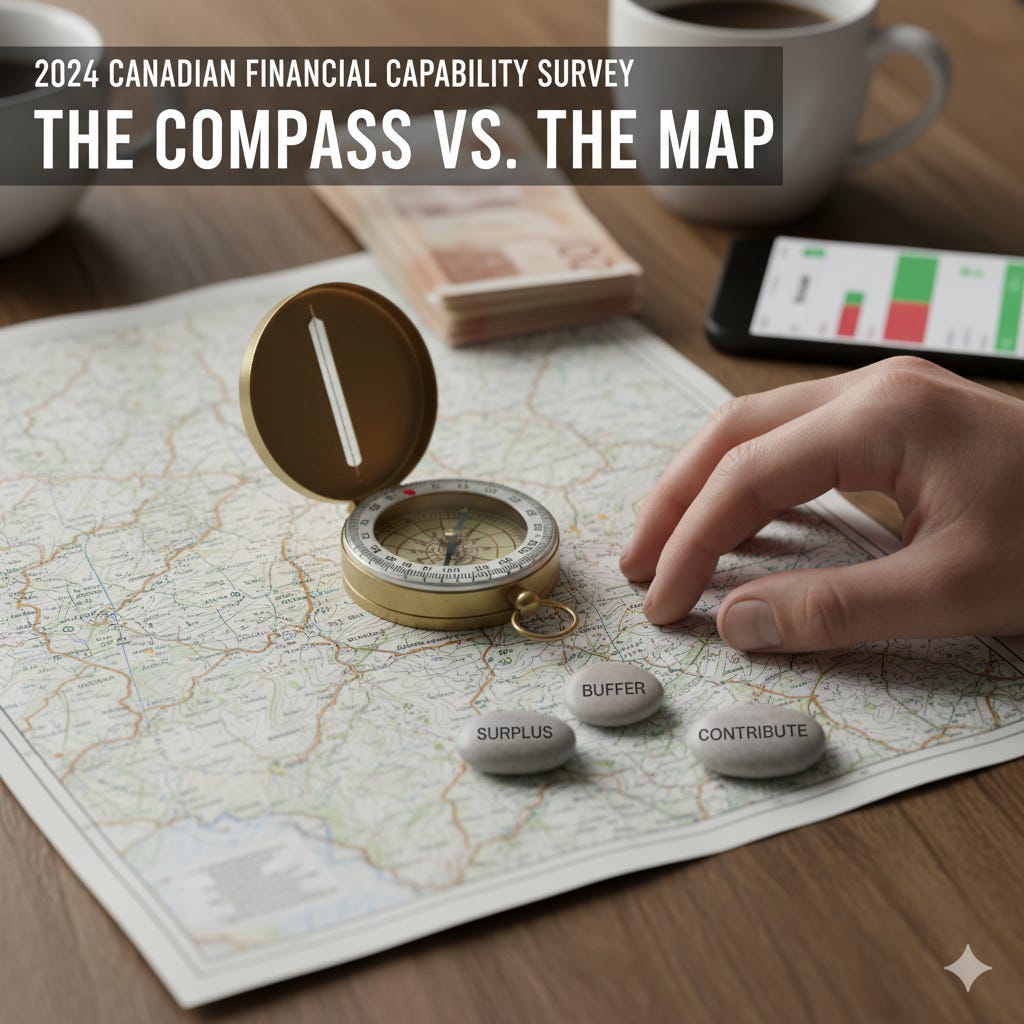
The Compass vs. the Map
Think of your money life as backcountry travel. A detailed topographic map is helpful, yet without a compass you drift. In this survey, Canadians own maps. RRSPs, TFSAs, RESPs and a budget are maps. A compass is a small set of orientation rules that work in any terrain. The three thresholds are the compass. Hold a monthly surplus. Keep a 2,000-dollar buffer. Contribute on a schedule. With a reliable compass, you can use any map better and trust your bearings when the weather turns.
Where frustration is justified
Frustration is rational when the terrain shifts. The report was fielded after rapid inflation and rising rates. Households did not cause those shocks. The data confirm that people under the most pressure are also those more likely to rely on high-cost credit and less likely to access trusted advice. That is not a personal failure. It is a system problem.
Where agency begins
Agency starts with orientation. The survey quietly hands you a testable plan anchored in the thresholds:
Protect the surplus. Treat a month where spending exceeds income as an incident. Investigate the cause and write one rule to prevent a repeat. The survey shows how quickly difficulty rises when spending outruns income.
Stage the buffer. If 2,000 dollars feels distant, define stages at 250, 500, 1,000 and 2,000. Use automatic transfers so progress does not rely on motivation. The stress gap by emergency capacity is large enough to make this the first win.
Schedule contributions, then size them. A small automatic RRSP or TFSA transfer beats sporadic lump sums. People who know their retirement target contribute more consistently. You can learn the number later. Build the habit now.
Replace guesswork with a brief advice script. If you skipped advice last year, try a constrained approach. One thirty-minute call with your financial institution to confirm fee levels, contribution automation and a two-fund allocation. Friends and family are helpful, but the survey shows they are the most common advice source by default, not by design.
This approach does not ask you to predict markets. It asks you to enforce three household boundaries that the data link to lower stress and higher follow-through.
Design your money life to pass the thresholds before you chase the goals
When surplus, buffer and contribution habits are in place, budgets and products start working as tools rather than talismans. The survey’s numbers point to a plain truth. You do not need more complexity. You need a compass you will hold in any weather. The rest of your map gets easier to read.
Sources
Advanis Inc. for the Financial Consumer Agency of Canada. (2025). 2024 Canadian Financial Capability Survey: Descriptive Report (Catalogue No. FC5-42/1-2024E-PDF; ISBN 978-0-660-76453-5). Ottawa, ON.