


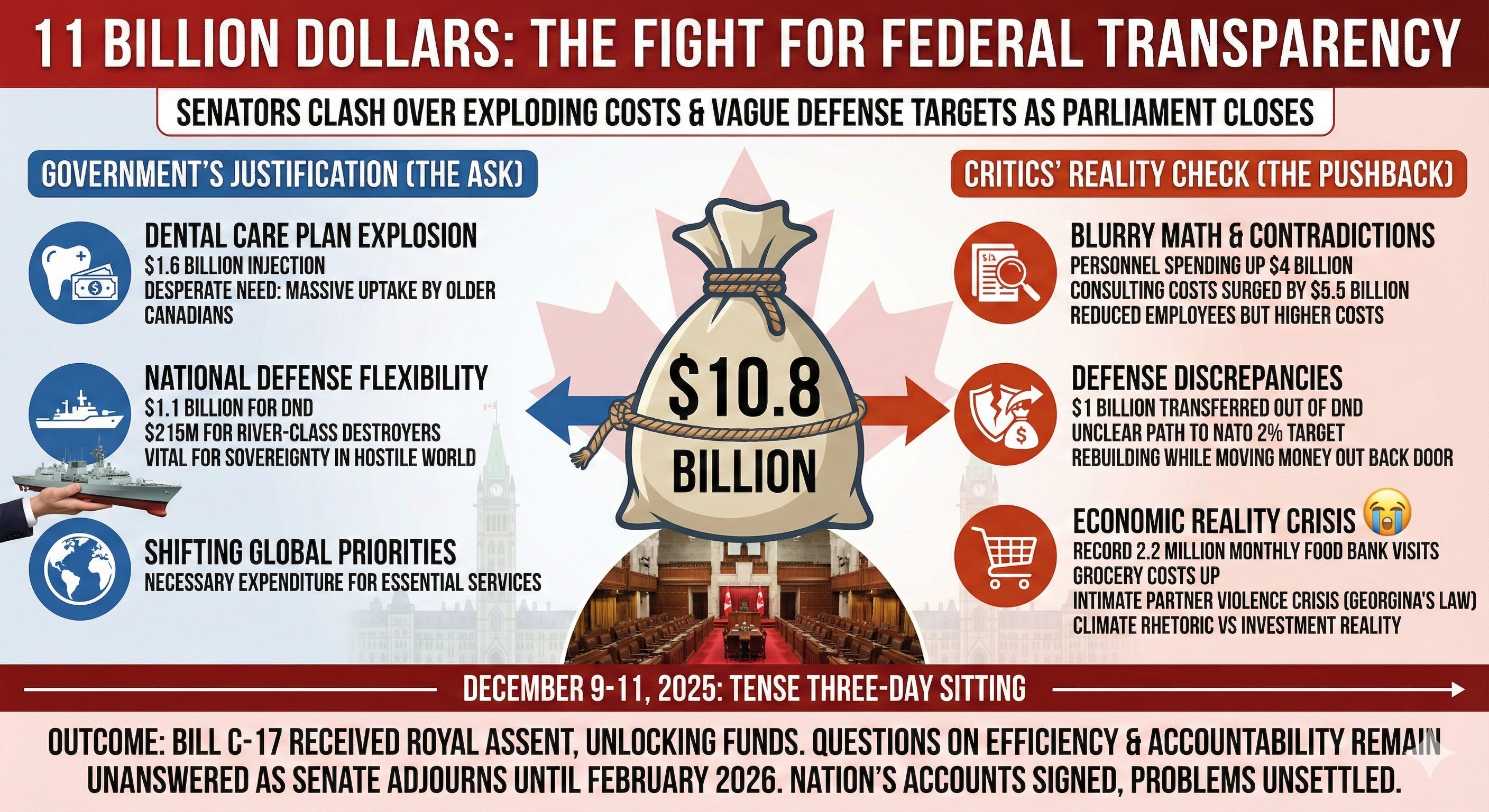
The holiday recess loomed over Ottawa, but inside the Red Chamber, the mood was anything but festive. As the clock ticked down on the legislative calendar, the Senate faced a massive request from the government: permission to spend an additional $10.8 billion. This request, known formally as Appropriation Bill C-17, brought the issue of federal spending accountability to the forefront of a tense three-day sitting.
While the government framed the expenditure as a necessary injection for national defense and essential health services, critics saw a balance sheet riddled with contradictions. The debates that unfolded between December 9 and 11, 2025, revealed a deep divide between the government’s fiscal narrative and the economic reality facing Canadians. From the staggering costs of dental care to the silent crisis of intimate partner violence, the Senate’s final week of the year became a microcosm of a nation grappling with its own sustainability.
The Destroyer on the Poster
Senator Sandra Pupatello rose on Wednesday afternoon to sponsor the government’s request. She did not rely solely on spreadsheets. In a move that drew immediate procedural scrutiny, she held up a photograph printed at a local office supply store. It depicted a River-class destroyer, a state-of-the-art warship intended to replace Canada’s aging fleet.
Pupatello argued that the $10.8 billion in Supplementary Estimates (B) was vital flexibility for a government managing shifting global priorities. The largest single line item was a $1.6 billion injection for the Canadian Dental Care Plan. The costs had ballooned beyond initial projections, a fact Pupatello attributed to a grim reality: the uptake was massive because the need was desperate. Thousands of older Canadians, having avoided the dentist for decades due to cost, were finally seeking treatment for severe, long-standing issues.
Defense was the second pillar of her argument. She highlighted $1.1 billion for the Department of National Defence, including $215 million specifically for the first three River-class destroyers. These ships, she noted, would be one and a half times the size of a Canadian football field. Her attempt to pass the photo around the chamber was met with a gentle rebuke regarding the use of props, but her point landed: the money was for tangible, steel-and-wire assets needed to defend Canadian sovereignty in an increasingly hostile world.
The Critic’s Ledger
Senator Elizabeth Marshall, the Senate’s meticulous finance critic, was less impressed by the glossy photos and more concerned with the blurry math. Marshall dismantled the government’s request line by line, exposing discrepancies that she argued undermined federal spending accountability.
She pointed out a perplexing contradiction in the public service. Treasury Board data indicated a reduction in the number of federal employees, yet personnel spending had jumped by $4 billion compared to the previous year. Furthermore, despite government commitments to cut consulting costs, spending on professional and special services had surged by $5.5 billion to a total of $28.2 billion.
Her critique of the defense budget was equally withering. While the government claimed it was on track to meet NATO’s 2 percent spending target, Marshall noted that $1 billion was simultaneously being transferred out of the Department of National Defence to other departments. When pressed in committee, officials had offered no explanation for this massive reallocation. The Parliamentary Budget Officer had testified that the path to meeting NATO targets was unclear, leaving senators to wonder how the government intended to rebuild the military while moving money out the back door.
Marshall also flagged a quiet but massive financial risk: contingent liabilities. She noted that tens of billions of dollars in potential costs related to Indigenous claims were altering the deficit reality, yet parliamentarians were given no visibility on the underlying flows of this money. To Marshall, the government was asking for a blank cheque without showing the stub.
Climate Rhetoric versus Investment Reality
The scrutiny extended beyond the immediate supply bill to the broader economic strategy outlined in Budget 2025. Senator Rosa Galvez delivered a scathing assessment of the government’s “Canada Strong” fiscal framework. She argued that the government was engaging in a rebranding exercise, recasting deficit spending as “investment” without providing metrics to prove those investments were yielding returns.
Galvez warned that Canada was failing to keep pace with the “Age of Electricity.” While global competitors like China, the US, and the EU were pouring trillions into renewables and grid modernization, Canada remained tethered to the past. She criticized the Carbon Capture, Utilization, and Storage tax credit as an inefficient fossil fuel subsidy that had a thirty-year history of underdelivering.
Her warning was stark: without a financial framework aligned with climate science, Canada risked becoming a “stranded-capital nation,” holding onto devaluing assets while the rest of the world moved on. She described a vicious cycle where climate shocks drove inflation, necessitating bailouts that deepened national debt, all while the economy stagnated.
The Hunger Crisis and the Minister
The theoretical debates over fiscal frameworks collided with on-the-ground misery when Minister Patty Hajdu entered the chamber for Question Period on Tuesday. The Leader of the Opposition, Senator Leo Housakos, did not mince words. He cited a record 2.2 million monthly visits to food banks and a projected $1,000 increase in grocery costs for the average family in the coming year.
Housakos accused the government of managing a decline in living standards, where affordable housing had become a fantasy and household debt had climbed to the highest levels in the G7. He demanded to know when the government would acknowledge that its policies were failing.
Minister Hajdu pushed back, attributing the spike in food prices largely to climate change disrupting global supply chains. She touted the Canada Child Benefit and the new National School Food Program as evidence that the government was supporting the most vulnerable. She shared anecdotes of students in her own riding of Thunder Bay–Superior North starting their days with full bellies thanks to federal support.
The exchange grew heated over the issue of corporate subsidies. Conservative senators listed billions of dollars given to companies like Stellantis, Northvolt, and Algoma Steel, which were followed almost immediately by layoffs or bankruptcies. Minister Hajdu defended the spending as “betting on Canada” and necessary to protect sovereignty in critical sectors like steel. However, the Opposition remained unconvinced, painting a picture of a government handing out taxpayer money to corporations while citizens stood in line for bread.
The Shadow of Georgina’s Law
Amid the battles over billions of dollars, a different kind of deficit took center stage on Thursday: the deficit of safety for Canadian women. Senator Fabian Manning rose to speak on Bill S-242, also known as Georgina’s Law. It was his third attempt since 2018 to pass legislation mandating a national action plan to prevent intimate partner violence.
Manning shared the harrowing story of Georgina McGrath, a woman from Newfoundland who endured years of brutal physical and mental abuse. He reminded the chamber that every 48 hours, a person in Canada is killed by an intimate partner. He spoke of the $7.4 billion annual cost of this violence to the economy, but emphasized that the true cost was measured in terror and lost lives.
Senator Kim Pate added a systemic dimension to the debate, recounting the tragic histories of Indigenous women like Tona and Carol Daniels. These women, she argued, were failed by the state twice: first when they were not protected from abuse, and second when the legal system criminalized them for trying to survive. Pate described a justice system that punished victims for the very trauma it failed to prevent, turning survivors into prisoners.
The debate on Georgina’s Law served as a somber counterweight to the financial discussions. It highlighted that while the Senate could authorize billions for destroyers and dental plans, the legislative machinery moved agonizingly slow for those facing immediate physical danger in their own homes.
The Long Winter Adjournment
As the sitting week drew to a close, the Senate hurried to clear its order paper. Appropriation Bill C-17 received Royal Assent, unlocking the funds the government had requested. Tributes were paid to retiring staff, and senators exchanged holiday wishes, momentarily setting aside their partisan swords.
Yet, the unresolved tensions hung in the air. The questions regarding the efficiency of federal spending accountability remained largely unanswered. The disparity between the government’s “Canada Strong” slogan and the reality of food bank lines and youth unemployment sat heavily on the record.
Senator Yuen Pau Woo offered a satirical poem to mark the season, mocking the political theatrics of the past year—the looming election, the trade wars, and the endless posturing. But beneath the humor lay a recognition of the uncertainty ahead. As the Speaker wished the chamber a peaceful break, the Senate adjourned until February 2026, leaving the nation’s accounts signed, but its problems far from settled.
Source Documents
Senate of Canada. (2025, December 9). Debates of the Senate (Hansard), 1st Session, 45th Parliament, Volume 154, Issue 43.
Senate of Canada. (2025, December 10). Debates of the Senate (Hansard), 1st Session, 45th Parliament, Volume 154, Issue 44.
Senate of Canada. (2025, December 11). Debates of the Senate (Hansard), 1st Session, 45th Parliament, Volume 154, Issue 45.